Park Jeongok, Lee Hyojin, Kim Youngkyung, Norton Christine, Woodward Sue, Lee Sejeong
Mo-Im Kim Nursing Research Institute, Yonsei University College of Nursing, Seoul, Korea.
College of Nursing and Brain Korea 21 FOUR Project, Yonsei University, Seoul, Korea.
Int Neurourol J. 2023 Mar;27(1):23-35. doi: 10.5213/inj.2346014.007. Epub 2023 Mar 31.
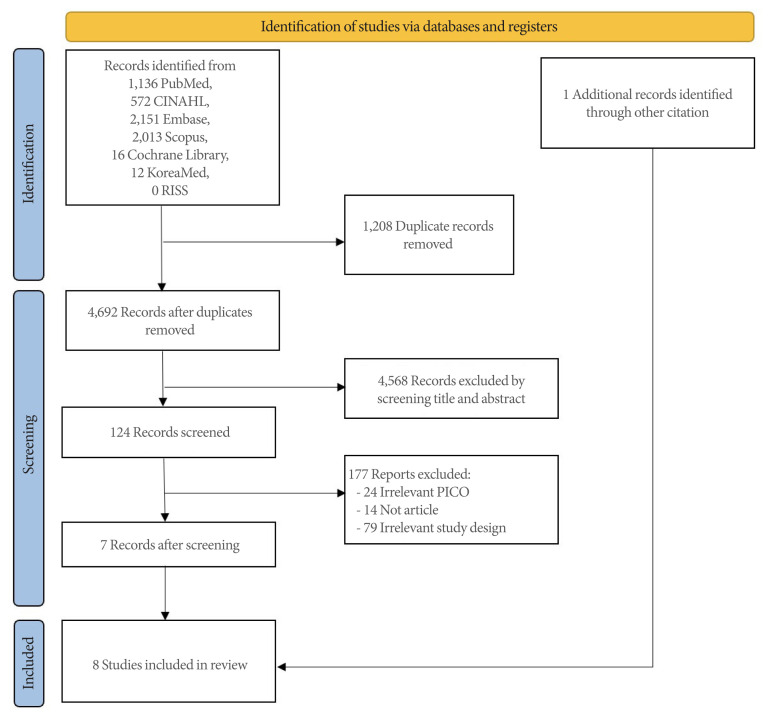
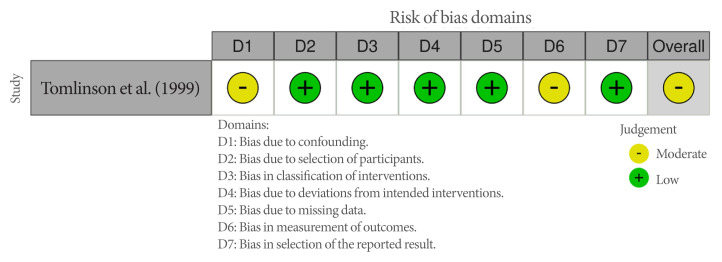
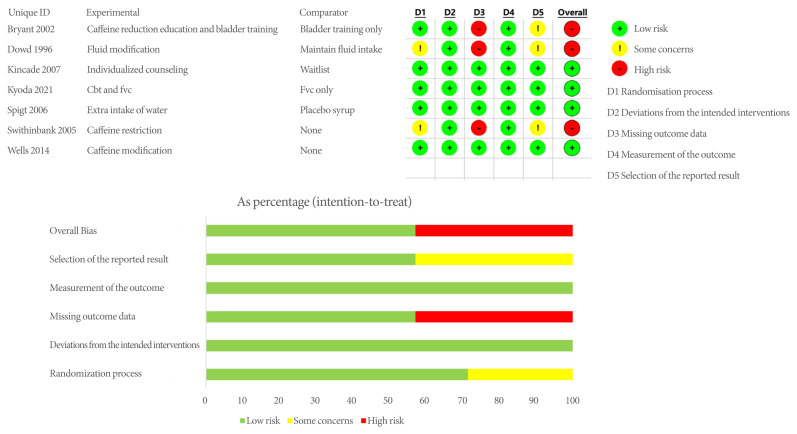
Overactive bladder (OAB) is prevalent in men and women and negatively impacts physical and psychological health. Fluid and caffeine intake modifications, which are lifestyle modification interventions, are simple methods to manage OAB. However, studies that synthesized both interventions and found scientific evidence are scarce. This review aimed to synthesize scientific evidence on whether fluid and caffeine intake modifications are effective for OAB symptoms. PubMed, CINAHL (Cumulative Index for Nursing and Allied Health Literature), Embase, Scopus, the Cochrane Library, KoreaMed, and RISS (Research Information Sharing Service) were used to search for studies and 8 studies were included. The Cochrane risk of bias tool (RoB 2.0) and ROBINS-I (Risk Of Bias In Non-randomized Studies - of Interventions) were used to assess the quality of selected studies. Due to the heterogeneous outcome variables, a meta-analysis was not conducted. Among the 8 included, 7 studies were randomized controlled trials and one was a quasi-experimental study. Four studies assessed urgency. Caffeine reduction was statistically effective for urgency symptoms, but increasing fluid intake was not. Frequency was assessed in 5 studies, which showed decreasing caffeine and fluid intake was effective in treating the symptoms. Urinary incontinence episodes were assessed in 6 studies, and nocturia in 2. Restricting caffeine intake was effective in treating these 2 symptoms, but restricting both caffeine and fluid intake was not. Quality of life (QoL) was examined in 5 studies, and modifying fluid and caffeine intake significantly improved QoL in 2. Although there were limited studies, our review provides scientific evidence that fluid and caffeine intake modification effectively manages OAB symptoms. Further research should examine acceptability and sustainability of interventions in the long-term and enable meta-analysis.
膀胱过度活动症(OAB)在男性和女性中都很普遍,会对身心健康产生负面影响。改变液体和咖啡因摄入量作为生活方式干预措施,是管理OAB的简单方法。然而,综合这两种干预措施并找到科学证据的研究却很稀少。本综述旨在综合关于改变液体和咖啡因摄入量对OAB症状是否有效的科学证据。通过PubMed、CINAHL(护理学与健康相关文献累积索引)、Embase、Scopus、Cochrane图书馆、KoreaMed和RISS(研究信息共享服务)检索研究,共纳入8项研究。使用Cochrane偏倚风险工具(RoB 2.0)和ROBINS - I(非随机干预研究中的偏倚风险)评估所选研究的质量。由于结果变量的异质性,未进行荟萃分析。在纳入的8项研究中,7项为随机对照试验,1项为准实验研究。4项研究评估了尿急情况。减少咖啡因摄入对尿急症状有统计学上的显著效果,但增加液体摄入量则没有。5项研究评估了尿频情况,结果显示减少咖啡因和液体摄入量对治疗该症状有效。6项研究评估了尿失禁发作情况,2项研究评估了夜尿情况。限制咖啡因摄入对治疗这两种症状有效,但同时限制咖啡因和液体摄入则无效。5项研究考察了生活质量(QoL),其中2项研究表明改变液体和咖啡因摄入量可显著改善生活质量。尽管研究有限,但我们的综述提供了科学证据,表明改变液体和咖啡因摄入量可有效管理OAB症状。进一步的研究应考察干预措施的长期可接受性和可持续性,并能够进行荟萃分析。