Department of Immunology and Infectious Diseases, Harvard T. H. Chan School of Public Health, Boston, Massachusetts, USA.
Harvard Chan Advanced Multi-omics Platform, Harvard T. H. Chan School of Public Health, Boston, Massachusetts, USA.
mSphere. 2023 Jun 22;8(3):e0008823. doi: 10.1128/msphere.00088-23. Epub 2023 Apr 5.
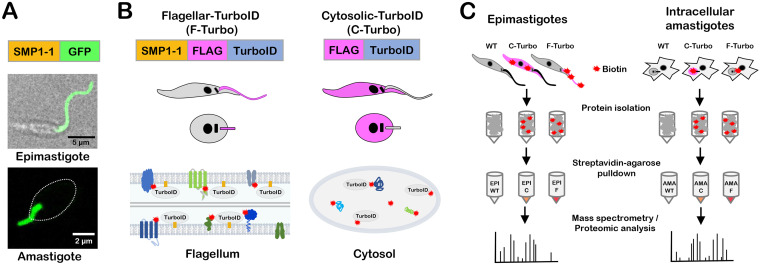
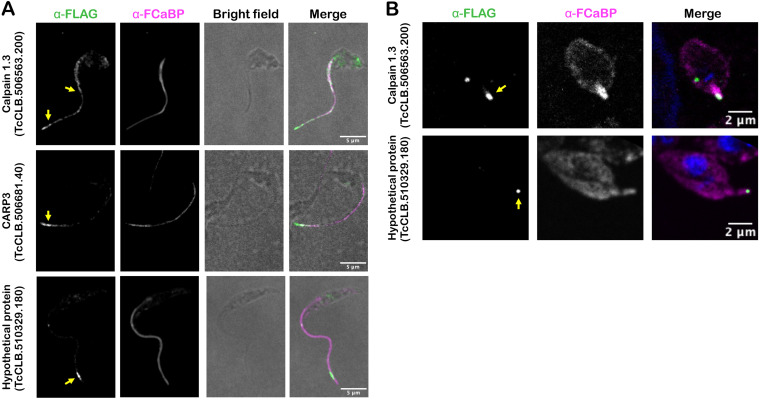
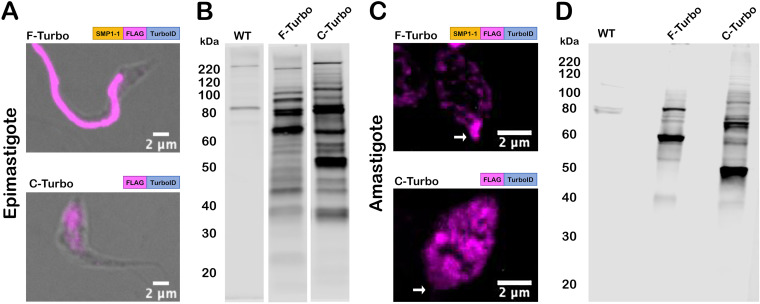
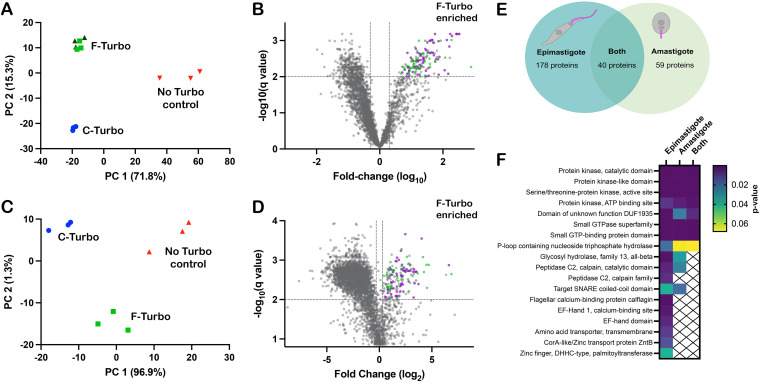
The flagellated kinetoplastid protozoan and causative agent of human Chagas disease, Trypanosoma cruzi, inhabits both invertebrate and mammalian hosts over the course of its complex life cycle. In these disparate environments, T. cruzi uses its single flagellum to propel motile life stages and, in some instances, to establish intimate contact with the host. Beyond its role in motility, the functional capabilities of the T. cruzi flagellum have not been defined. Moreover, the lack of proteomic information for this organelle, in any parasite life stage, has limited functional investigation. In this study, we employed a proximity-dependent biotinylation approach based on the differential targeting of the biotin ligase TurboID to the flagellum or cytosol in replicative stages of T. cruzi to identify proteins that are enriched in the flagellum by mass spectrometry. Proteomic analysis of the resulting biotinylated protein fractions yielded 218 candidate flagellar proteins in T. cruzi epimastigotes (insect stage) and 99 proteins in intracellular amastigotes (mammalian stage). Forty of these enriched flagellar proteins were common to both parasite life stages and included orthologs of known flagellar proteins in other trypanosomatid species, proteins specific to the T. cruzi lineage and hypothetical proteins. With the validation of flagellar localization for several of the identified candidates, our results demonstrate that TurboID-based proximity proteomics is an effective tool for probing subcellular compartments in T. cruzi. The proteomic data sets generated in this work offer a valuable resource to facilitate functional investigation of the understudied T. cruzi flagellum. Trypanosoma cruzi is a protozoan parasite that causes Chagas disease, which causes substantial morbidity and mortality in South and Central America. Throughout its life cycle, T. cruzi interacts with insect and mammalian hosts via its single flagellum, establishing intimate contact with host membranes. Currently, few flagellar proteins have been identified in T. cruzi that could provide insight into the mechanisms involved in mediating physical and biochemical interactions with the host. Here, we set out to identify flagellar proteins in the main replicative stages of T. cruzi using a proximity-labeling approach coupled with mass spectrometry. The >200 candidate flagellar proteins identified represent the first large-scale identification of candidate flagellar proteins in T. cruzi with preliminary validation. These data offer new avenues to investigate the biology of T. cruzi-host interactions, a promising area for development of new strategies aimed at the control of this pathogen.
鞭毛动基体原生动物,也是导致人类恰加斯病的病原体,克氏锥虫,在其复杂的生命周期中同时栖息于无脊椎动物和哺乳动物宿主中。在这些不同的环境中,克氏锥虫利用其单一的鞭毛来推动运动阶段,并在某些情况下与宿主建立密切接触。除了在运动中的作用外,克氏锥虫鞭毛的功能能力尚未确定。此外,由于缺乏任何寄生虫生活阶段的细胞器的蛋白质组学信息,因此限制了对其功能的研究。在这项研究中,我们采用了一种基于 TurboID 差异靶向鞭毛或细胞质的邻近依赖性生物素化方法,在克氏锥虫的复制阶段,通过质谱法鉴定富含鞭毛的蛋白质。对生物素化蛋白部分的蛋白质组学分析在克氏锥虫的前鞭毛体(昆虫阶段)中产生了 218 种候选鞭毛蛋白,在细胞内无鞭毛体(哺乳动物阶段)中产生了 99 种蛋白。这些富含鞭毛的蛋白中有 40 种是两种寄生虫生活阶段共有的,包括其他锥虫物种中已知鞭毛蛋白的同源物、特有的克氏锥虫谱系蛋白和假设蛋白。通过对几种鉴定出的候选蛋白的鞭毛定位进行验证,我们的结果表明,基于 TurboID 的邻近蛋白质组学是一种有效的工具,可以探测克氏锥虫的亚细胞区室。本工作中生成的蛋白质组数据集为研究研究不足的克氏锥虫鞭毛提供了有价值的资源。克氏锥虫是一种原生动物寄生虫,可引起恰加斯病,在南美洲和中美洲造成大量的发病率和死亡率。在其整个生命周期中,克氏锥虫通过其单一鞭毛与昆虫和哺乳动物宿主相互作用,与宿主膜建立密切接触。目前,在克氏锥虫中发现的很少鞭毛蛋白可以提供有关介导与宿主的物理和生化相互作用的机制的见解。在这里,我们使用一种结合了质谱法的邻近标记方法,旨在鉴定克氏锥虫的主要复制阶段中的鞭毛蛋白。鉴定出的>200 种候选鞭毛蛋白代表了克氏锥虫中候选鞭毛蛋白的首次大规模鉴定,并进行了初步验证。这些数据为研究克氏锥虫与宿主相互作用的生物学提供了新的途径,这是开发针对这种病原体的新控制策略的一个很有前途的领域。