Department of Psychiatry and Psychotherapy, University Hospital Carl Gustav Carus of the Technische Universität Dresden, Dresden, Germany.
Coordination Centre for Clinical Trials, Faculty of Medicine Carl Gustav Carus, Technische Universität Dresden, Dresden, Germany.
Transl Psychiatry. 2023 Apr 5;13(1):113. doi: 10.1038/s41398-023-02404-7.
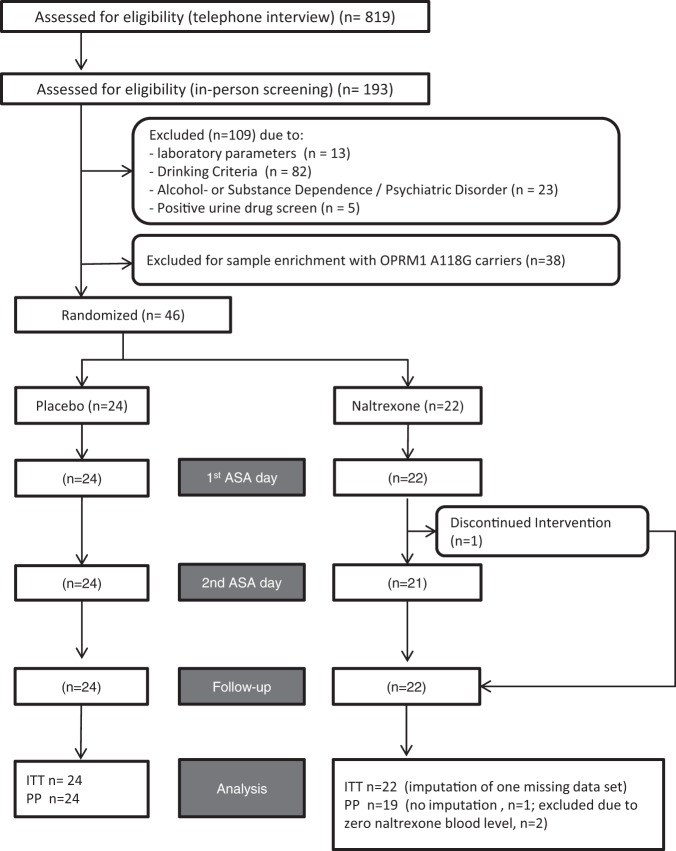
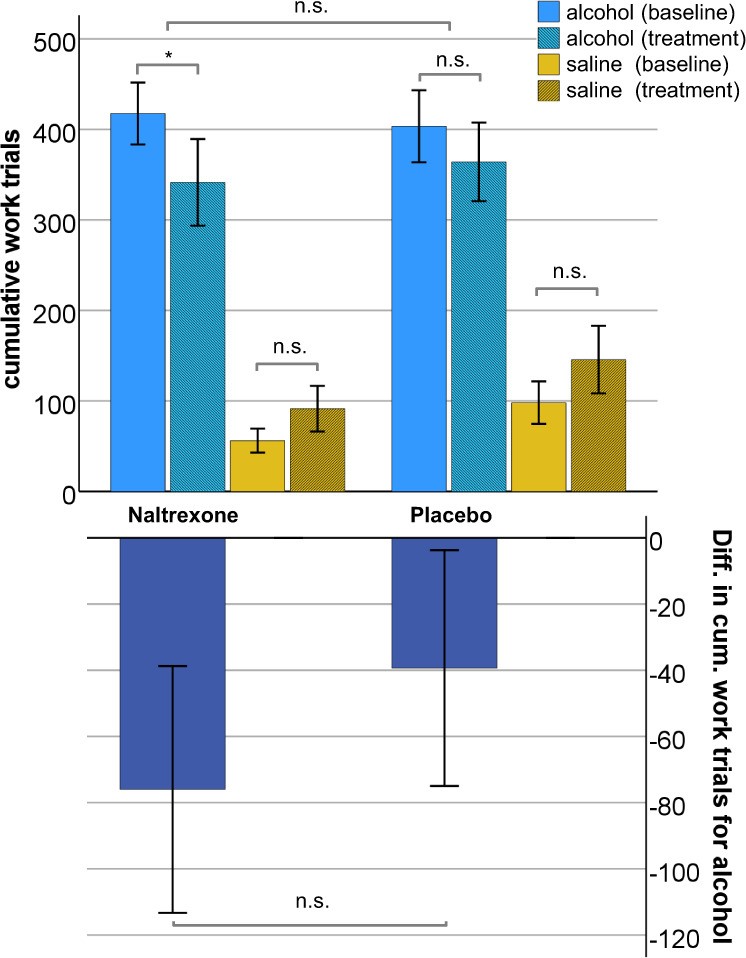
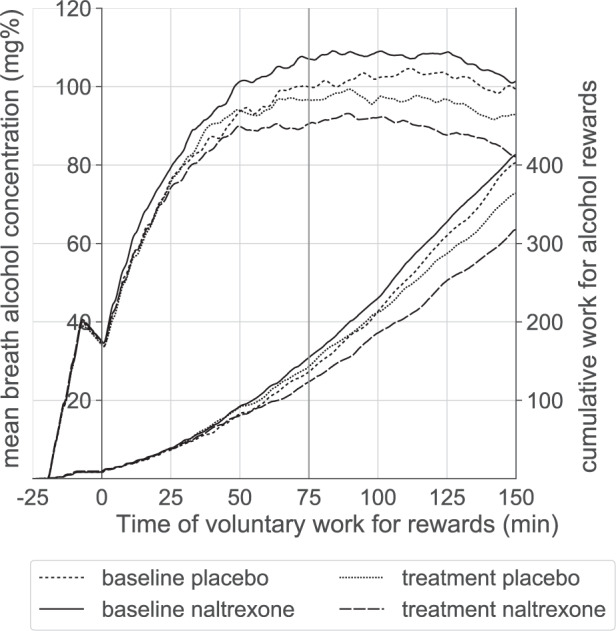
This registered clinical trial sought to validate a laboratory test system devised to screen medications for alcoholism treatment (TESMA) under different contingencies of alcohol reinforcement. Forty-six nondependent, but at least medium-risk drinkers were given the opportunity to earn intravenous infusions of ethanol, or saline, as rewards for work in a progressive-ratio paradigm. Work demand pattern and alcohol exposure dynamics were devised to achieve a gradual shift from low-demand work for alcohol (WFA) permitting quickly increasing breath alcohol concentrations (BrAC) to high-demand WFA, which could only decelerate an inevitable decrease of the previously earned BrAC. Thereby, the reward contingency changed, modeling different drinking motivations. The experiment was repeated after at least 7 days of randomized, double-blinded treatment with naltrexone, escalated to 50 mg/d, or placebo. Subjects treated with naltrexone reduced their cumulative WFA (cWFA) slightly more than participants receiving placebo. This difference was not statistically significant in the preplanned analysis of the entire 150 min of self-administration, i.e., our primary endpoint (p = 0.471, Cohen's d = 0.215). Naltrexone serum levels correlated with change in cWFA (r = -0.53; p = 0.014). Separate exploratory analyses revealed that naltrexone significantly reduced WFA during the first, but not the second half of the experiment (Cohen's d = 0.643 and 0.14, respectively). Phase-dependent associations of WFA with changes in subjective stimulation, wellbeing and desire for alcohol suggested that the predominant reinforcement of WFA was positive during the first phase only, and might have been negative during the second. We conclude that the TESMA is a safe and practical method. It bears the potential to quickly and efficiently screen new drugs for their efficacy to attenuate positively reinforced alcohol consumption. It possibly also provides a condition of negative reinforcement, and for the first time provides experimental evidence suggesting that naltrexone's effect might depend on reward contingency.
这项注册临床试验旨在验证一种旨在筛选酒精中毒治疗药物的实验室测试系统(TESMA),该系统适用于不同的酒精强化条件。46 名非依赖性但至少中度风险的饮酒者有机会通过累进比率范式的工作获得静脉内输注乙醇或生理盐水作为奖励。工作需求模式和酒精暴露动力学的设计旨在实现从允许快速增加呼气酒精浓度(BrAC)的低需求酒精工作(WFA)到高需求 WFA 的逐渐转变,而高需求 WFA 只能减缓先前获得的 BrAC 的不可避免的下降。因此,奖励条件发生了变化,模拟了不同的饮酒动机。在至少 7 天的纳曲酮随机、双盲治疗后,即每天 50 毫克或安慰剂,重复了该实验。接受纳曲酮治疗的受试者的累积 WFA(cWFA)略有减少,比接受安慰剂的参与者减少得稍多。在整个 150 分钟自我给药的预先计划分析中,这种差异没有统计学意义,即我们的主要终点(p=0.471,Cohen's d=0.215)。纳曲酮血清水平与 cWFA 的变化相关(r=-0.53;p=0.014)。单独的探索性分析表明,纳曲酮在实验的前半部分显著减少了 WFA,但在后半部分没有(Cohen's d 分别为 0.643 和 0.14)。WFA 与主观刺激、幸福感和饮酒欲望变化的阶段相关性表明,WFA 的主要强化在前半部分是积极的,而在后半部分可能是消极的。我们得出结论,TESMA 是一种安全实用的方法。它有可能快速有效地筛选新药物,以减轻积极强化的酒精消费。它可能还提供了一种负强化的条件,并首次提供了实验证据,表明纳曲酮的作用可能取决于奖励条件。