Asim Syed Anam, Tran Sarah, Reynolds Nicholas, Sauve Olivia, Zhang Huiming
Department of Biomedical Sciences, University of Windsor, Windsor, ON, Canada.
Front Neurosci. 2023 Mar 20;17:1130892. doi: 10.3389/fnins.2023.1130892. eCollection 2023.
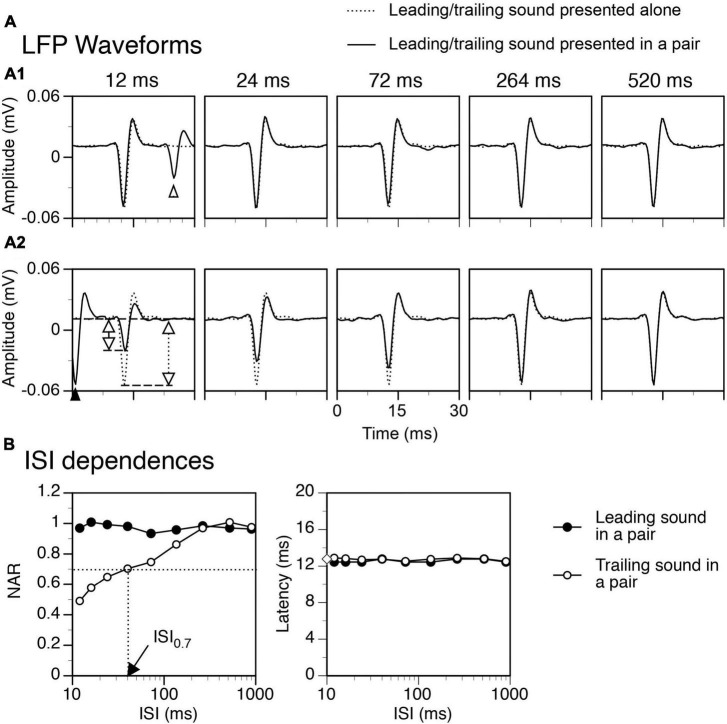
In a natural acoustic environment, a preceding sound can suppress the perception of a succeeding sound which can lead to auditory phenomena such as forward masking and the precedence effect. The degree of suppression is dependent on the relationship between the sounds in sound quality, timing, and location. Correlates of such phenomena exist in sound-elicited activities of neurons in hearing-related brain structures. The present study recorded responses to pairs of leading-trailing sounds from ensembles of neurons in the rat's inferior colliculus. Results indicated that a leading sound produced a suppressive aftereffect on the response to a trailing sound when the two sounds were colocalized at the ear contralateral to the site of recording (i.e., the ear that drives excitatory inputs to the inferior colliculus). The degree of suppression was reduced when the time gap between the two sounds was increased or when the leading sound was relocated to an azimuth at or close to the ipsilateral ear. Local blockage of the type-A γ-aminobutyric acid receptor partially reduced the suppressive aftereffect when a leading sound was at the contralateral ear but not at the ipsilateral ear. Local blockage of the glycine receptor partially reduced the suppressive aftereffect regardless of the location of the leading sound. Results suggest that a sound-elicited suppressive aftereffect in the inferior colliculus is partly dependent on local interaction between excitatory and inhibitory inputs which likely involves those from brainstem structures such as the superior paraolivary nucleus. These results are important for understanding neural mechanisms underlying hearing in a multiple-sound environment.
在自然声学环境中,先前的声音可以抑制后续声音的感知,这可能导致诸如前掩蔽和优先效应等听觉现象。抑制程度取决于声音在音质、时间和位置上的关系。在与听觉相关的脑结构中,神经元的声音诱发活动中存在此类现象的相关因素。本研究记录了大鼠下丘神经元群体对前后声音对的反应。结果表明,当两个声音在记录部位对侧的耳朵处共定位时(即驱动兴奋性输入到下丘的耳朵),前导声音对后续声音的反应产生抑制后效应。当两个声音之间的时间间隔增加或前导声音重新定位到同侧耳朵或靠近同侧耳朵的方位时,抑制程度降低。当A 型γ-氨基丁酸受体局部阻断时,前导声音在对侧耳朵而非同侧耳朵时,部分降低了抑制后效应。无论前导声音的位置如何,甘氨酸受体局部阻断都部分降低了抑制后效应。结果表明,下丘中声音诱发的抑制后效应部分取决于兴奋性和抑制性输入之间的局部相互作用,这可能涉及来自脑干结构如外侧上橄榄核的输入。这些结果对于理解多声环境中听力的神经机制很重要。