Institute of Pharmacology, Heidelberg University, Heidelberg, Germany.
Department of Life Sciences, Faculty of Natural Sciences, Imperial College London, London, UK.
Nat Neurosci. 2023 May;26(5):820-829. doi: 10.1038/s41593-023-01291-x. Epub 2023 Apr 6.
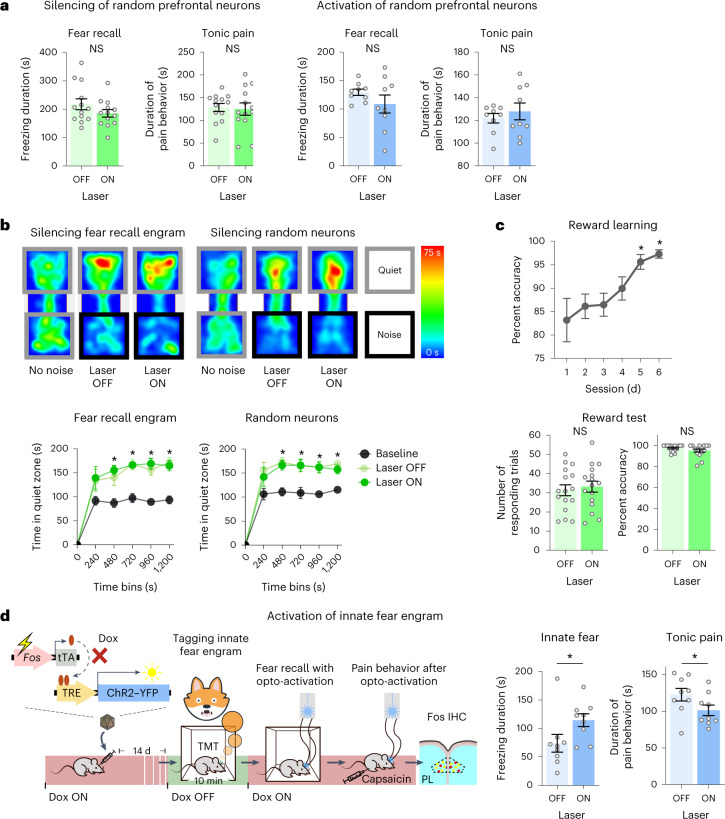
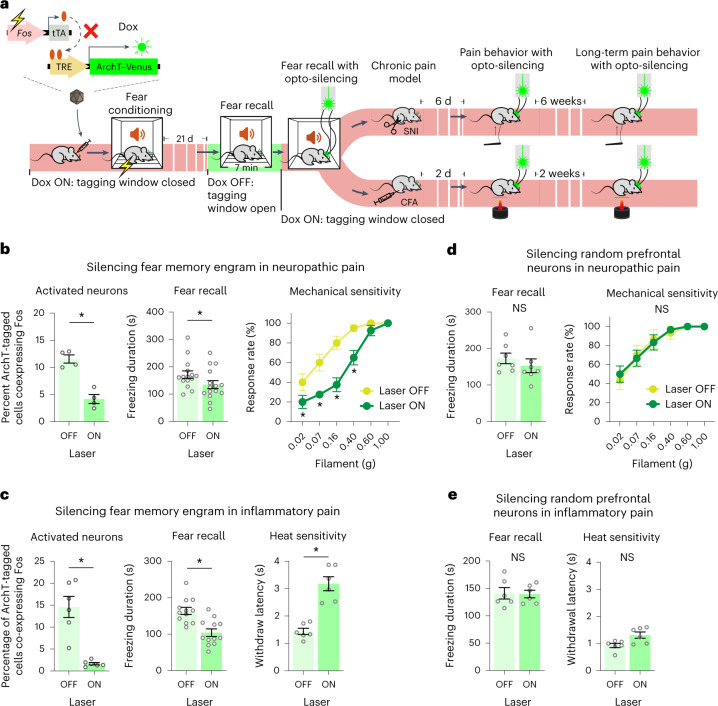
A painful episode can lead to a life-long increase in an individual's experience of pain. Fearful anticipation of imminent pain could play a role in this phenomenon, but the neurobiological underpinnings are unclear because fear can both suppress and enhance pain. Here, we show in mice that long-term associative fear memory stored in neuronal engrams in the prefrontal cortex determines whether a painful episode shapes pain experience later in life. Furthermore, under conditions of inflammatory and neuropathic pain, prefrontal fear engrams expand to encompass neurons representing nociception and tactile sensation, leading to pronounced changes in prefrontal connectivity to fear-relevant brain areas. Conversely, silencing prefrontal fear engrams reverses chronically established hyperalgesia and allodynia. These results reveal that a discrete subset of prefrontal cortex neurons can account for the debilitating comorbidity of fear and chronic pain and show that attenuating the fear memory of pain can alleviate chronic pain itself.
一个痛苦的插曲可能会导致个体对疼痛的体验终生增加。对即将到来的疼痛的恐惧预期可能在这种现象中起作用,但神经生物学基础尚不清楚,因为恐惧既可以抑制又可以增强疼痛。在这里,我们在小鼠中表明,储存在前额叶皮层神经元中的长期联想性恐惧记忆决定了一个痛苦插曲是否会影响以后的生活中的疼痛体验。此外,在炎症和神经病理性疼痛的情况下,前额叶的恐惧记忆会扩大,包括代表伤害感受和触觉的神经元,导致与恐惧相关的大脑区域的前额叶连接发生明显变化。相反,沉默前额叶的恐惧记忆会逆转慢性建立的痛觉过敏和感觉异常。这些结果表明,前额叶皮层的一小部分神经元可以解释恐惧和慢性疼痛的这种使人衰弱的合并症,并表明减轻疼痛的恐惧记忆可以缓解慢性疼痛本身。