Evidence-Based Medicine, Department I of Internal Medicine, Center for Integrated Oncology Aachen Bonn Cologne Duesseldorf, Faculty of Medicine and University Hospital Cologne, University of Cologne, Cologne, Germany.
German Cancer Society, Berlin, Germany.
BMC Health Serv Res. 2023 Apr 6;23(1):347. doi: 10.1186/s12913-023-09189-x.
Guideline recommendations do not necessarily translate into changes in clinical practice behaviour or better patient outcomes.
This systematic review aims to identify recent clinical guideline implementation strategies in oncology and to determine their effect primarily on patient-relevant outcomes and secondarily on healthcare professionals' adherence.
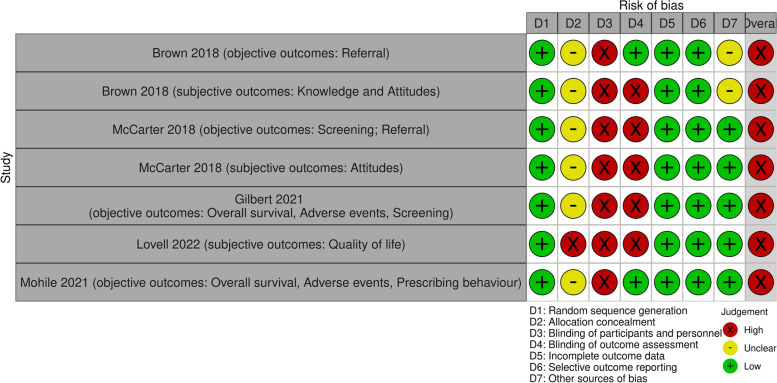
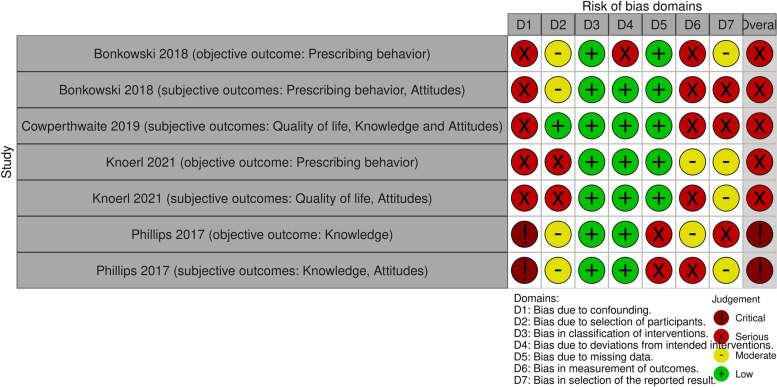
A systematic search of five electronic databases (PubMed, Web of Science, GIN, CENTRAL, CINAHL) was conducted on 16 december 2022. Randomized controlled trials (RCTs) and non-randomized studies of interventions (NRSIs) assessing the effectiveness of guideline implementation strategies on patient-relevant outcomes (overall survival, quality of life, adverse events) and healthcare professionals' adherence outcomes (screening, referral, prescribing, attitudes, knowledge) in the oncological setting were targeted. The Cochrane risk-of-bias tool and the ROBINS-I tool were used for assessing the risk of bias. Certainty in the evidence was evaluated according to GRADE recommendations. This review was prospectively registered in the International Prospective Register of Systematic Reviews (PROSPERO) with the identification number CRD42021268593.
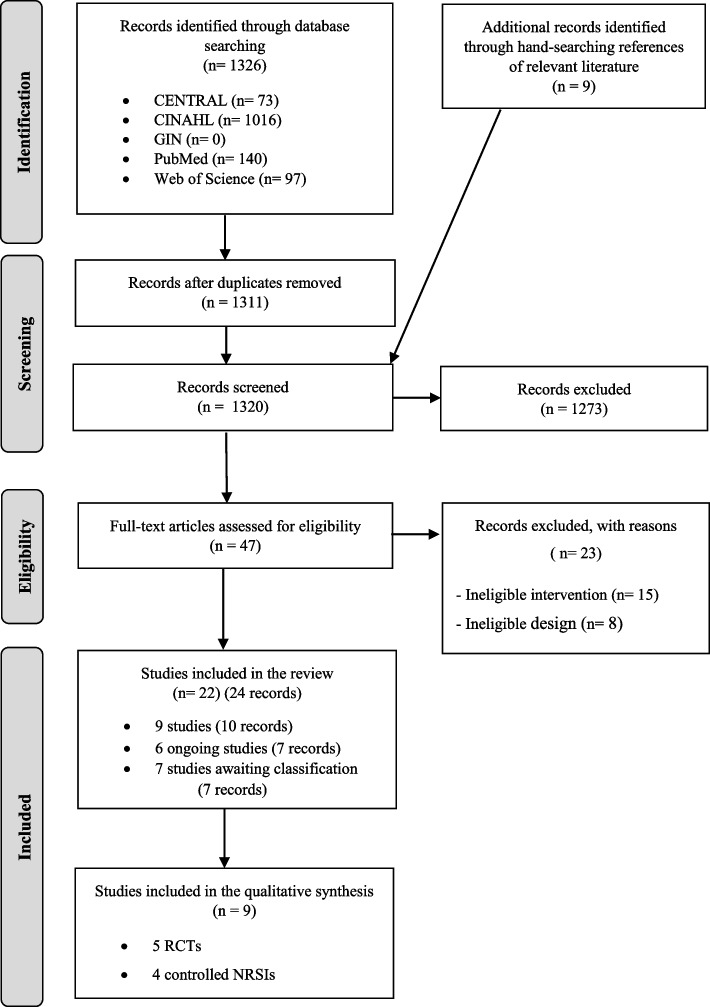
Of 1326 records identified, nine studies, five cluster RCTs and four controlled before-and after studies, were included in the narrative synthesis. All nine studies assess the effect of multi-component interventions in 3577 cancer patients and more than 450 oncologists, nurses and medical staff.
PATIENT-LEVEL: Educational meetings combined with materials, opinion leaders, audit and feedback, a tailored intervention or academic detailing may have little to no effect on overall survival, quality of life and adverse events of cancer patients compared to no intervention, however, the evidence is either uncertain or very uncertain.
PROVIDER-LEVEL: Multi-component interventions may increase or slightly increase guideline adherence regarding screening, referral and prescribing behaviour of healthcare professionals according to guidelines, but the certainty in evidence is low. The interventions may have little to no effect on attitudes and knowledge of healthcare professionals, still, the evidence is very uncertain.
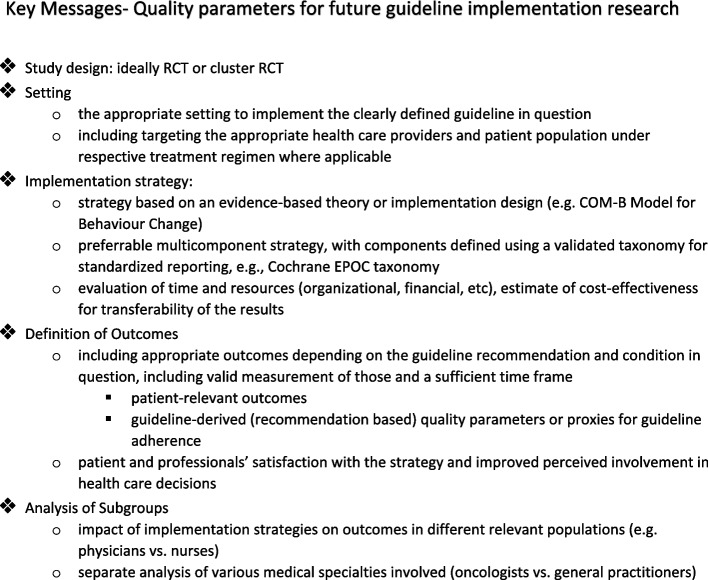
Knowledge and skill accumulation through team-oriented or online educational training and dissemination of materials embedded in multi-component interventions seem to be the most frequently researched guideline implementation strategies in oncology recently. This systematic review provides an overview of recent guideline implementation strategies in oncology, encourages future implementation research in this area and informs policymakers and professional organisations on the development and adoption of implementation strategies.
指南建议不一定能转化为临床实践行为的改变或更好的患者结局。
本系统评价旨在确定肿瘤学领域最近的临床指南实施策略,并主要确定其对患者相关结局的影响,其次是对医疗保健专业人员的依从性的影响。
于 2022 年 12 月 16 日对五个电子数据库(PubMed、Web of Science、GIN、CENTRAL、CINAHL)进行了系统检索。旨在评估干预措施的随机对照试验(RCT)和非随机研究(NRSI)的有效性,这些研究评估了肿瘤学环境中指南实施策略对患者相关结局(总生存率、生活质量、不良事件)和医疗保健专业人员的依从性结局(筛查、转诊、处方、态度、知识)的影响。使用 Cochrane 偏倚风险工具和 ROBINS-I 工具评估偏倚风险。根据 GRADE 建议评估证据的确定性。该综述前瞻性地在国际前瞻性系统评价登记处(PROSPERO)进行了注册,识别号为 CRD42021268593。
从 1326 条记录中,有 9 项研究,5 项聚类 RCT 和 4 项对照前后研究,被纳入叙述性综述。这 9 项研究均评估了 3577 名癌症患者和 450 多名肿瘤学家、护士和医务人员中多种成分干预的效果。
与无干预相比,教育会议结合材料、意见领袖、审核和反馈、量身定制的干预或学术细化可能对癌症患者的总生存率、生活质量和不良事件几乎没有影响,但证据不确定或非常不确定。
多组分干预措施可能会增加或略微增加医疗保健专业人员根据指南进行筛查、转诊和处方行为的指南依从性,但证据的确定性较低。这些干预措施对医疗保健专业人员的态度和知识可能几乎没有影响,尽管证据仍不确定。
通过面向团队或在线教育培训以及将材料嵌入多组分干预措施中进行知识和技能积累,似乎是肿瘤学领域最近研究最多的指南实施策略。本系统评价提供了肿瘤学领域最近的指南实施策略概述,鼓励该领域未来开展实施研究,并为决策者和专业组织提供关于实施策略的制定和采用的信息。