Zhang Kangfuxi, Yuan Jing, Pei Xuyao, Fu Zhao, Zhao Yilu, Hu Na, Wang Yufeng, Yang Li, Cao Qingjiu
Peking University Sixth Hospital, Peking University Institute of Mental Health, NHC Key Laboratory of Mental Health (Peking University), National Clinical Research Centre for Mental Disorders (Peking University Sixth Hospital), Beijing, China.
Front Neurosci. 2023 Mar 21;17:1149703. doi: 10.3389/fnins.2023.1149703. eCollection 2023.
Social deficits are among the most important functional impairments in attention-deficit/hyperactivity disorder (ADHD). However, the relationship between social impairment and ADHD core symptoms as well as the underlying cerebral blood flow (CBF) characteristics remain unclear.
A total of 62 ADHD subjects with social deficits (ADHD + SD), 100 ADHD subjects without social deficits (ADHD-SD) and 81 age-matched typically developing controls (TDC) were enrolled. We first examined the correlation between the Social Responsiveness Scale (SRS-1) and ADHD core symptoms (inattention, hyperactivity, and impulsion) and then explored categorical and dimensional ADHD-related regional CBF by arterial spin labeling (ASL). For the categorical analysis, a voxel-based comparison of CBF maps between the ADHD + SD, ADHD-SD, and TDC groups was performed. For the dimensional analysis, the whole-brain voxel-wise correlation between CBF and ADHD symptoms (inattention, hyperactivity/impulsivity, and total scores) was evaluated in three groups. Finally, correlations between the SRS-1 and ADHD-related regional CBF were investigated. We applied Gaussian random field (GRF) for the correction of multiple comparisons in imaging results (voxel-level < 0.01, and cluster-level < 0.05).
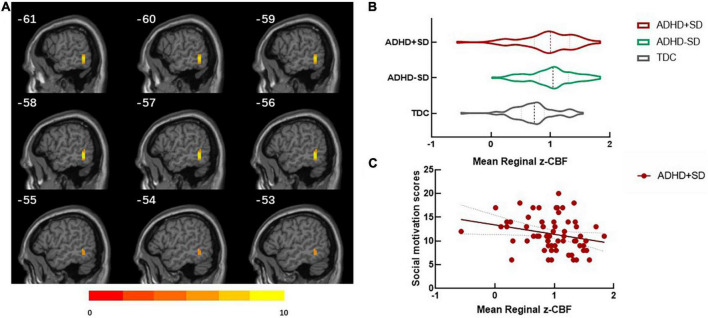
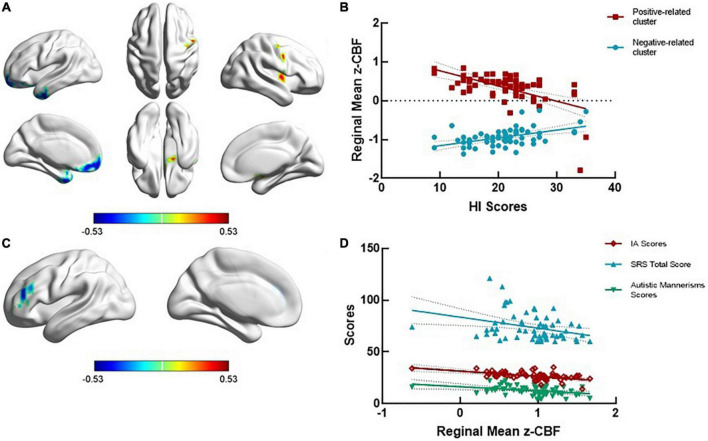
The clinical characteristics analysis showed that social deficits positively correlated with ADHD core symptoms, especially in social communication and autistic mannerisms domains. In the categorical analysis, we found that CBF in the left middle/inferior temporal gyrus in ADHD groups was higher than TDCs and was negatively correlated with the social motivation scores. Moreover, in dimensional analysis, we found that CBF in the left middle frontal gyrus was negatively correlated with the inattention scores, SRS total scores and autistic mannerisms scores in ADHD + SD subjects.
The present study shows that inattention, hyperactivity, and impulsivity may be responsible for the occurrence of social deficits in ADHD, with autistic traits being another significant contributing factor. Additionally, CBF in the left middle/inferior temporal gyrus and the left middle frontal gyrus might represent the corresponding physiological mechanisms underlying social deficits in ADHD.
社交缺陷是注意缺陷多动障碍(ADHD)最重要的功能损害之一。然而,社交损害与ADHD核心症状之间的关系以及潜在的脑血流量(CBF)特征仍不清楚。
共纳入62名有社交缺陷的ADHD受试者(ADHD + SD)、100名无社交缺陷的ADHD受试者(ADHD-SD)和81名年龄匹配的正常发育对照(TDC)。我们首先检查社交反应量表(SRS-1)与ADHD核心症状(注意力不集中、多动和冲动)之间的相关性,然后通过动脉自旋标记(ASL)探索与ADHD相关的分类和维度区域CBF。对于分类分析,对ADHD + SD组、ADHD-SD组和TDC组之间的CBF图进行基于体素的比较。对于维度分析,在三组中评估CBF与ADHD症状(注意力不集中、多动/冲动和总分)之间的全脑体素水平相关性。最后,研究SRS-1与ADHD相关区域CBF之间的相关性。我们应用高斯随机场(GRF)对成像结果中的多重比较进行校正(体素水平<0.01,聚类水平<0.05)。
临床特征分析表明,社交缺陷与ADHD核心症状呈正相关,尤其是在社交沟通和自闭症行为领域。在分类分析中,我们发现ADHD组左侧颞中/下回的CBF高于TDC组,且与社交动机得分呈负相关。此外,在维度分析中,我们发现左侧额中回的CBF与ADHD + SD受试者的注意力不集中得分、SRS总分和自闭症行为得分呈负相关。
本研究表明,注意力不集中、多动和冲动可能是ADHD社交缺陷发生的原因,自闭症特征是另一个重要的促成因素。此外,左侧颞中/下回和左侧额中回的CBF可能代表了ADHD社交缺陷的相应生理机制。