Laboratory of Molecular and Cellular Epigenetics (GIGA at University of Liege), Sart-Tilman, Molecular Biology, Teaching and Research Centre (TERRA), Gembloux, Belgium.
Department of Pneumology and Thoracic Oncology, (CHU Lille) and INSERM (ONCOTHAI), Lille, France.
Front Immunol. 2023 Mar 21;14:1148798. doi: 10.3389/fimmu.2023.1148798. eCollection 2023.
Only a fraction of patients with malignant pleural mesothelioma (MPM) will respond to chemo- or immunotherapy. For the majority, the condition will irremediably relapse after 13 to 18 months. In this study, we hypothesized that patients' outcome could be correlated to their immune cell profile. Focus was given to peripheral blood eosinophils that, paradoxically, can both promote or inhibit tumor growth depending on the cancer type.
The characteristics of 242 patients with histologically proven MPM were retrospectively collected in three centers. Characteristics included overall survival (OS), progression-free survival (PFS), overall response rate (ORR) and disease control rate (DCR). The mean absolute eosinophil counts (AEC) were determined by averaging AEC data sets of the last month preceding the administration of chemo- or immunotherapy.
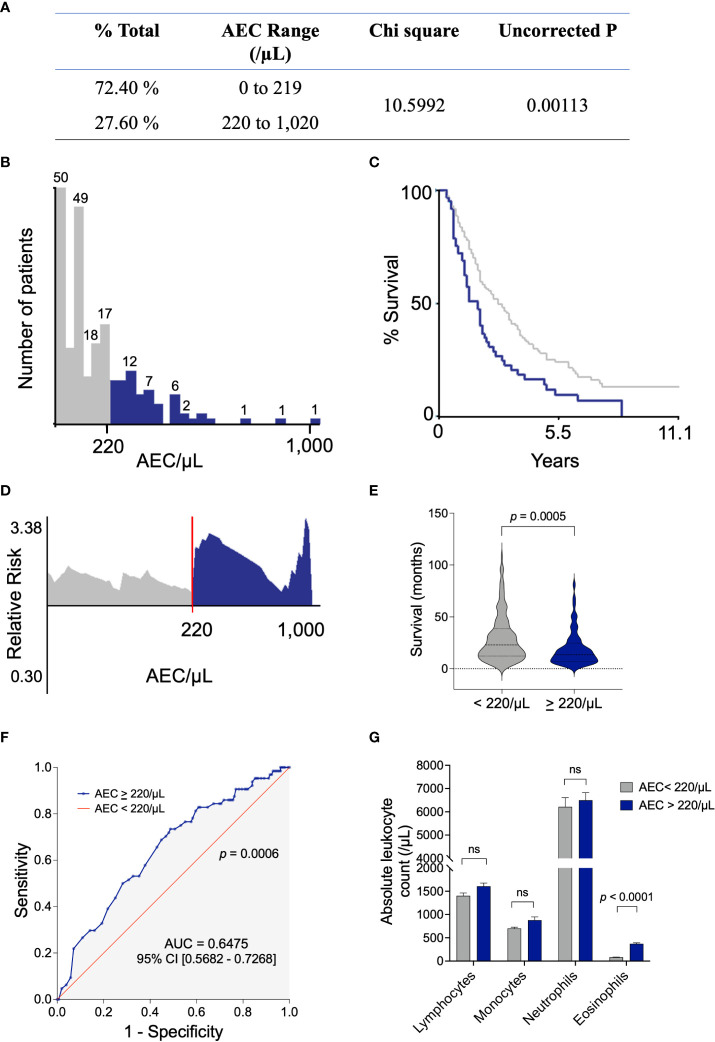
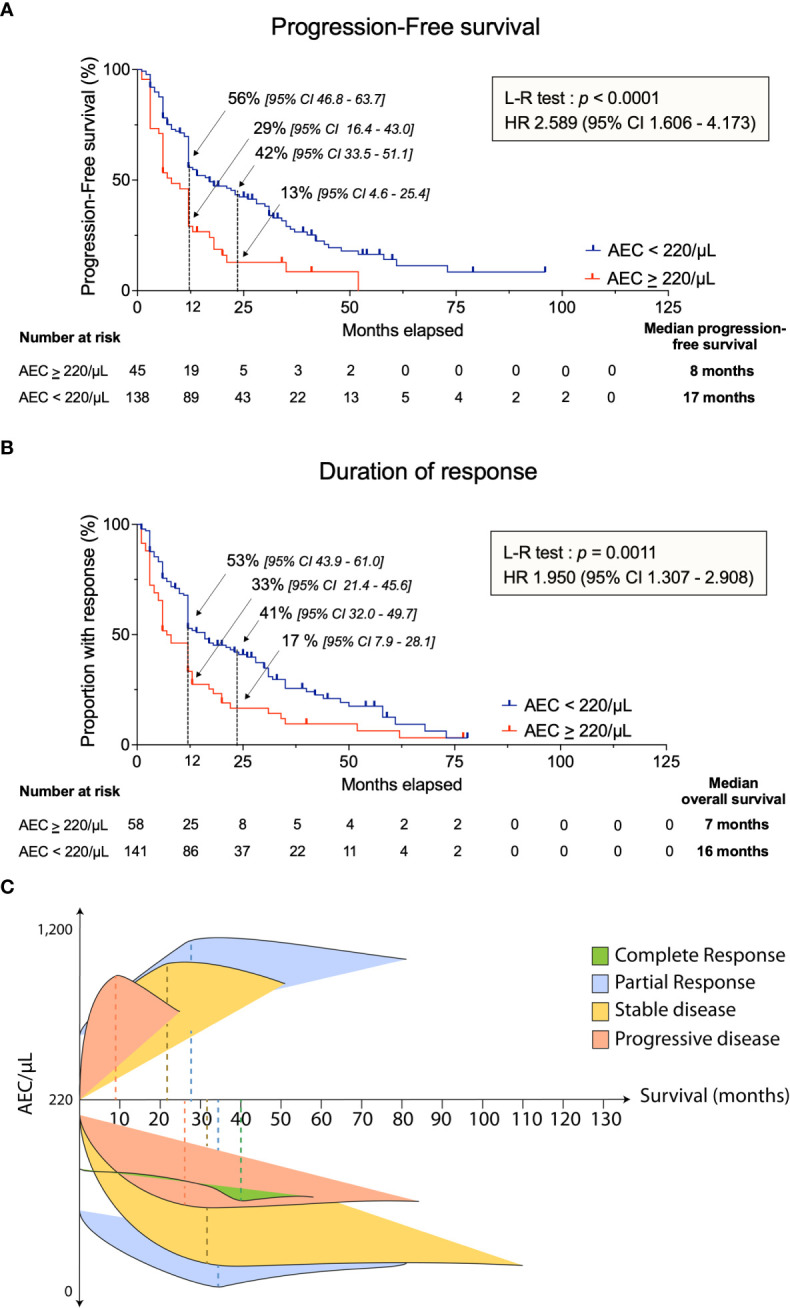
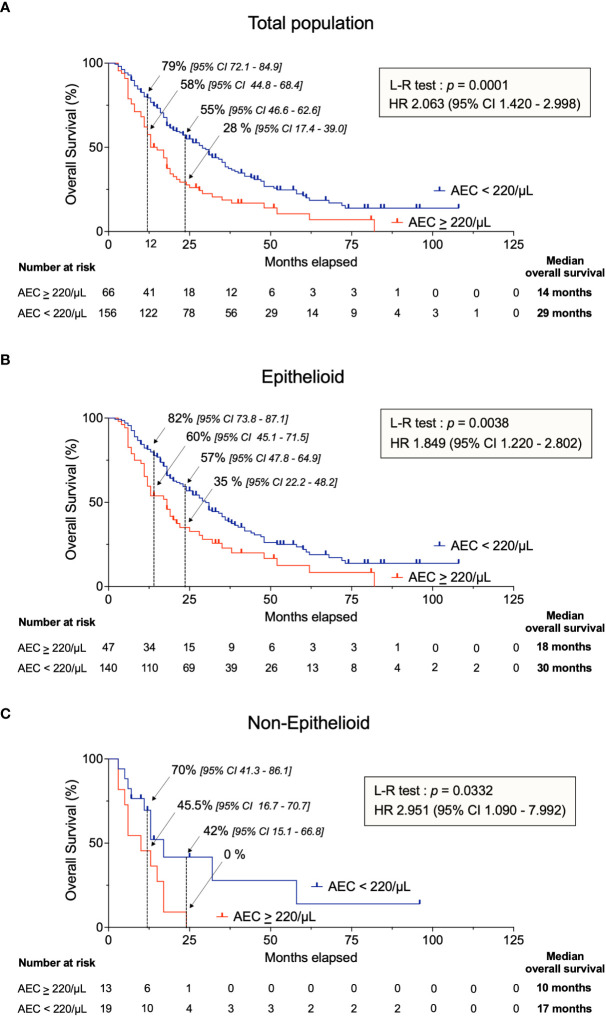
An optimal cutoff of 220 eosinophils/µL of blood segregated the cohort into two groups with significantly different median OS after chemotherapy (14 and 29 months above and below the threshold, = 0.0001). The corresponding two-year OS rates were 28% and 55% in the AEC ≥ 220/µL and AEC < 220/µL groups, respectively. Based on shorter median PFS (8 17 months, < 0.0001) and reduced DCR (55.9% vs 35.2% at 6 months), the response to standard chemotherapy was significantly affected in the AEC ≥ 220/µL subset. Similar conclusions were also drawn from data sets of patients receiving immune checkpoint-based immunotherapy.
In conclusion, baseline AEC ≥ 220/µL preceding therapy is associated with worse outcome and quicker relapse in MPM.
只有一小部分恶性胸膜间皮瘤(MPM)患者对化疗或免疫治疗有反应。对于大多数患者来说,病情在 13 至 18 个月后会不可避免地复发。在这项研究中,我们假设患者的预后可以与他们的免疫细胞特征相关。我们特别关注外周血嗜酸性粒细胞,这些细胞根据癌症类型可以促进或抑制肿瘤生长。
我们回顾性地收集了三个中心的 242 名组织学证实的 MPM 患者的特征。特征包括总生存期(OS)、无进展生存期(PFS)、总缓解率(ORR)和疾病控制率(DCR)。通过平均化疗或免疫治疗前最后一个月的 AEC 数据集来确定平均绝对嗜酸性粒细胞计数(AEC)。
嗜酸性粒细胞计数 220 个/µL 的最佳截值将队列分为两组,化疗后中位 OS 有显著差异(高于和低于阈值分别为 14 和 29 个月, = 0.0001)。相应的 AEC≥220/µL 和 AEC<220/µL 两组的两年 OS 率分别为 28%和 55%。基于较短的中位 PFS(8 17 个月, < 0.0001)和降低的 DCR(6 个月时为 55.9%和 35.2%),AEC≥220/µL 组对标准化疗的反应明显受到影响。从接受免疫检查点为基础的免疫治疗的患者的数据集中也得出了类似的结论。
总之,治疗前基线 AEC≥220/µL 与 MPM 较差的预后和更快的复发相关。