Department of Otorhinolaryngology, The Affiliated Traditional Chinese Medicine Hospital of Southwest Medical University, Luzhou, China.
Spinal Surgery Department, the Affiliated Traditional Chinese Medicine Hospital of Southwest Medical University, Luzhou, China.
Medicine (Baltimore). 2023 Apr 7;102(14):e33158. doi: 10.1097/MD.0000000000033158.
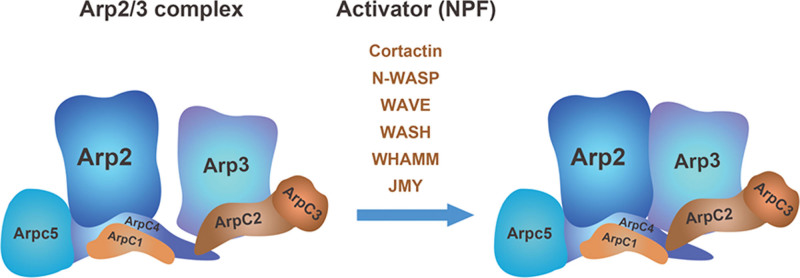
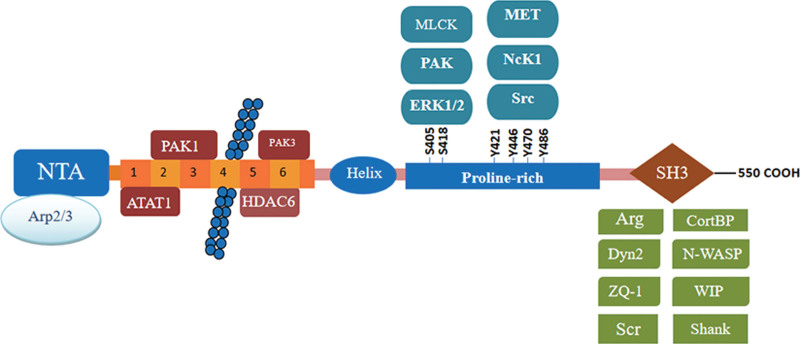
The actin 2/3 complex (Arp2/3) regulates actin polymerization and nucleation of actin filaments, is associated with cell motility, and has been shown to play a key role in the invasion and migration of cancer cells. nucleation-promoting factor (NPF) such as N-WASP (neural-WASP famly verprolin-homologous protein family), WAVE (WASP famly verprolin-homologous protein family), and WASH (WASP and Scar homologue) undergo conformational changes upon receipt of multiple upstream signals including Rho family GTPases, cdc42 (Cell division control protein 42 homolog), and phosphatidylinositol 4,5-bisphosphate (PtdIns 4,5 P2) to bind and activate the Arp2/3 complex. Once activated, the Arp2/3 complex forms actin-based membrane protrusions necessary for cancer cells to acquire an invasive phenotype. Therefore, how to influence the invasion and migration of cancer cells by regulating the activity of the Arp2/3 complex has attracted great research interest in recent years. Several studies have explored the effects of phosphorylation modifications of cortactin and several NPFs (Nucleation Promoting Factor) including N-WASP and WAVE on the activity of the Arp2/3 complex and ultimately on cancer cell invasiveness, and have attempted to suggest new strategies for antiinvasive therapy as a result. Other studies have highlighted the potential of targeting genes encoding partial or complete proteins of the Arp2/3 complex as a therapeutic strategy to prevent cancer cell invasion and metastasis. This article reviews the role of the Arp2/3 complex in the development, invasion, and metastasis of different types of cancer and the mechanisms regulating the activity of the Arp2/3 complex.
肌动蛋白 2/3 复合物 (Arp2/3) 调节肌动蛋白聚合和肌动蛋白丝的成核,与细胞运动有关,并已被证明在癌细胞的侵袭和迁移中发挥关键作用。成核促进因子 (NPF) 如 N-WASP(神经元-WASP 家族卷曲螺旋同源蛋白家族)、WAVE(WASP 家族卷曲螺旋同源蛋白家族)和 WASH(WASP 和 Scar 同源物)在接收多个上游信号后发生构象变化,包括 Rho 家族 GTPases、CDC42(细胞分裂控制蛋白 42 同源物)和磷脂酰肌醇 4,5-二磷酸 (PtdIns 4,5 P2),以结合并激活 Arp2/3 复合物。一旦被激活,Arp2/3 复合物形成基于肌动蛋白的膜突起,这对于癌细胞获得侵袭表型是必要的。因此,近年来,如何通过调节 Arp2/3 复合物的活性来影响癌细胞的侵袭和迁移引起了极大的研究兴趣。几项研究探讨了肌动蛋白结合蛋白 cortactin 和几种 NPFs(成核促进因子)包括 N-WASP 和 WAVE 的磷酸化修饰对 Arp2/3 复合物活性的影响,以及最终对癌细胞侵袭性的影响,并试图提出新的抗侵袭治疗策略。其他研究强调了靶向 Arp2/3 复合物部分或完整蛋白编码基因作为预防癌细胞侵袭和转移的治疗策略的潜力。本文综述了 Arp2/3 复合物在不同类型癌症的发生、侵袭和转移中的作用以及调节 Arp2/3 复合物活性的机制。