Li Qing, Wang Su-Jie, Wang Wen-Jia, Ye Yu-Cai, Ling Ya-Qin, Dai Ya-Fei
Institute of Pathophysiology, College of Basic Medical Sciences, Lanzhou University, Lanzhou, China.
Clinical Laboratory, Gansu Provincial Maternity and Child-care Hospital, Lanzhou, China.
Transl Cancer Res. 2023 Mar 31;12(3):461-472. doi: 10.21037/tcr-22-2272. Epub 2023 Mar 21.
P21-activated kinase 4 (PAK4) involves in cell proliferation in cancer and mutually regulates with p53, a molecule is demonstrated to control cell autophagy by mammalian target of rapamycin (mTOR)/protein kinase B (AKT) signaling. Since the signaling exhibits an association with PAK family members in cell autophagy, it implies that PAK4-relevant proliferation may be impacted by autophagy via p53 with a lack of evidence in cancer cells.
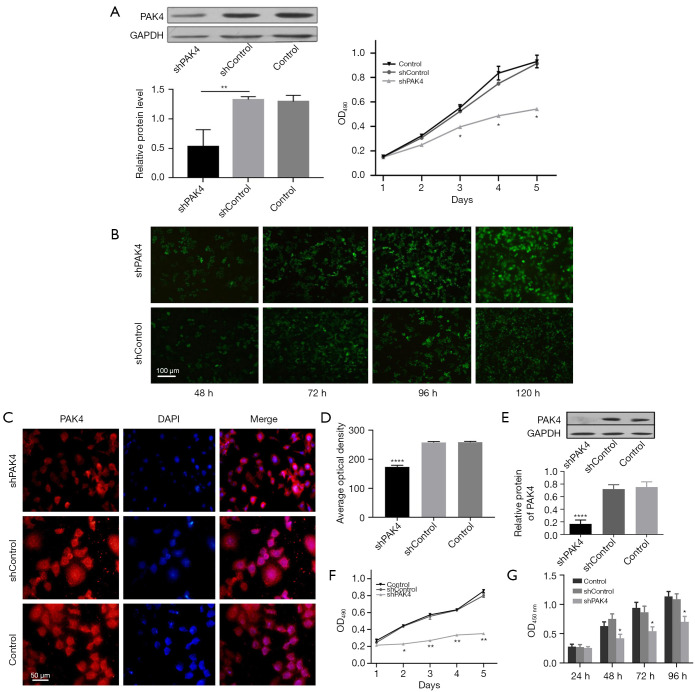
In this research, transient and stable PAK4-knockdown human hepatocarcinoma cell lines (HepG2) were constructed by transfection of PAK4-RNA interference (RNAi) plasmid and lentivirus containing PAK4-RNAi plasmid, respectively. We investigated cell proliferation using methyl thiazolyl tetrazolium (MTT) and Cell Counting Kit 8 (CCK8) assays, cell cycle by flow cytometry (FCM) and cell autophagy by monodansylcadaverine (MDC) staining and autophagic biomarker's expression, and detected the expressions of p53, mTOR, phosphorylated-AKT (p-AKT) and AKT by immunofluorescence and western blot to explore the mechanism.
We successfully constructed transient and stable PAK4-knockdown HepG2 cell lines, and detected dysfunction of the cells' proliferation. An increased expression of p53, as a molecule of cell-cycle-surveillance on G1/S phase, was demonstrated in the cells although the cell cycle blocked at G2/M. And then, we detected increased autophagosome and autophagic biomarker LC3-II, and decreased expressions in p-AKT and mTOR.
The proliferation is reduced in PAK4-knockdown HepG2 cells, which is relative to not only cell cycle arrest but also cell autophagy, and p53/mTOR/p-AKT signaling involves in the cell progress. The findings provide a new mechanism on PAK4 block in cancer therapy.
p21激活激酶4(PAK4)参与癌症细胞增殖,并与p53相互调节,p53是一种通过雷帕霉素哺乳动物靶蛋白(mTOR)/蛋白激酶B(AKT)信号传导控制细胞自噬的分子。由于该信号传导在细胞自噬中与PAK家族成员相关联,这意味着与PAK4相关的增殖可能通过p53受到自噬的影响,而在癌细胞中缺乏相关证据。
在本研究中,分别通过转染PAK4-RNA干扰(RNAi)质粒和含有PAK4-RNAi质粒的慢病毒,构建了瞬时和稳定的PAK4敲低人肝癌细胞系(HepG2)。我们使用甲基噻唑基四氮唑(MTT)和细胞计数试剂盒8(CCK8)检测细胞增殖,通过流式细胞术(FCM)检测细胞周期,通过单丹磺酰尸胺(MDC)染色和自噬生物标志物的表达检测细胞自噬,并通过免疫荧光和蛋白质印迹检测p53、mTOR、磷酸化-AKT(p-AKT)和AKT的表达,以探索其机制。
我们成功构建了瞬时和稳定的PAK4敲低HepG2细胞系,并检测到细胞增殖功能障碍。尽管细胞周期阻滞在G2/M期,但作为G1/S期细胞周期监测分子的p53表达增加。然后,我们检测到自噬体和自噬生物标志物LC3-II增加,以及p-AKT和mTOR表达降低。
PAK4敲低的HepG2细胞增殖减少,这不仅与细胞周期停滞有关,还与细胞自噬有关,并且p53/mTOR/p-AKT信号传导参与细胞进程。这些发现为癌症治疗中PAK4阻断提供了一种新机制。