Institute of Agricultural Engineering, University of Bonn, Bonn, Germany.
Department of Animal & Poultry Science, University of Saskatchewan, Saskatoon, Canada.
PeerJ. 2023 Apr 4;11:e14703. doi: 10.7717/peerj.14703. eCollection 2023.
One priority for animal welfare is for animals to experience less fear, especially during human contact. For domestic animals, breeds that are less fearful may provide genetic resources to develop strains with improved welfare due to lower susceptibility to fear. Genetic predispositions inherited in these breeds might reflect the large diversity of chicken breeds. The goal of the present study was to systematically test a diverse group of chicken breeds to search for breeds that experience less fear.
Nineteen chicken breeds from commercial hybrid lines, native layer-type, meat-type and dual-purpose breeds, ornamental breeds as well as bantam breeds were tested in a standardized tonic immobility (TI) test. Chickens were manually restrained on their back, and the time to first head movement and first leg movement, the duration of TI, as well as the number of attempts needed to induce TI were measured.
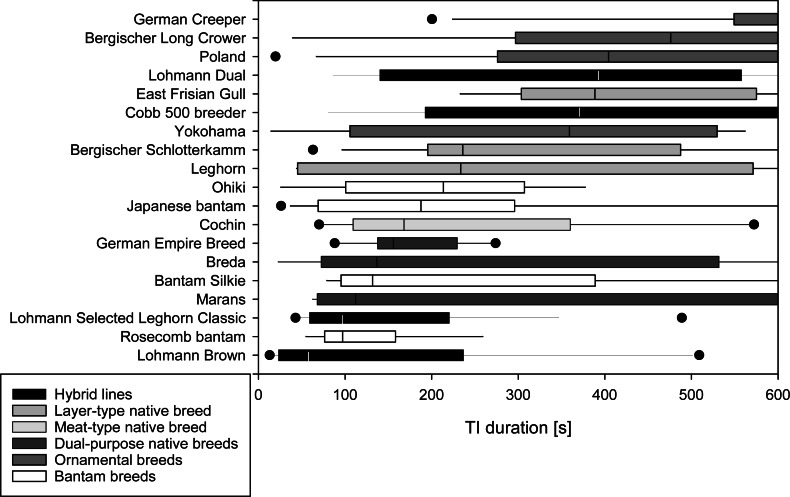
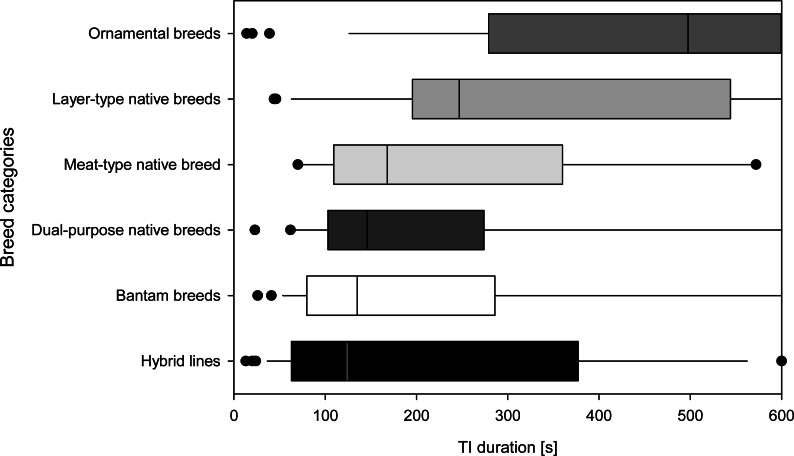
The TI response differed among chicken breeds ( ≤ 0.001) for naïve, mature hens. The median number of attempts required to induce TI ranged from 1 to 2 and did not differ significantly among breeds. Median durations were much more variable, with Lohmann Brown showing shortest durations (6 s, 12 s, 58 s for time to first head movement, first leg movement and total duration of TI, respectively). In contrast, medians reached the maximum of 600 s for all three measures in German Creepers. Repeated tests on the same individuals did not affect attempts needed to induce TI nor TI durations. Breeds clustered into two main groups, with layer-type native breeds and ornamental breeds having longer TI durations, and bantam, dual-purpose and meat-type native breeds having shorter TI durations.
Our findings provide evidence for substantial variation of fearfulness among breeds. This variation could be linked to the intended use during the breed's specific history. Knowledge and quantitative measurement of these behavioural responses provide the opportunity to improve welfare through selection and future breeding.
动物福利的一个重点是让动物减少恐惧,尤其是在与人类接触时。对于家养动物来说,那些不太恐惧的品种可能为开发福利改善品种提供遗传资源,因为这些品种对恐惧的敏感性较低。这些品种中遗传的易感性可能反映了鸡品种的巨大多样性。本研究的目的是系统地测试一组多样化的鸡品种,以寻找恐惧程度较低的品种。
19 个鸡品种来自商业杂交系、本地层鸡、肉用鸡和兼用鸡、观赏鸡和矮脚鸡,在标准化的紧张性不动(TI)测试中进行测试。鸡被手动仰卧固定,测量第一次头部运动和第一次腿部运动的时间、TI 的持续时间以及诱导 TI 所需的尝试次数。
在未成熟的成熟母鸡中,TI 反应在鸡品种之间存在差异(≤0.001)。诱导 TI 所需的尝试次数中位数范围为 1 至 2,品种之间无显著差异。中位数持续时间差异较大,洛曼棕鸡最短(分别为首次头部运动、首次腿部运动和 TI 总持续时间的 6 秒、12 秒和 58 秒)。相比之下,德国爬行动物的所有三个指标的中位数均达到 600 秒的最大值。对同一个体进行重复测试不会影响诱导 TI 所需的尝试次数或 TI 持续时间。品种聚类为两个主要组,层鸡本地品种和观赏鸡品种 TI 持续时间较长,矮脚鸡、兼用鸡和肉用鸡本地品种 TI 持续时间较短。
我们的研究结果为品种之间存在显著的恐惧差异提供了证据。这种差异可能与品种在特定历史时期的预期用途有关。对这些行为反应的了解和定量测量为通过选择和未来的繁殖来提高福利提供了机会。