Majumder Barun, Budhu Sadna, Ganusov Vitaly V
Department of Microbiology, University of Tennessee, Knoxville, TN 37996, USA.
Department of Pharmacology, Weill Cornell Medicine, New York, NY 10021, USA.
bioRxiv. 2023 Mar 29:2023.03.28.534600. doi: 10.1101/2023.03.28.534600.
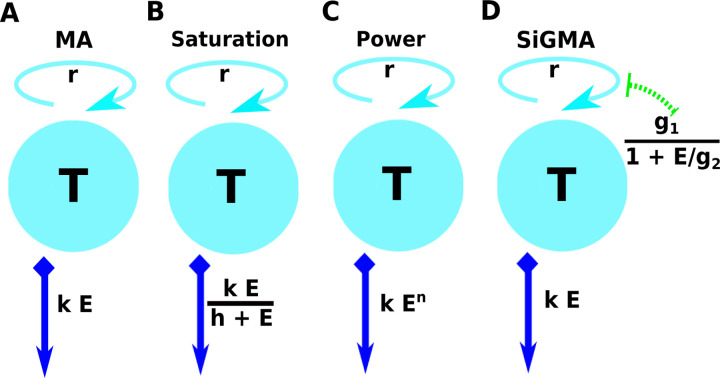
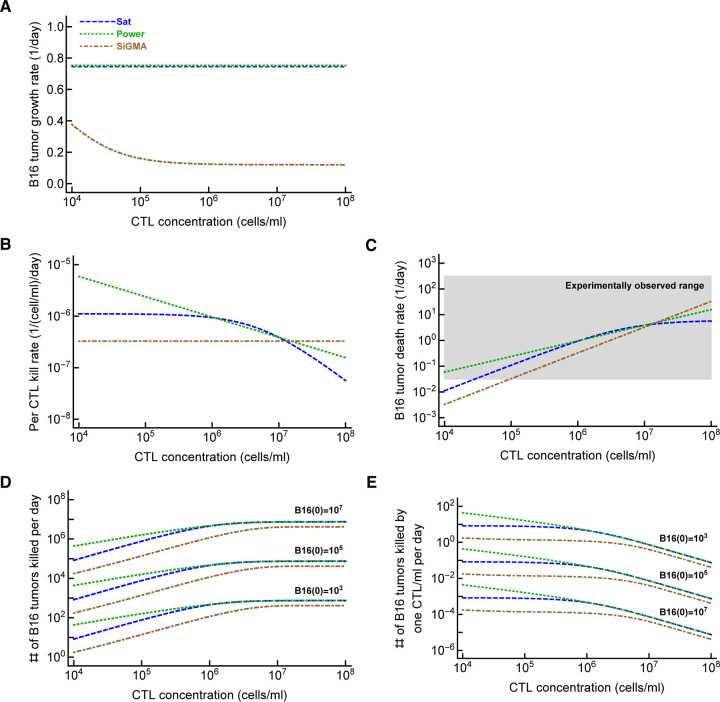
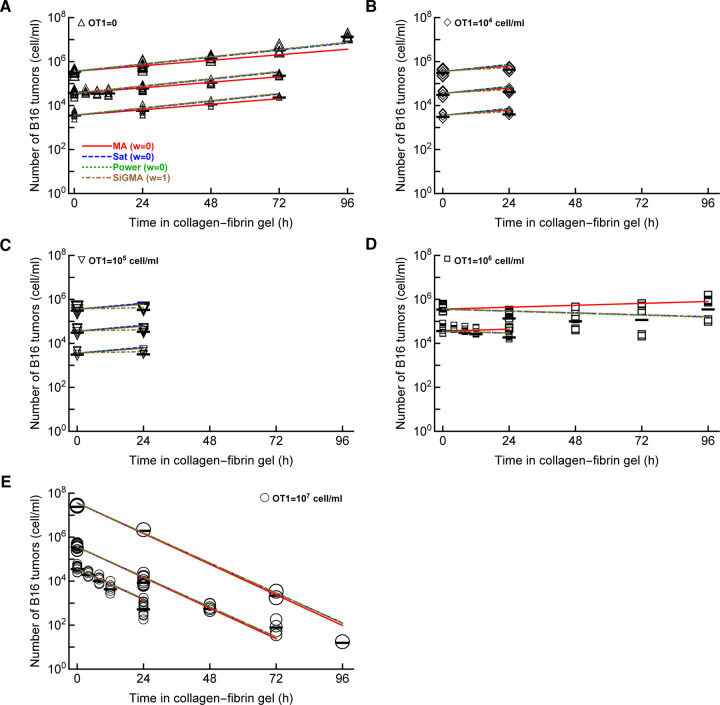
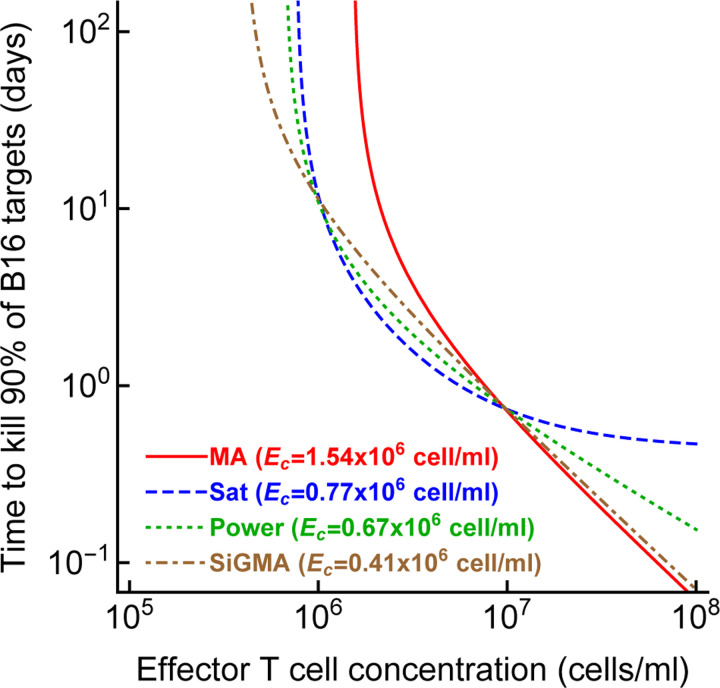
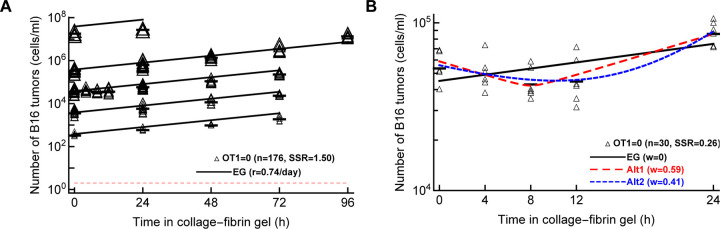
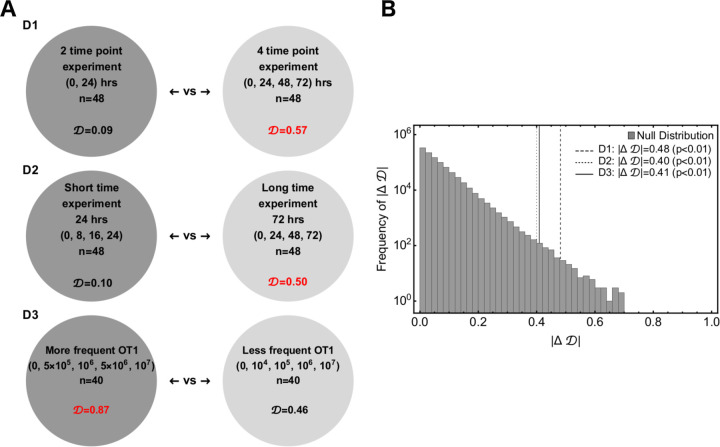
Cytotoxic T lymphocytes (CTLs) are important in controlling some viral infections, and therapies involving transfer of large numbers of cancer-specific CTLs have been successfully used to treat several types of cancers in humans. While molecular mechanisms of how CTLs kill their targets are relatively well understood we still lack solid quantitative understanding of the kinetics and efficiency at which CTLs kill their targets in different conditions. Collagen-fibrin gel-based assays provide a tissue-like environment for the migration of CTLs, making them an attractive system to study the cytotoxicity in vitro. Budhu [1] systematically varied the number of peptide (SIINFEKL)- pulsed B16 melanoma cells and SIINFEKL-specific CTLs (OT-1) and measured remaining targets at different times after target and CTL co-inoculation into collagen-fibrin gels. The authors proposed that their data were consistent with a simple model in which tumors grow exponentially and are killed by CTLs at a per capita rate proportional to the CTL density in the gel. By fitting several alternative mathematical models to these data we found that this simple "exponential-growth-mass-action-killing" model does not precisely fit the data. However, determining the best fit model proved difficult because the best performing model was dependent on the specific dataset chosen for the analysis. When considering all data that include biologically realistic CTL concentrations ( ≤ 10 cell/ml) the model in which tumors grow exponentially and CTLs suppress tumor's growth non-lytically and kill tumors according to the mass-action law (SiGMA model) fitted the data with best quality. Results of power analysis suggested that longer experiments (∼ 3 - 4 days) with 4 measurements of B16 tumor cell concentrations for a range of CTL concentrations would best allow to discriminate between alternative models. Taken together, our results suggest that interactions between tumors and CTLs in collagen-fibrin gels are more complex than a simple exponential-growth- mass-action killing model and provide support for the hypothesis that CTLs impact on tumors may go beyond direct cytotoxicity.
细胞毒性T淋巴细胞(CTLs)在控制某些病毒感染方面很重要,涉及大量癌症特异性CTLs转移的疗法已成功用于治疗人类的几种癌症。虽然CTLs杀死靶标的分子机制相对较为清楚,但我们仍然缺乏对CTLs在不同条件下杀死靶标的动力学和效率的可靠定量理解。基于胶原-纤维蛋白凝胶的检测为CTLs的迁移提供了类似组织的环境,使其成为体外研究细胞毒性的有吸引力的系统。布杜[1]系统地改变了肽(SIINFEKL)脉冲的B16黑色素瘤细胞和SIINFEKL特异性CTLs(OT-1)的数量,并在靶标和CTL共同接种到胶原-纤维蛋白凝胶后不同时间测量剩余靶标。作者提出他们的数据与一个简单模型一致,即肿瘤呈指数生长,并被CTLs以与凝胶中CTL密度成正比的人均速率杀死。通过将几种替代数学模型拟合到这些数据中,我们发现这个简单的“指数生长-质量作用杀伤”模型并不能精确拟合数据。然而,确定最佳拟合模型证明很困难,因为表现最佳的模型取决于为分析选择的特定数据集。当考虑所有包含生物学现实CTL浓度(≤10细胞/ml)的数据时,肿瘤呈指数生长且CTLs非裂解性抑制肿瘤生长并根据质量作用定律杀死肿瘤的模型(SiGMA模型)以最佳质量拟合数据。功效分析结果表明,对于一系列CTL浓度进行4次B16肿瘤细胞浓度测量的较长实验(约3 - 4天)最能区分替代模型。综上所述,我们的结果表明胶原-纤维蛋白凝胶中肿瘤与CTLs之间的相互作用比简单的指数生长-质量作用杀伤模型更复杂,并为CTLs对肿瘤的影响可能超出直接细胞毒性这一假设提供了支持。