Kim Taeeun, Huh Jin Won, Hong Sang-Bum, Jung Jiwon, Kim Min Jae, Chong Yong Pil, Sung Heungsup, Doh Kyung Hyun, Kim Sung-Han, Lee Sang-Oh, Kim Yang Soo, Lim Chae-Man, Koh Younsuck, Choi Sang-Ho
Division of Infectious Diseases, Department of Medicine, Nowon Eulji University Hospital, Seoul 01830, Republic of Korea.
Department of Pulmonary and Critical Care Medicine, Asan Medical Center, University of Ulsan College of Medicine, Seoul, Republic of Korea.
Open Forum Infect Dis. 2023 Mar 10;10(4):ofad131. doi: 10.1093/ofid/ofad131. eCollection 2023 Apr.
Severe respiratory syncytial virus (RSV)-associated pneumonia in adults has rarely been addressed. We investigated the burden and clinical characteristics of severe RSV-associated pneumonia in critically ill adult patients.
We analyzed a prospective cohort of 2865 adults with severe pneumonia who were admitted to the intensive care unit in a 2700-bed tertiary care hospital from 2010 to 2019. The epidemiology, characteristics, and outcomes of 92 cases of severe RSV-associated pneumonia and 163 cases of severe influenza virus (IFV)-associated pneumonia were compared.
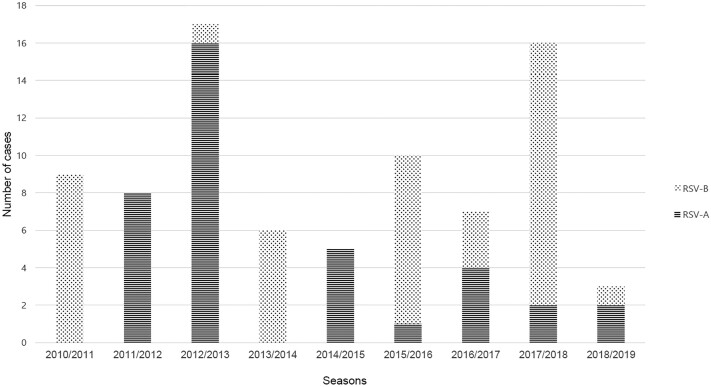
Of 1589 cases of severe community-acquired pneumonia, the incidence of RSV-associated pneumonia was less than half that of IFV-associated pneumonia (3.4% vs 8.1%). However, among 1276 cases of severe hospital-acquired pneumonia (HAP), there were slightly more cases of RSV-associated than IFV-associated pneumonia (3.8% vs 3.5%). During the 9 epidemic seasons, RSV-A (5 seasons) and RSV-B (4 seasons) predominated alternately. Structural lung disease, diabetes mellitus, and malignancy were common underlying diseases in both groups. Immunocompromise (57.6% vs 34.4%; < .001) and hospital acquisition (47.8% vs 23.9%; < .001) were significantly more common in the RSV group. Coinfection with (3.3% vs 9.8%; = .08) and methicillin-susceptible (1.1% vs 6.8%; = .06) tended to be less frequent in the RSV group. The 90-day mortality was high in both groups (39.1% vs 40.5%; = .89).
RSV infection was associated with substantial morbidity and mortality in critically ill adult patients, similar to IFV. The relatively higher incidence of RSV in severe HAP suggests that the transmissibility of RSV can exceed that of IFV in a hospital setting.
成人严重呼吸道合胞病毒(RSV)相关肺炎鲜有研究。我们调查了危重症成年患者中严重RSV相关肺炎的负担及临床特征。
我们分析了2010年至2019年期间在一家拥有2700张床位的三级医院重症监护病房收治的2865例严重肺炎成年患者的前瞻性队列。比较了92例严重RSV相关肺炎和163例严重流感病毒(IFV)相关肺炎的流行病学、特征及结局。
在1589例严重社区获得性肺炎中,RSV相关肺炎的发病率不到IFV相关肺炎的一半(3.4%对8.1%)。然而,在1276例严重医院获得性肺炎(HAP)中,RSV相关肺炎的病例略多于IFV相关肺炎(3.8%对3.5%)。在9个流行季节中,RSV-A(5个季节)和RSV-B(4个季节)交替占主导。结构性肺病、糖尿病和恶性肿瘤是两组常见的基础疾病。免疫功能低下(57.6%对34.4%;P<0.001)和医院获得性感染(47.8%对23.9%;P<0.001)在RSV组明显更常见。RSV组与[具体病原体名称]的合并感染(3.3%对9.8%;P = 0.08)和对甲氧西林敏感的[具体病原体名称](1.1%对6.8%;P = 0.06)往往较少见。两组的90天死亡率都很高(39.1%对40.5%;P = 0.89)。
RSV感染与危重症成年患者的高发病率和死亡率相关,与IFV相似。严重HAP中RSV相对较高的发病率表明,在医院环境中RSV的传播性可能超过IFV。