Division of Hematology and Oncology, Department of Internal Medicine, University of Michigan, Ann Arbor, MI, USA.
Rogel Cancer Center, University of Michigan, Ann Arbor, MI, USA.
Oncologist. 2023 Jun 2;28(6):531-541. doi: 10.1093/oncolo/oyad063.
Patients with advanced biliary tract cancers (BTCs) have poor prognoses and limited therapeutic options. Renin-angiotensin antagonists (ACE-I/ARBs), statins, and aspirin may have potential anti-tumorigenic effects and decrease mortality per retrospective analyses in some solid tumors.
To evaluate the efficacy of ACE-Is/ARBs, statins, and/or aspirin concurrent to first-line systemic therapy in patients with advanced or metastatic BTC.
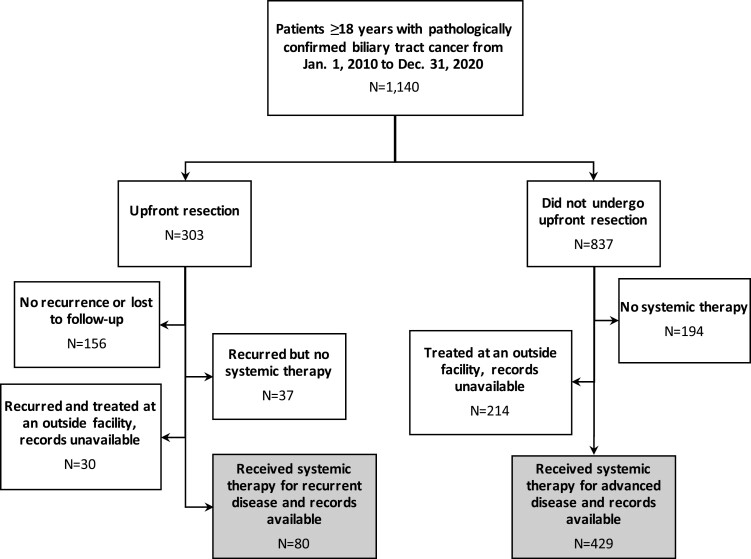
Adult patients at University of Michigan with pathologic confirmation of BTC between January 2010 and December 2020 were included in this retrospective analysis.
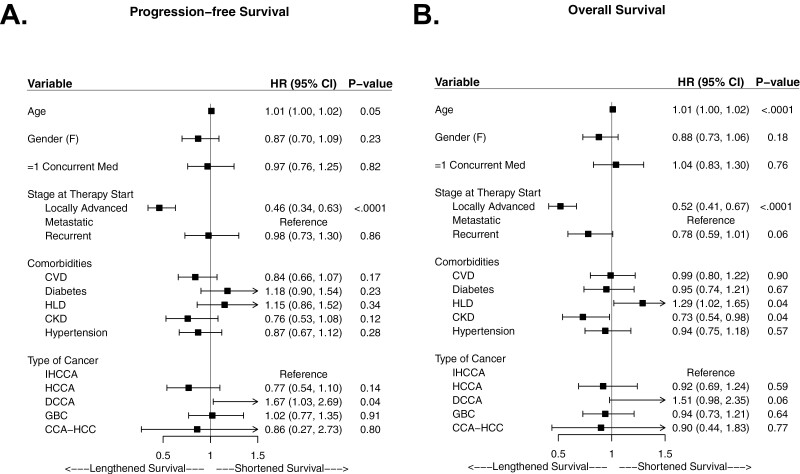
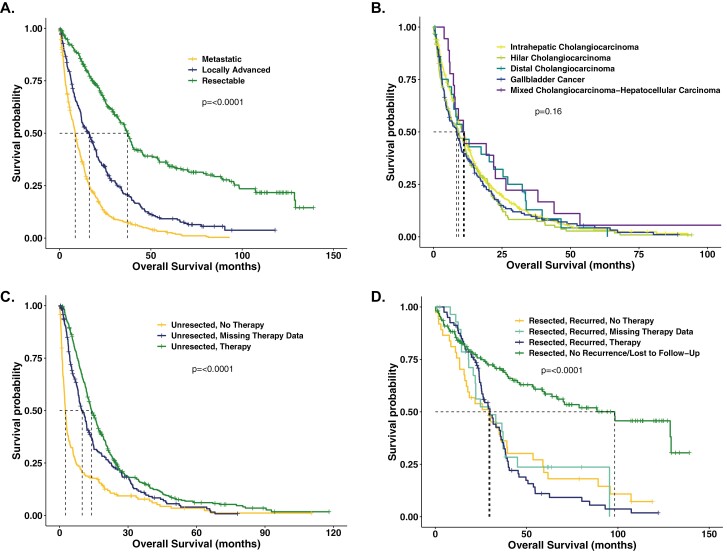
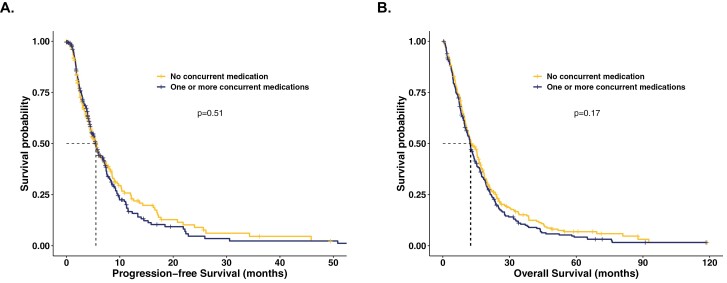
Of 1140 patients who met eligibility, a total of 509 patients received one or more concomitant medication(s) of interest in conjunction with systemic therapy for advanced cancer. In the total cohort, the overall survival for locally advanced patients (N = 305) was 16.3 months (95% CI: 12.1-18.6), and metastatic patients (N = 512) 8.6 months (95% CI: 7.6-9.5); P < .0001. Within this concomitant medication cohort, patients with locally advanced stage (n = 132) experienced significantly longer progression-free survival (9.8 vs 4.5; P < 0.0001), and overall survival (17.4 vs 10.6; P < 0.0001) than those with metastatic (n = 297) cancer, respectively. Patients who received ACE-Is/ARBs, statins, and/or aspirin (n = 245) versus not (n = 264) concurrent with systemic anti-cancer therapy did not experience improved progression-free (5.5 vs 5.5 months; hazard ratio (HR) 1.1; P = 0.51), or overall survival (12.3 vs 12.6 months; HR 1.1; P = 0.18), respectively.
In contrast to prior studies, no progression free or overall survival benefit in patients with advanced BTC from concurrent use of ACE-I/ARBs, statin, and/or aspirin with systemic therapy was observed when assessed by BTC subtype or specific systemic therapy regimen.
晚期胆道癌(BTC)患者预后较差,治疗选择有限。肾素-血管紧张素拮抗剂(ACEI/ARB)、他汀类药物和阿司匹林可能具有潜在的抗肿瘤作用,并通过一些实体瘤的回顾性分析降低死亡率。
评估 ACEI/ARB、他汀类药物和/或阿司匹林与一线系统治疗联合用于晚期或转移性 BTC 患者的疗效。
本回顾性分析纳入了 2010 年 1 月至 2020 年 12 月期间在密歇根大学经病理证实患有 BTC 的成年患者。
在符合条件的 1140 名患者中,共有 509 名患者在接受晚期癌症的系统治疗时同时使用了一种或多种感兴趣的联合药物。在总队列中,局部进展期患者(N=305)的总生存期为 16.3 个月(95%CI:12.1-18.6),转移性患者(N=512)为 8.6 个月(95%CI:7.6-9.5);P<0.0001。在这一联合药物队列中,局部进展期患者(n=132)的无进展生存期(9.8 个月 vs 4.5 个月;P<0.0001)和总生存期(17.4 个月 vs 10.6 个月;P<0.0001)明显长于转移性癌症患者(n=297)。与未接受 ACEI/ARB、他汀类药物和/或阿司匹林治疗的患者(n=264)相比,接受 ACEI/ARB、他汀类药物和/或阿司匹林治疗的患者(n=245)无进展生存期(5.5 个月 vs 5.5 个月;风险比(HR)1.1;P=0.51)和总生存期(12.3 个月 vs 12.6 个月;HR 1.1;P=0.18)均无改善。
与之前的研究相比,在评估 BTC 亚型或特定系统治疗方案时,未观察到晚期 BTC 患者联合使用 ACEI/ARB、他汀类药物和/或阿司匹林与系统治疗相比,无进展生存期或总生存期有获益。