
生长激素剂量调节与胎龄小导致身材矮小儿童的最终身高:法国真实数据。
Growth Hormone Dose Modulation and Final Height in Short Children Born Small for Gestational Age: French Real-Life Data.
机构信息
Department of Clinical Genetics and Infant Medicine, Medical School and University Hospital of the University of Lorraine, Nancy, France.
Division of Pediatric Endocrinology and Metabolism, Lyon University Pediatric Hospital, Lyon, France.
出版信息
Horm Res Paediatr. 2023;96(5):495-508. doi: 10.1159/000530572. Epub 2023 Apr 11.
INTRODUCTION
Growth hormone (GH) therapy improves height outcomes in short children born small for gestational age (SGA); however, real-world data on long-term GH exposure are few.
METHODS
We report results from an observational study (NCT01578135) including children born SGA, treated with GH at 126 sites in France, and followed up for >5 years until achieving final adult height (FAH) or until study termination. Primary endpoints were the proportion of patients with normal (>-2) height standard deviation score (SDS) at the last visit and with normal FAH SDS. Post hoc analyses were performed by multivariate logistic regression analysis with stepwise elimination to identify factors associated with GH dose modulation and normal height SDS achievement.
RESULTS
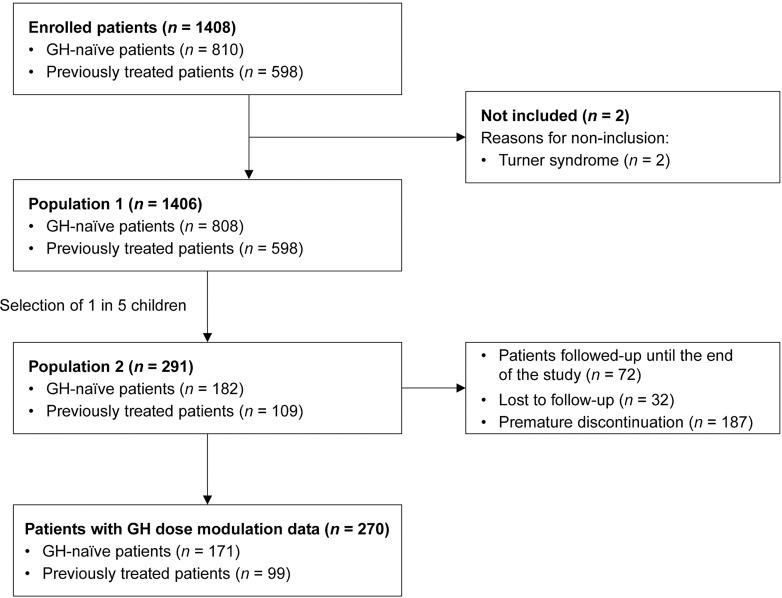
Of 1,408 registered patients, a representative sample (n = 291) was selected for long-term follow-up. At the last visit, 193/291 (66.3%) children achieved normal height SDS and 72/291 (24.7%) reached FAH. FAH SDS was >-2 for chronological age in 48 (66.7%) children and >-2 for adult age in 40 (55.6%) children. In the post hoc analyses, height SDS at the last visit was a significant determinant of whether GH dose had been modulated. Factors significantly associated with reaching normal height SDS were baseline height SDS (taller, better), age at treatment start (younger, better), treatment duration excluding discontinuation periods (longer, better), and absence of a chronic disease. Most (70%) adverse events were non-serious, with 39% considered possibly/probably related to GH treatment.
CONCLUSIONS
GH therapy was fairly effective in most short children born SGA. No new safety concerns were identified.
简介
生长激素(GH)治疗可改善因宫内发育迟缓(SGA)而身材矮小的儿童的身高结局;然而,关于长期 GH 暴露的真实数据很少。
方法
我们报告了一项观察性研究(NCT01578135)的结果,该研究纳入了在法国 126 个地点接受 GH 治疗的 SGA 出生儿童,并进行了超过 5 年的随访,直至达到最终成人身高(FAH)或研究结束。主要终点是最后一次就诊时正常(>-2)身高标准差评分(SDS)的患者比例和正常 FAH SDS。采用逐步消除的多变量逻辑回归分析进行事后分析,以确定与 GH 剂量调节和正常身高 SDS 获得相关的因素。
结果
在注册的 1408 名患者中,选择了具有代表性的样本(n=291)进行长期随访。在最后一次就诊时,291 名儿童中有 193 名(66.3%)达到正常身高 SDS,72 名(24.7%)达到 FAH。48 名(66.7%)儿童的 FAH SDS 与实际年龄相比为>-2,40 名(55.6%)儿童的 FAH SDS 与成人年龄相比为>-2。在事后分析中,最后一次就诊时的身高 SDS 是决定 GH 剂量是否调节的重要因素。与达到正常身高 SDS 相关的因素包括:基线身高 SDS(越高越好)、治疗开始时的年龄(越小越好)、排除停药期的治疗持续时间(越长越好)以及无慢性疾病。大多数(70%)不良事件是非严重的,39%认为可能/可能与 GH 治疗有关。
结论
GH 治疗对大多数因 SGA 而身材矮小的儿童相当有效。未发现新的安全问题。

 Zotero 插件