Department of Surgery, Sidney Kimmel Cancer Center, Thomas Jefferson University Hospital, Philadelphia, PA, 19107, USA.
Department of Pathology and Genomic Medicine, Sidney Kimmel Cancer Center, Thomas Jefferson University Hospital, Philadelphia, PA, 19107, USA.
Diagn Pathol. 2023 Apr 11;18(1):45. doi: 10.1186/s13000-023-01323-x.
Malignant perivascular epithelioid cell tumors (PEComas) are exceedingly rare malignant mesenchymal neoplasms with characteristic morphological and immunohistochemical (IHC) patterns. However, some malignant PEComas are poorly differentiated with atypical histopathological features, making a definitive diagnosis difficult. PEComas are most commonly found in females and often show either TSC1 or TSC2 alterations, which result in the activation of the mTOR pathway, or TFE3 fusions. Given these molecular characteristics, mTOR inhibitors have recently been approved by the FDA in the treatment of malignant PEComas, particularly in those with TSC1/2 alterations. Therefore, molecular analyses may be helpful for both the diagnostic workup of and predicting response to mTOR inhibitors in cases of malignant PEComas.
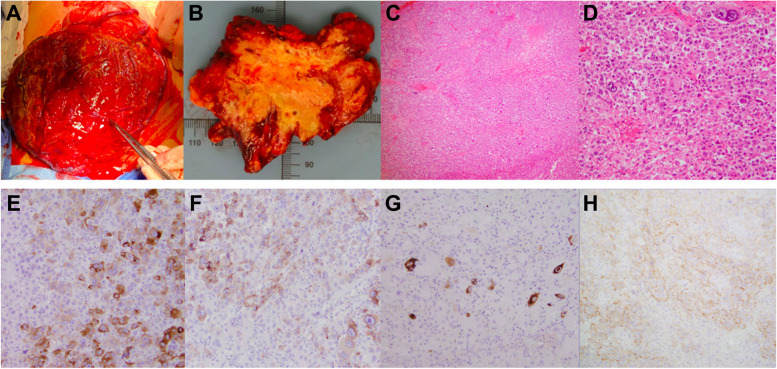
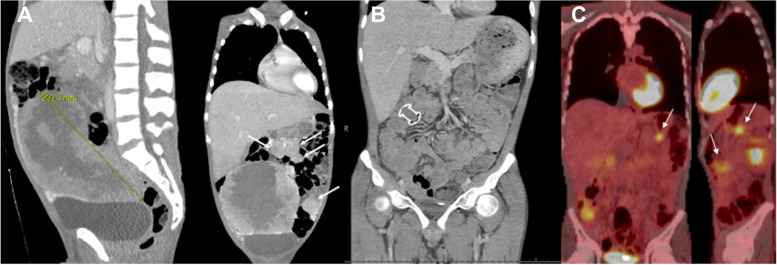
Here, we report a case of an aggressive, 23 cm mesenteric malignant PEComa with multiple peritoneal metastases in a young male patient. Pathological examination of the initial biopsy showed a malignant epithelioid neoplasm with high-grade morphology and atypical immunoprofile, which precluded a definitive diagnosis. Because of the patient's excessive transfusion requirements due to intra-tumoral hemorrhage, a palliative R2 resection was performed. Histopathological examination of the tumor revealed focal immunoreactivity for Melan-A, HMB-45, desmin, and CD117. Although a diagnosis of malignant PEComa was favored, other entities such as epithelioid gastrointestinal stromal tumor (GIST) or melanoma could not be definitively ruled out. Given the favored diagnosis, the patient was started on sirolimus, an mTOR inhibitor, rather than chemotherapy. Molecular analyses were performed and the tumor was found to harbor mutations in TP53 and TSC2, supporting a definitive diagnosis of malignant PEComa. The patient was then switched to nab-sirolimus, with initial stabilization of the disease.
This report details a multidisciplinary approach for the diagnosis and management of a highly aggressive, metastatic malignant PEComa in a young male patient. The basis for the treatment of malignant PEComas with the recently FDA-approved mTOR inhibitor, nab-sirolimus, is also reviewed. In summary, this case highlights the importance of molecular analysis, particularly TSC1/2 alterations, for both the definitive diagnosis of malignant PEComas and predicting their response to nab-sirolimus.
恶性血管周上皮样细胞瘤(PEComas)是一种极其罕见的恶性间叶性肿瘤,具有特征性的形态学和免疫组织化学(IHC)模式。然而,一些恶性 PEComas 分化不良,具有非典型的组织病理学特征,导致难以明确诊断。PEComas 最常见于女性,常表现为 TSC1 或 TSC2 改变,导致 mTOR 通路激活,或 TFE3 融合。鉴于这些分子特征,mTOR 抑制剂最近已被 FDA 批准用于治疗恶性 PEComas,特别是那些 TSC1/2 改变的患者。因此,分子分析对于恶性 PEComas 的诊断和预测 mTOR 抑制剂的反应可能都有帮助。
本病例报告了一名年轻男性患者患有侵袭性 23cm 肠系膜恶性 PEComa,伴有多处腹膜转移。初始活检的病理检查显示为高级别形态的恶性上皮样肿瘤,免疫组化表现不典型,无法明确诊断。由于患者因肿瘤内出血而需要大量输血,因此进行了姑息性 R2 切除术。肿瘤的组织病理学检查显示 Melan-A、HMB-45、结蛋白和 CD117 局灶性免疫反应。虽然倾向于诊断为恶性 PEComa,但不能明确排除其他实体瘤,如上皮性胃肠道间质瘤(GIST)或黑色素瘤。鉴于倾向于诊断为恶性 PEComa,给予患者 mTOR 抑制剂依维莫司而非化疗。进行了分子分析,发现肿瘤存在 TP53 和 TSC2 突变,支持恶性 PEComa 的明确诊断。然后将患者转换为纳武利尤单抗,疾病初步稳定。
本报告详细介绍了一种多学科方法,用于诊断和治疗年轻男性患者的高度侵袭性、转移性恶性 PEComa。还回顾了最近 FDA 批准的 mTOR 抑制剂纳武利尤单抗治疗恶性 PEComas 的基础。总之,本病例强调了分子分析的重要性,特别是 TSC1/2 改变,不仅对恶性 PEComa 的明确诊断有帮助,对预测其对纳武利尤单抗的反应也有帮助。