Health Economics and Policy Unit, Department of Health Systems and Policy, Kamuzu University of Health Sciences (KuHes), Private Bag 360, BLANTYRE 3, Lilongwe, Malawi.
Centre of Bioethics in Eastern and Southern Africa, Blantyre, Malawi.
BMC Health Serv Res. 2023 Apr 11;23(1):353. doi: 10.1186/s12913-023-09276-z.
The objective of this study was to assess the feasibility and acceptability of institutionalizing Health Technology Assessment (HTA) in Malawi.
This study employed a document review and qualitative research methods, to understand the status of HTA in Malawi. This was complemented by a review of the status and nature of HTA institutionalization in selected countries.Qualitative research employed a Focus Group Discussion (FGD ) with 7 participants, and Key Informant Interviews (KIIs) with12 informants selected based on their knowledge and expertise in policy processes related to HTA in Malawi.Data extracted from the literature was organized in Microsoft Excel, categorized according to thematic areas and analyzed using a literature review framework. Qualitative data from KIIs and the FGD was analyzed using a thematic content analysis approach.
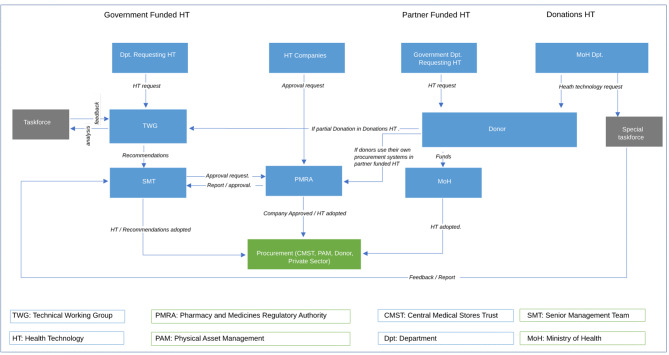
Some HTA processes exist and are executed through three structures namely: Ministry of Health Senior Management Team, Technical Working Groups, and Pharmacy and Medicines Regulatory Authority (PMRA) with varyingdegrees of effectiveness.The main limitations of current HTA mechanisms include limited evidence use, lack of a standardized framework for technology adoption, donor pressure, lack of resources for the HTA process and technology acquisition, laws and practices that undermine cost-effectiveness considerations. KII and FGD results showed overwhelming demand for strengthening HTA in Malawi, with a stronger preference for strengthening coordination and capacity of existing entities and structures.
The study has shown that HTA institutionalization is acceptable and feasible in Malawi. However, the current committee based processes are suboptimal to improve efficiency due to lack of a structured framework. A structured HTA framework has the potential to improve processes in pharmaceuticals and medical technologies decision-making.In the short to medium term, HTA capacity building should focus on generating demand and increasing capacity in cost-effectiveness assessments. Country-specific assessments should precede HTA institutionalization as well as recommendations for new technology adoptions.
本研究旨在评估在马拉维将健康技术评估(HTA)制度化的可行性和可接受性。
本研究采用文件审查和定性研究方法,了解马拉维 HTA 的现状。这一方法得到了对选定国家 HTA 制度化状况和性质的审查的补充。定性研究采用了与 7 名参与者进行的焦点小组讨论(FGD),以及根据他们在与马拉维 HTA 相关政策过程中的知识和专业知识选择的 12 名知情人进行的关键知情者访谈(KII)。从文献中提取的数据在 Microsoft Excel 中进行了组织,根据主题领域进行了分类,并使用文献综述框架进行了分析。来自 KII 和 FGD 的定性数据使用主题内容分析方法进行了分析。
一些 HTA 流程存在,并通过三个结构执行,即卫生部高级管理团队、技术工作组和药剂和药品监管局(PMRA),其有效性各不相同。当前 HTA 机制的主要限制包括证据使用有限、缺乏采用技术的标准化框架、捐助者压力、HTA 流程和技术获取资源不足、法律和做法破坏了成本效益考虑。KII 和 FGD 的结果表明,马拉维强烈要求加强 HTA,强烈倾向于加强现有实体和结构的协调和能力。
该研究表明,HTA 制度化在马拉维是可以接受和可行的。然而,由于缺乏结构化框架,目前基于委员会的流程效率低下。结构化的 HTA 框架有可能改善药品和医疗技术决策过程。在短期到中期内,HTA 能力建设应侧重于提高成本效益评估方面的需求和能力。在进行 HTA 制度化以及为新技术采用提出建议之前,应进行国家特定评估。