Pushparaj Pradeepa, Nicoletto Andrea, Dopico Xaquin Castro, Sheward Daniel J, Kim Sungyong, Ekström Simon, Murrell Ben, Corcoran Martin, Karlsson Hedestam Gunilla B
Department of Microbiology, Tumor and Cell Biology, Karolinska Institutet, Stockholm, Sweden.
Department of Biomedical Engineering, Lund University, Lund, Sweden.
Front Virol. 2023 Mar 1;3:1128253. doi: 10.3389/fviro.2023.1128253.
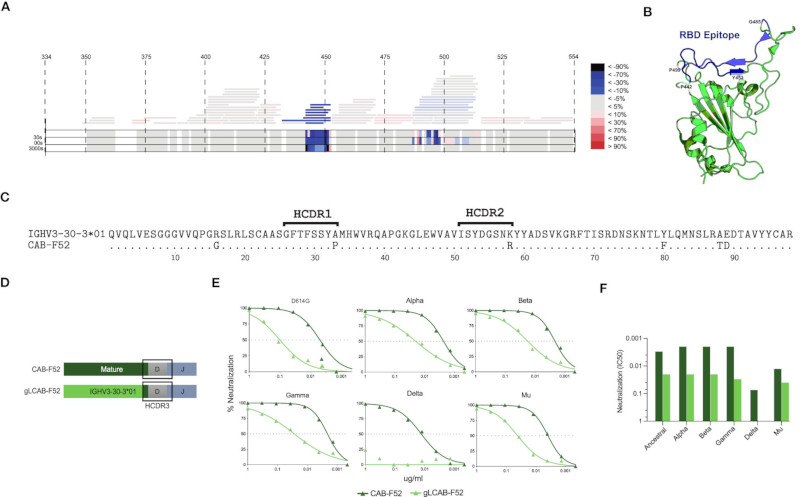
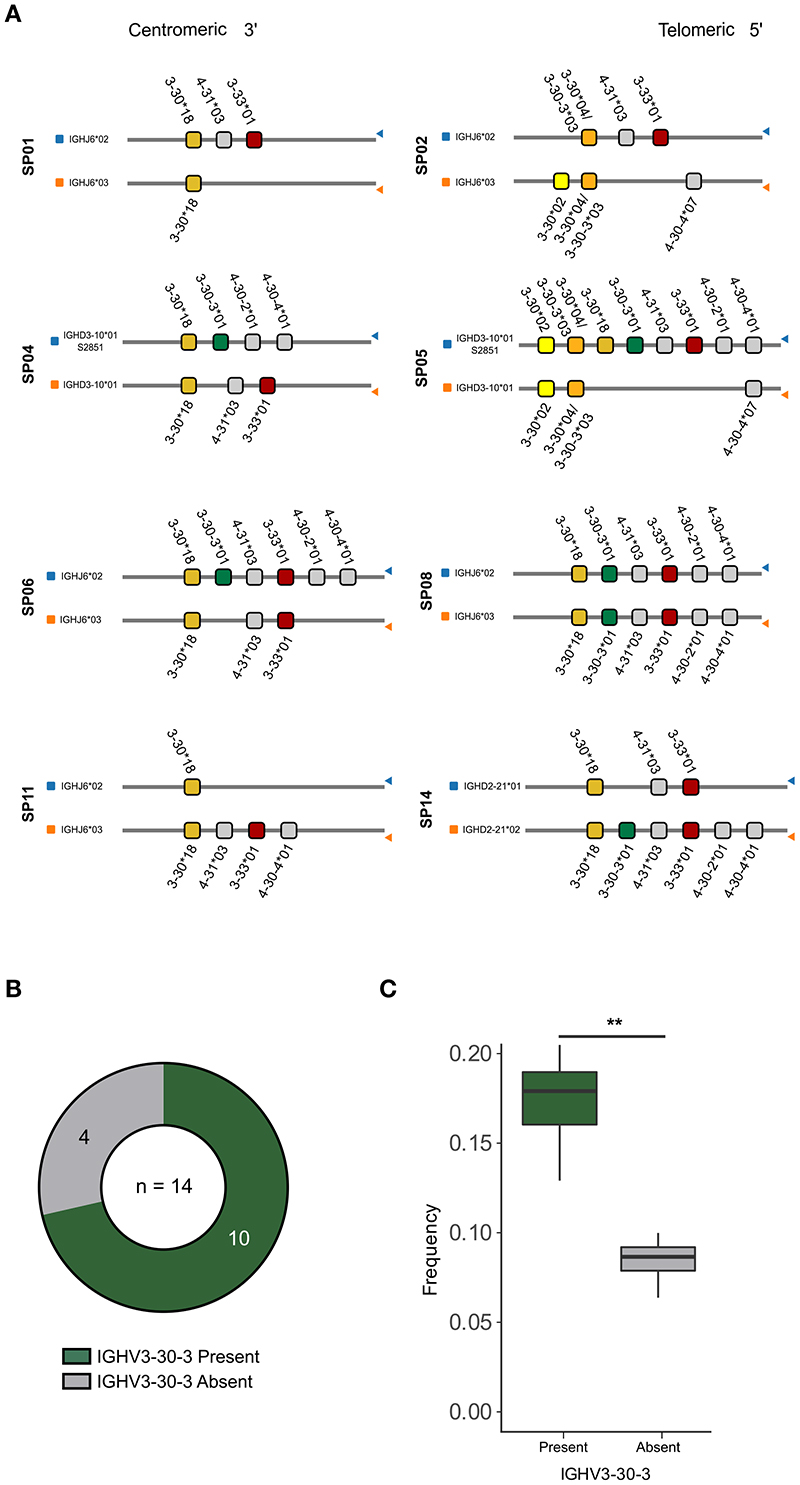
The antibody response to SARS-CoV-2 shows biased immunoglobulin heavy chain variable (IGHV) gene usage, allowing definition of genetic signatures for some classes of neutralizing antibodies. We investigated IGHV gene usage frequencies by sorting spike-specific single memory B cells from individuals infected with SARS-CoV-2 early in the pandemic. From two study participants and 703 spikespecific B cells, the most used genes were IGHV1-69, IGHV3-30-3, and IGHV3-30. Here, we focused on the IGHV3-30 group of genes and an IGHV3-30-3-using ultrapotent neutralizing monoclonal antibody, CAB-F52, which displayed broad neutralizing activity also in its germline-reverted form. IGHV3-30-3 is encoded by a region of the IGH locus that is highly variable at both the allelic and structural levels. Using personalized IG genotyping, we found that 4 of 14 study participants lacked the IGHV3-30-3 gene on both chromosomes, raising the question if other, highly similar IGHV genes could substitute for IGHV3-30-3 in persons lacking this gene. In the context of CAB-F52, we found that none of the tested IGHV3-33 alleles, but several IGHV3-30 alleles could substitute for IGHV3-30-3, suggesting functional redundancy between the highly homologous IGHV3-30 and IGHV3-30-3 genes for this antibody.
对严重急性呼吸综合征冠状病毒2(SARS-CoV-2)的抗体反应显示出免疫球蛋白重链可变(IGHV)基因使用偏向性,这使得能够定义某些类别的中和抗体的基因特征。我们通过对大流行早期感染SARS-CoV-2的个体的刺突特异性单个记忆B细胞进行分选,研究了IGHV基因的使用频率。在两名研究参与者的703个刺突特异性B细胞中,最常用的基因是IGHV1-69、IGHV3-30-3和IGHV3-30。在此,我们聚焦于IGHV3-30基因家族以及一种使用IGHV3-30-3的超高效中和单克隆抗体CAB-F52,该抗体在其胚系回复形式下也表现出广泛的中和活性。IGHV3-30-3由IGH基因座的一个区域编码,该区域在等位基因和结构水平上都高度可变。通过个性化IG基因分型,我们发现14名研究参与者中有4人在两条染色体上都缺乏IGHV3-30-3基因,这就提出了一个问题,即对于缺乏该基因的人,其他高度相似的IGHV基因是否可以替代IGHV3-30-3。在CAB-F52的背景下,我们发现测试的IGHV3-33等位基因均不能替代IGHV3-30-3,但几个IGHV3-30等位基因可以替代,这表明对于该抗体,高度同源的IGHV3-30和IGHV3-30-3基因之间存在功能冗余。