School of Medicine and Research Center, Universidad Espíritu Santo, Km 2.5 vía Samborondon, Guayas, 092301, Ecuador.
Biostatistics/Epidemiology, Freenome Inc, 279 E Grand Ave. 5th floor, South San Francisco, CA 94080, USA.
Int Health. 2023 Sep 1;15(5):611-613. doi: 10.1093/inthealth/ihad024.
Information on the relationship between tooth loss and mortality among individuals living in rural settings is limited.
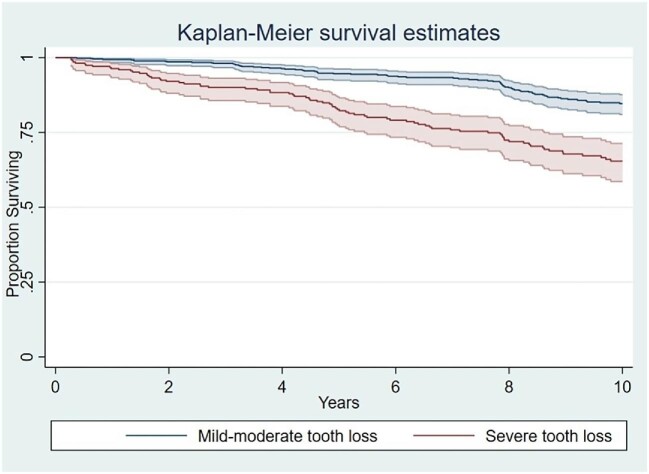
In this prospective cohort study, Atahualpa residents ≥40 y of age (n=933) were followed for a mean of 7.3±3.2 y to estimate mortality risk according to whether they had severe tooth loss (<10 remaining teeth).
Overall, 151 individuals (16%) died, resulting in a crude mortality rate of 2.35 per 100 person-years of follow-up. Individuals with severe tooth loss were more likely to die (73/276) compared with those with mild-moderate tooth loss (78/657), after adjusting for relevant covariates (hazard ratio 1.45 [95% confidence interval 1.02 to 2.04]).
Severe tooth loss is associated with increased mortality in remote communities.
关于生活在农村环境中的个体的牙齿缺失与死亡率之间的关系的信息有限。
在这项前瞻性队列研究中,对 Atahualpa 年龄≥40 岁的居民(n=933)进行了平均 7.3±3.2 年的随访,以根据他们是否有严重的牙齿缺失(<10 颗剩余牙齿)来估计死亡率风险。
总体而言,有 151 人(16%)死亡,导致随访期间每 100 人年的粗死亡率为 2.35。与轻度-中度牙齿缺失者(78/657)相比,严重牙齿缺失者(73/276)更有可能死亡(调整相关协变量后,危险比为 1.45[95%置信区间 1.02 至 2.04])。
严重的牙齿缺失与偏远社区的死亡率增加有关。