Hasíková Lenka, Závada Jakub, Serranová Tereza, Kozlík Petr, Kalíková Květa, Kotačková Lenka, Trnka Jiří, Zogala David, Šonka Karel, Růžička Evžen, Dušek Petr
Institute of Rheumatology, Prague, Czech Republic; Department of Rheumatology, First Faculty of Medicine, Charles University, Prague, Czech Republic.
Department of Neurology and Centre of Clinical Neuroscience, First Faculty of Medicine, Charles University and General University Hospital, Prague, Czech Republic.
NPJ Parkinsons Dis. 2023 Apr 12;9(1):60. doi: 10.1038/s41531-023-00505-0.
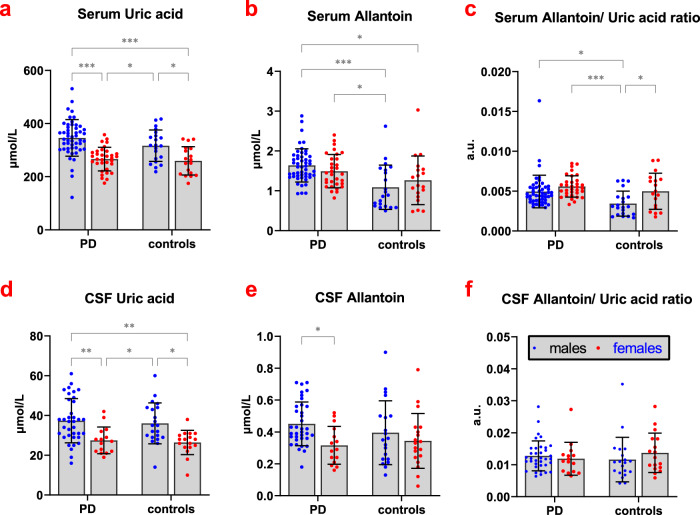
Oxidative stress supposedly plays a role in the pathogenesis of Parkinson's disease (PD). Uric acid (UA), a powerful antioxidant, is lowered in PD while allantoin, the oxidation product of UA and known biomarker of oxidative stress, was not systematically studied in PD. We aim to compare serum and cerebrospinal fluid (CSF) levels of UA, allantoin, and allantoin/UA ratio in de novo PD patients and controls, and evaluate their associations with clinical severity and the degree of substantia nigra degeneration in PD. We measured serum and CSF levels of UA, allantoin, and allantoin/UA ratio in 86 PD patients (33 females, mean age 57.9 (SD 12.6) years; CSF levels were assessed in 51 patients) and in 40 controls (19 females, 56.7 (14.1) years). PD patients were examined using Movement Disorder Society-Unified Parkinson's Disease Rating Scale (MDS-UPDRS), Montreal Cognitive Assessment (MoCA), Scales for Outcomes in Parkinson Disease-Autonomic (SCOPA-AUT), the University of Pennsylvania Smell Identification Test (UPSIT), one-night video-polysomnography, and dopamine transporter single-photon emission computed tomography (DAT-SPECT). Serum allantoin and allantoin/UA ratio were significantly increased in the PD group compared to controls (p < 0.001 and p = 0.002, respectively). Allantoin/UA ratios in serum and CSF were positively associated with the SCOPA-AUT score (p = 0.005 and 0.031, respectively) and RBD presence (p = 0.044 and 0.028, respectively). In conclusion, serum allantoin and allantoin/UA ratio are elevated in patients with de novo PD. Allantoin/UA ratio in serum and CSF is associated with autonomic dysfunction and RBD presence, indicating that higher systemic oxidative stress occurs in PD patients with more diffuse neurodegenerative changes.
氧化应激被认为在帕金森病(PD)的发病机制中起作用。尿酸(UA)是一种强大的抗氧化剂,在PD患者中水平降低,而UA的氧化产物尿囊素作为氧化应激的已知生物标志物,在PD中尚未得到系统研究。我们旨在比较初发PD患者和对照组血清及脑脊液(CSF)中UA、尿囊素水平以及尿囊素/UA比值,并评估它们与临床严重程度及PD中黑质变性程度的相关性。我们测量了86例PD患者(33例女性,平均年龄57.9(标准差12.6)岁;51例患者评估了CSF水平)和40例对照组(19例女性,56.7(14.1)岁)的血清及CSF中UA、尿囊素水平以及尿囊素/UA比值。使用运动障碍协会统一帕金森病评定量表(MDS-UPDRS)、蒙特利尔认知评估量表(MoCA)、帕金森病自主神经功能结局量表(SCOPA-AUT)、宾夕法尼亚大学嗅觉识别测试(UPSIT)、一夜视频多导睡眠图以及多巴胺转运体单光子发射计算机断层扫描(DAT-SPECT)对PD患者进行检查。与对照组相比,PD组血清尿囊素和尿囊素/UA比值显著升高(分别为p < 0.001和p = 0.002)。血清和CSF中的尿囊素/UA比值与SCOPA-AUT评分呈正相关(分别为p = 0.005和0.031)以及与快速眼动睡眠行为障碍(RBD)的存在呈正相关(分别为p = 0.044和0.028)。总之,初发PD患者血清尿囊素和尿囊素/UA比值升高。血清和CSF中的尿囊素/UA比值与自主神经功能障碍和RBD的存在相关,表明在具有更广泛神经退行性变的PD患者中发生了更高的全身氧化应激。