Laboratorio de Regeneración, Oncología Molecular y TGF-β, IMIB-Arrixaca, El Palmar, 30120 Murcia, Spain.
Advanced Therapies in Regenerative Medicine Based on Molecular and Cellular Biology, Universidad Católica de Murcia (UCAM), Campus de los Jerónimos, Guadalupe, 30107 Murcia, Spain.
Int J Mol Sci. 2023 Mar 25;24(7):6210. doi: 10.3390/ijms24076210.
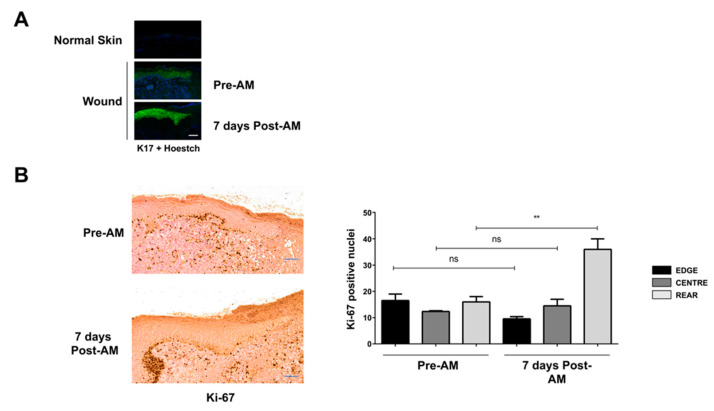
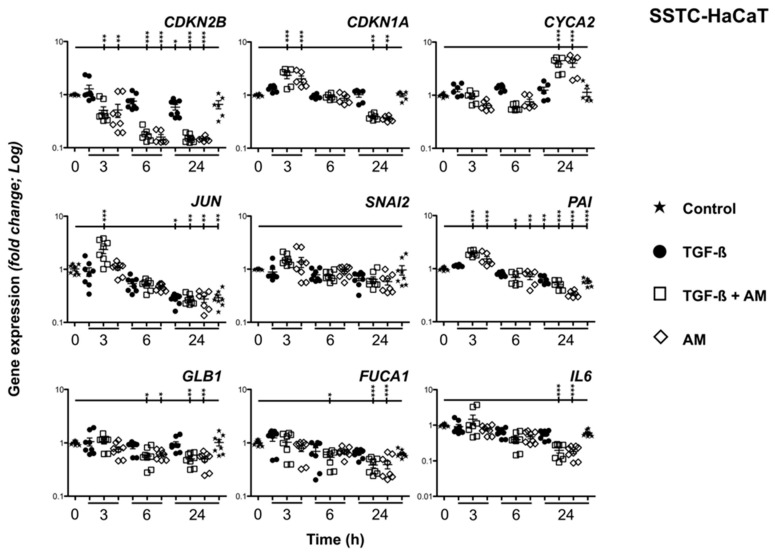
Unsuccessful wound closure in chronic wounds can be linked to altered keratinocyte activation and their inability to re-epithelize. Suggested mechanisms driving this impairment involve unbalanced cytokine signaling. However, the molecular events leading to these aberrant responses are poorly understood. Among cytokines affecting keratinocyte responses, Transforming Growth Factor-β (TFG-β) is thought to have a great impact. In this study, we have used a previously characterized skin epidermal in vitro model, HaCaT cells continuously exposed to TGF-β1, to study the wound recovery capabilities of chronified/senescent keratinocytes. In this setting, chronified keratinocytes show decreased migration and reduced activation in response to injury. Amniotic membrane (AM) has been used successfully to manage unresponsive complicated wounds. In our in vitro setting, AM treatment of chronified keratinocytes re-enabled migration in the early stages of wound healing, also promoting proliferation at later stages. Interestingly, when checking the gene expression of markers known to be altered in TGF-β chronified cells and involved in cell cycle regulation, early migratory responses, senescence, and chronic inflammation, we discovered that AM treatment seemed to reset back to keratinocyte status. The analysis of the evolution of both the levels of keratinocyte activation marker cytokeratin 17 and the spatial-temporal expression pattern of the proliferation marker Ki-67 in human in vivo biopsy samples suggests that responses to AM recorded in TGF-β chronified HaCaT cells would be homologous to those of resident keratinocytes in chronic wounds. All these results provide further evidence that sustained TGF-β might play a key role in wound chronification and postulate the validity of our TGF-β chronified HaCaT in vitro model for the study of chronic wound physiology.
慢性伤口中不成功的伤口闭合可能与角蛋白细胞激活改变及其无法再上皮化有关。驱动这种损伤的机制涉及不平衡的细胞因子信号。然而,导致这些异常反应的分子事件知之甚少。在影响角蛋白细胞反应的细胞因子中,转化生长因子-β(TGF-β)被认为具有很大的影响。在这项研究中,我们使用了先前表征的皮肤表皮体外模型,即持续暴露于 TGF-β1 的 HaCaT 细胞,研究了慢性/衰老角蛋白细胞的伤口恢复能力。在这种情况下,慢性角蛋白细胞显示出迁移减少和对损伤的反应性降低。羊膜(AM)已成功用于治疗无反应性复杂伤口。在我们的体外环境中,AM 处理慢性角蛋白细胞可在伤口愈合的早期重新启用迁移,同时在后期促进增殖。有趣的是,当检查已知在 TGF-β 慢性细胞中改变并参与细胞周期调节、早期迁移反应、衰老和慢性炎症的基因表达标记时,我们发现 AM 处理似乎将角蛋白细胞状态重置回。分析体内活检样本中角蛋白细胞激活标记物角蛋白 17 的水平和增殖标记物 Ki-67 的时空表达模式的演变表明,在 TGF-β 慢性 HaCaT 细胞中记录的 AM 反应与慢性伤口中常驻角蛋白细胞的反应是同源的。所有这些结果进一步证明持续的 TGF-β 可能在伤口慢性化中发挥关键作用,并假设我们的 TGF-β 慢性 HaCaT 体外模型用于慢性伤口生理学研究的有效性。