Department of Biomedical and Clinical Sciences, Università degli Studi di Milano, 20157 Milan, Italy.
Diabetes Research Institute, IRCCS Ospedale San Raffaele, 20132 Milan, Italy.
Int J Mol Sci. 2023 Apr 5;24(7):6779. doi: 10.3390/ijms24076779.
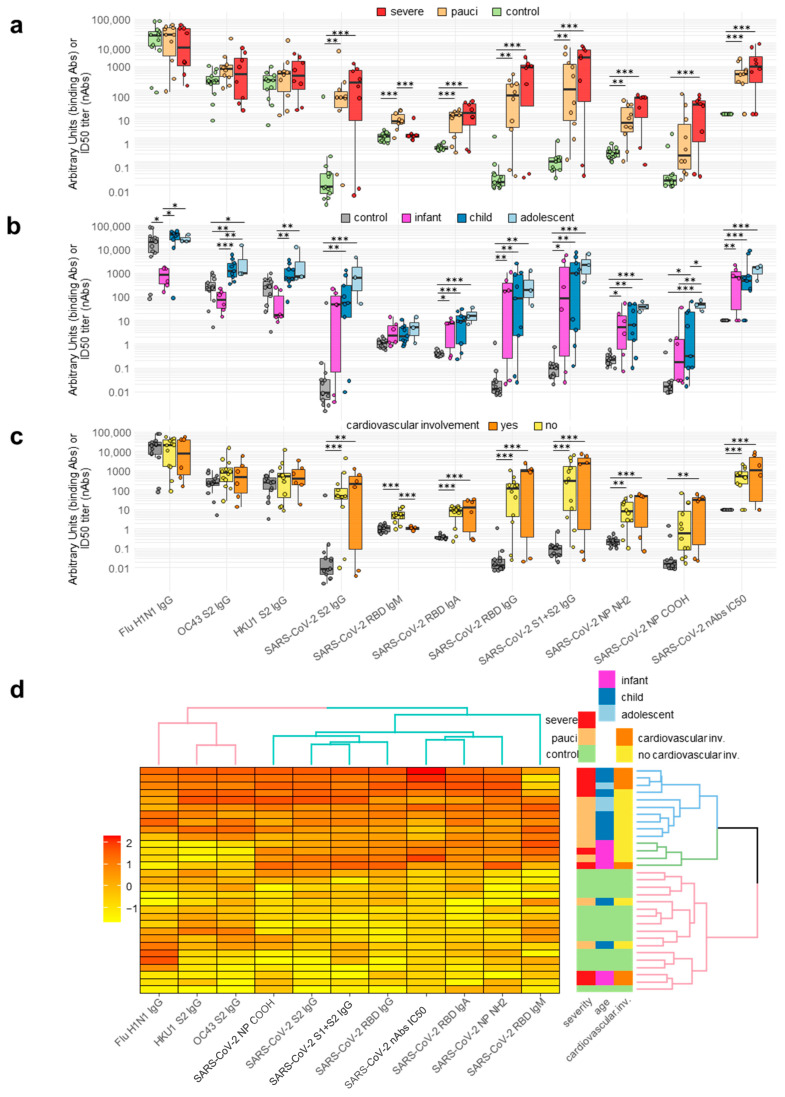
Coronavirus disease 19 (COVID-19) is clinically less severe in children, even if the wide variety and degree of severity of symptoms reported in children pose a still-unresolved challenge for clinicians. We performed an in-depth analysis of the immunological profiles of 18 hospitalized SARS-CoV-2-infected children, whose results were compared to those obtained from 13 age- and sex-matched healthy controls (HC). The patients were categorized as paucisymptomatic/moderate (55.6%) or severe/critical (44.5%) according to established diagnostic criteria and further stratified into the categories of infants (1-12 months), children (1-12 years), and adolescents (>12 years). We assessed SARS-CoV-2-specific RBD antibodies (Ab), neutralizing antibodies (nAb), and circulating cytokines/chemokines in the plasma, and the SARS-CoV-2-specific immune response was measured in PBMCs by gene expression and secretome analyses. Our results showed peculiar circulating cytokine/chemokine profiles among patients sharing a similar clinical phenotype. A cluster of patients consisting of infants with severe symptoms presented hyperinflammatory profiles, together with extremely polarized antibody profiles. In a second cluster consisting of paucisymptomatic patients, a less pronounced increase in the level of inflammatory cytokines, together with an association between the selected cytokines and humoral responses, was observed. A third cluster, again consisting of paucisymptomatic patients, showed a circulating cytokine/chemokine profile which overlapped with that of the HC. The SARS-CoV-2-stimulated production of pro-inflammatory proteins, T lymphocyte activation, and migration-specific proteins, were significantly increased in SARS-CoV-2-infected children compared to the HC. Our findings suggest that immune response activation in the course of SARS-CoV-2 infection in children is directly correlated with clinical severity and, to a lesser extent, age.
新型冠状病毒病 19(COVID-19)在儿童中临床症状较轻,尽管儿童报告的症状种类繁多且严重程度不同,但这仍然是临床医生面临的尚未解决的挑战。我们对 18 名住院的 SARS-CoV-2 感染儿童的免疫特征进行了深入分析,并将结果与 13 名年龄和性别匹配的健康对照(HC)进行了比较。根据既定的诊断标准,患者被分为症状轻微/中度(55.6%)或严重/危重症(44.5%),并进一步分为婴儿(1-12 个月)、儿童(1-12 岁)和青少年(>12 岁)。我们评估了血浆中的 SARS-CoV-2 特异性受体结合域抗体(Ab)、中和抗体(nAb)和循环细胞因子/趋化因子,并通过基因表达和分泌组分析测量了 PBMC 中的 SARS-CoV-2 特异性免疫反应。我们的结果显示,具有相似临床表型的患者存在独特的循环细胞因子/趋化因子谱。一组由重症婴儿组成的患者表现出炎症反应过度的特征,同时伴有极度极化的抗体谱。在另一组由症状轻微的患者组成的聚类中,观察到炎症细胞因子水平的增加不那么明显,并且选择的细胞因子与体液反应之间存在关联。第三组,也是由症状轻微的患者组成,其循环细胞因子/趋化因子谱与 HC 重叠。与 HC 相比,SARS-CoV-2 感染儿童中 SARS-CoV-2 刺激产生的促炎蛋白、T 淋巴细胞激活和迁移特异性蛋白显著增加。我们的研究结果表明,SARS-CoV-2 感染过程中儿童的免疫反应激活与临床严重程度直接相关,与年龄的相关性较小。