
评估一种基于蛋白酶K的提取方法用于检测人工污染乳制品中的甲型肝炎病毒、戊型肝炎病毒和诺如病毒。
Evaluation of a Proteinase K-Based Extraction Method to Detect Hepatitis A Virus, Hepatitis E Virus and Norovirus in Artificially Contaminated Dairy Products.
作者信息
Hennechart-Collette Catherine, Fourniol Lisa, Fraisse Audrey, Martin-Latil Sandra, Perelle Sylvie
机构信息
Laboratory for Food Safety, Université Paris-Est, Anses, F-94700 Maisons-Alfort, France.
出版信息
Foods. 2023 Apr 1;12(7):1489. doi: 10.3390/foods12071489.
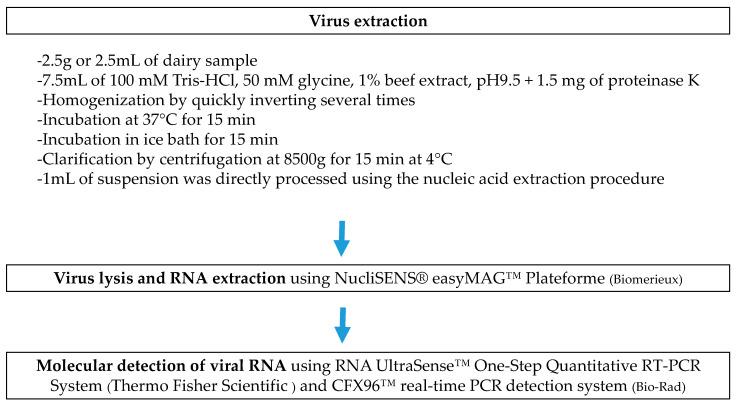
Human norovirus and hepatitis viruses (hepatitis A (HAV) and hepatitis E (HEV)) are leading causes of foodborne disease worldwide. Among the various food products, different types of dairy products can be implicated in viral foodborne outbreaks and contamination can occur at different stages, such as preparation, contact with contaminated equipment or via other foods. The aim of this study was to characterise a proteinase K method adapted from the ISO 15216 method for the detection of HAV, HEV and norovirus in artificially contaminated dairy products, based on the recent international standard of ISO 16140-4. Results showed that the recovery yields obtained from pure RNA in dairy products ranged from 5.76% to 76.40% for HAV, from 35.09% to 100.00% for HEV, from 25.09% to 100.00% for norovirus GI and from 47.83% to 100.00% for norovirus GII. The process control MNV-1 was detected in all RNA extracts, with recovery yields between 36.83% and 100.00%. The limit of detection (LOD) of the method was between 184 and 642 genome copies/mL (or/g) for the LOD and 802 and 2800 genome copies/mL or/g for the LOD according to the virus analysed. This method proved to be suitable for detecting viruses in dairy products for routine diagnostic needs.
人诺如病毒和肝炎病毒(甲型肝炎病毒(HAV)和戊型肝炎病毒(HEV))是全球食源性疾病的主要病因。在各类食品中,不同类型的乳制品可能引发病毒性食源性疾病暴发,且污染可能发生在不同阶段,如制备过程、与受污染设备接触或通过其他食品传播。本研究的目的是根据ISO 16140-4的最新国际标准,对一种从ISO 15216方法改编而来的蛋白酶K方法进行特性分析,用于检测人工污染乳制品中的HAV、HEV和诺如病毒。结果表明,从乳制品中的纯RNA获得的回收率,HAV为5.76%至76.40%,HEV为35.09%至100.00%,诺如病毒GI为25.09%至100.00%,诺如病毒GII为47.83%至100.00%。在所有RNA提取物中均检测到过程对照MNV-1,回收率在36.83%至100.00%之间。根据所分析的病毒,该方法的检测限(LOD)在184至642个基因组拷贝/毫升(或/克)之间(用于LOD),在802至2800个基因组拷贝/毫升或/克之间(用于LOD)。该方法被证明适用于检测乳制品中的病毒,以满足常规诊断需求。

 Zotero 插件