Matsumoto Shuji, Shimodozono Megumi, Noma Tomokazu, Miyara Kodai, Onoda Tetsuya, Ijichi Rina, Shigematsu Takashi, Satone Akira, Okuma Hidenobu, Seto Makiko, Taketsuna Masanori, Kaneda Hideaki, Matsuo Miyuki, Kojima Shinsuke
Center of Medical Education, Faculty of Health Sciences, Ryotokuji University, Chiba 279-8567, Japan.
Department of Rehabilitation and Physical Medicine, Mito Clinical Education and Training Center, University of Tsukuba Hospital, Mito 310-0015, Japan.
J Clin Med. 2023 Apr 1;12(7):2638. doi: 10.3390/jcm12072638.
We evaluated whether the Walkaide device could effectively improve walking ability and lower extremity function in post-stroke patients with foot drop. Patients aged 20-85 years with an initial stroke within ≤6 months and a functional ambulation classification score of 3 or 4 were eligible.
Patients were randomly allocated to the functional electrical stimulation (FES) or control group at a 1:1 ratio. A 40 min training program using Walkaide was additionally performed by the FES group five times per week for 8 weeks. The control group received the 40 min training program without FES.
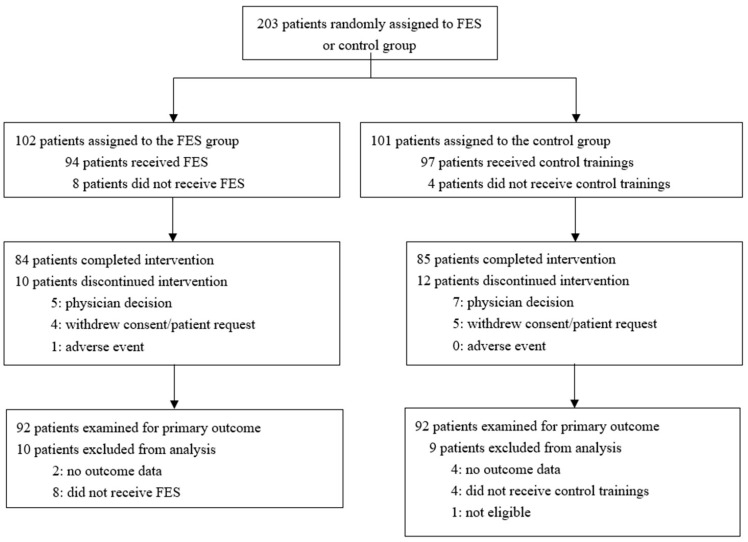
A total of 203 patients were allocated to the FES ( = 102) or control ( = 101) groups. Patients who did not receive the intervention or whose data were unavailable were excluded. Finally, the primary outcome data of 184 patients ( = 92 in each group) were analyzed. The mean change in the maximum distance during the 6-MWT (primary outcome) was 68.37 ± 62.42 m and 57.50 ± 68.17 m in the FES and control groups (difference: 10.86 m; 95% confidence interval: -8.26 to 29.98, = 0.26), respectively.
In Japanese post-stroke patients with foot drop, FES did not significantly improve the 6 min walk distance during the convalescent phase. The trial was registered at UMIN000020604.
我们评估了Walkaide设备能否有效改善中风后足下垂患者的步行能力和下肢功能。年龄在20 - 85岁之间、首次中风发生在≤6个月内且功能步行分类评分为3或4分的患者符合条件。
患者按1:1比例随机分配至功能性电刺激(FES)组或对照组。FES组每周额外进行5次、每次40分钟使用Walkaide的训练项目,共8周。对照组接受无FES的40分钟训练项目。
共有203例患者被分配至FES组(n = 102)或对照组(n = 101)。未接受干预或数据不可用的患者被排除。最终,分析了184例患者(每组92例)的主要结局数据。FES组和对照组在6分钟步行试验(主要结局)中最大距离的平均变化分别为68.37±62.42米和57.50±68.17米(差异:10.86米;95%置信区间:-8.26至29.98,P = 0.26)。
在日本中风后足下垂患者中,FES在恢复期并未显著改善6分钟步行距离。该试验在UMIN000020604注册。