
中性粒细胞胞外诱捕网形成增加在 COVID-19 患者急性肾损伤中的作用。
Role of increased neutrophil extracellular trap formation on acute kidney injury in COVID-19 patients.
机构信息
Department of Internal Medicine & Kidney Research Institute, Hallym University Sacred Heart Hospital, Anyang, Republic of Korea.
Division of Infectious Diseases, Department of Internal Medicine, Hallym University Sacred Heart Hospital, Anyang, Republic of Korea.
出版信息
Front Immunol. 2023 Mar 27;14:1122510. doi: 10.3389/fimmu.2023.1122510. eCollection 2023.
BACKGROUND
A strong association between elevated neutrophil extracellular trap (NET) levels and poor clinical outcomes in patients with coronavirus infection 2019 (COVID-19) has been reported. However, while acute kidney injury (AKI) is a common complication of COVID-19, the role of NETs in COVID-19-associated AKI is unclear. We investigated the association between elevated NETs and AKI and the prognostic role of NETs in COVID-19 patients.
METHODS
Two representative markers of NETs, circulating nucleosomes and myeloperoxidase-DNA, were measured in 115 hospitalized patients. Serum levels of interleukin [IL]-6, monocyte chemotactic protein-1 [MCP-1], plasma von Willebrand factor (vWF) and urinary biomarkers of renal tubular damage (β2-microglobulin [β2M] and kidney injury molecule 1 [KIM-1]) were measured.
RESULTS
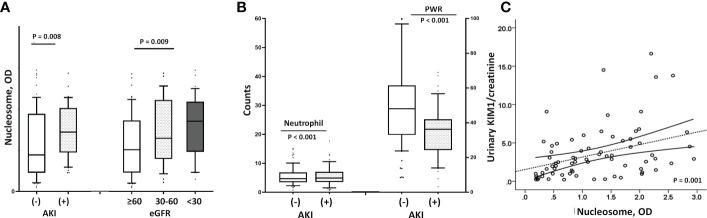
AKI was found in 43 patients (37.4%), and pre-existing chronic kidney disease (CKD) was a strong risk factor for AKI. Higher circulating NET levels were a significant predictor of increased risk of initial ICU admission, in-hospital mortality (adjusted HR 3.21, 95% CI 1.08-9.19) and AKI (OR 3.67, 95% CI 1.30-10.41), independent of age, diabetes, pre-existing CKD and IL-6 levels. There were strong correlations between circulating nucleosome levels and urinary KIM-1/creatinine (r=0.368, p=0.001) and β2M (r=0.218, p=0.049) levels. NETs were also strongly closely associated with serum vWF (r = 0.356, p<0.001), but not with IL-6 or MCP-1 levels.
CONCLUSIONS
Elevated NETs were closely associated with AKI, which was a strong predictor of mortality. The close association between NETs and vWF may suggest a role for NETs in COVID-19-associated vasculopathy leading to AKI.
背景
有报道称,中性粒细胞胞外诱捕网(NET)水平升高与 2019 年冠状病毒病(COVID-19)患者的临床预后不良密切相关。然而,虽然急性肾损伤(AKI)是 COVID-19 的常见并发症,但 NET 在 COVID-19 相关 AKI 中的作用尚不清楚。我们研究了升高的 NET 与 AKI 的关系以及 NET 在 COVID-19 患者中的预后作用。
方法
在 115 名住院患者中测量了两个代表性的 NET 标志物,即循环核小体和髓过氧化物酶-DNA。测量了血清白细胞介素[IL]-6、单核细胞趋化蛋白-1[MCP-1]、血浆血管性血友病因子(vWF)和肾小管损伤的尿生物标志物(β2-微球蛋白[β2M]和肾损伤分子 1[KIM-1])。
结果
发现 43 名患者(37.4%)存在 AKI,且预先存在的慢性肾脏病(CKD)是 AKI 的强烈危险因素。较高的循环 NET 水平是初始 ICU 入院、住院死亡率(调整后的 HR 3.21,95%CI 1.08-9.19)和 AKI(OR 3.67,95%CI 1.30-10.41)风险增加的显著预测因子,独立于年龄、糖尿病、预先存在的 CKD 和 IL-6 水平。循环核小体水平与尿 KIM-1/肌酐(r=0.368,p=0.001)和β2M(r=0.218,p=0.049)水平之间存在很强的相关性。NET 也与血清 vWF 密切相关(r = 0.356,p<0.001),但与 IL-6 或 MCP-1 水平无关。
结论
升高的 NET 与 AKI 密切相关,AKI 是死亡率的强预测因子。NET 与 vWF 之间的密切关系可能表明 NET 在 COVID-19 相关血管病导致 AKI 中的作用。


 Zotero 插件