Yoo Jimin, Shim Dong Jae, Kim Doyoung, Baek Seung Hwan, Park Chang Suk, Lee Jeong Whee
J Korean Soc Radiol. 2023 Mar;84(2):477-482. doi: 10.3348/jksr.2022.0096. Epub 2023 Feb 14.
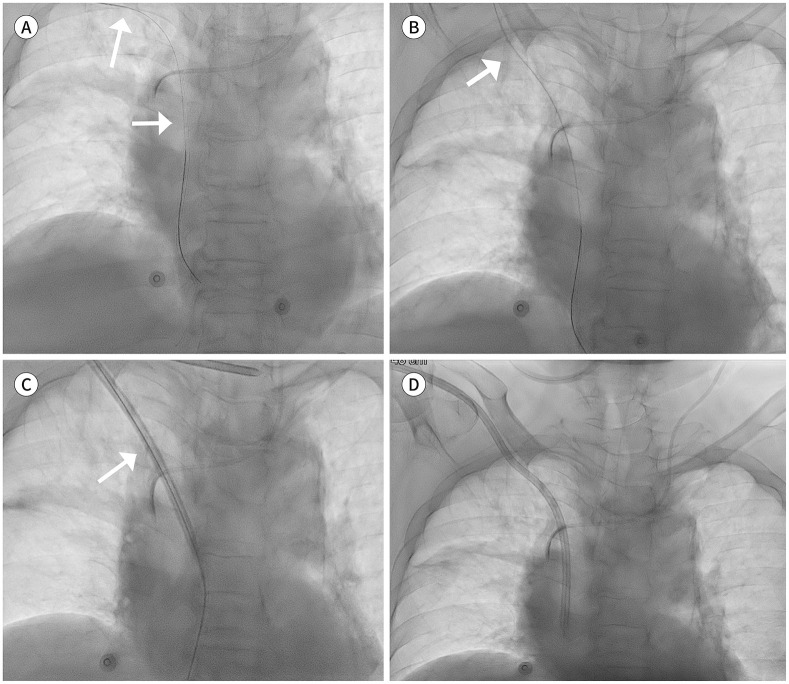
The subclavian vein is an uncommon route for tunneled hemodialysis catheter (tHDC) placement because of its potency for future dialysis access. However, when favored access routes have been exhausted because of repeated catheterization or limited life expectancy, the subclavian vein can be used for urgent hemodialysis. A subclavian catheterization has a technical problem. The subclavian vein often forms a right angle with the vena cava, and advancing stiff peel-away sheath can cause a vascular injury. However, raising the patient's arm can alter the position of the guidewire and, therefore, change the angle of the vein favorable for tHDC placement. Herein, we report two patients who underwent subclavian catheterization; one experienced an injury to the superior vena cava after undergoing the conventional procedure, whereas the other patient with raised arm during the catheterization procedure had safe catheter placement.
由于锁骨下静脉对未来的透析通路有重要作用,所以它是隧道式血液透析导管(tHDC)置入的一条不常用途径。然而,当由于反复置管或预期寿命有限而使常用的通路途径无法使用时,锁骨下静脉可用于紧急血液透析。锁骨下静脉置管存在一个技术问题。锁骨下静脉通常与腔静脉形成直角,推进硬的可剥离鞘管可能会导致血管损伤。然而,抬高患者的手臂可以改变导丝的位置,从而改变有利于tHDC置入的静脉角度。在此,我们报告两名接受锁骨下静脉置管的患者;其中一名在接受常规操作后发生上腔静脉损伤,而另一名在置管过程中抬高手臂的患者则安全地完成了导管置入。