Public Health, Department of Social Medicine, Osaka University Graduate School of Medicine, 2-2 Yamadaoka, Suita, Osaka, 565-0871, Japan.
Pain Medicine, Juntendo University Graduate School of Medicine, Tokyo, Japan.
Sci Rep. 2023 Apr 13;13(1):6068. doi: 10.1038/s41598-023-32945-2.
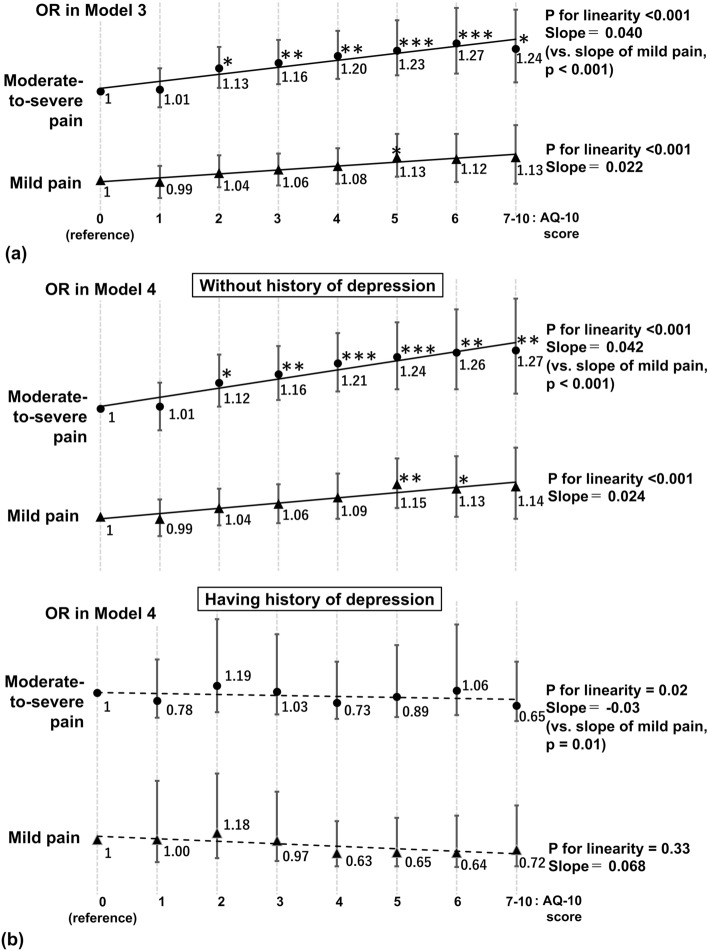
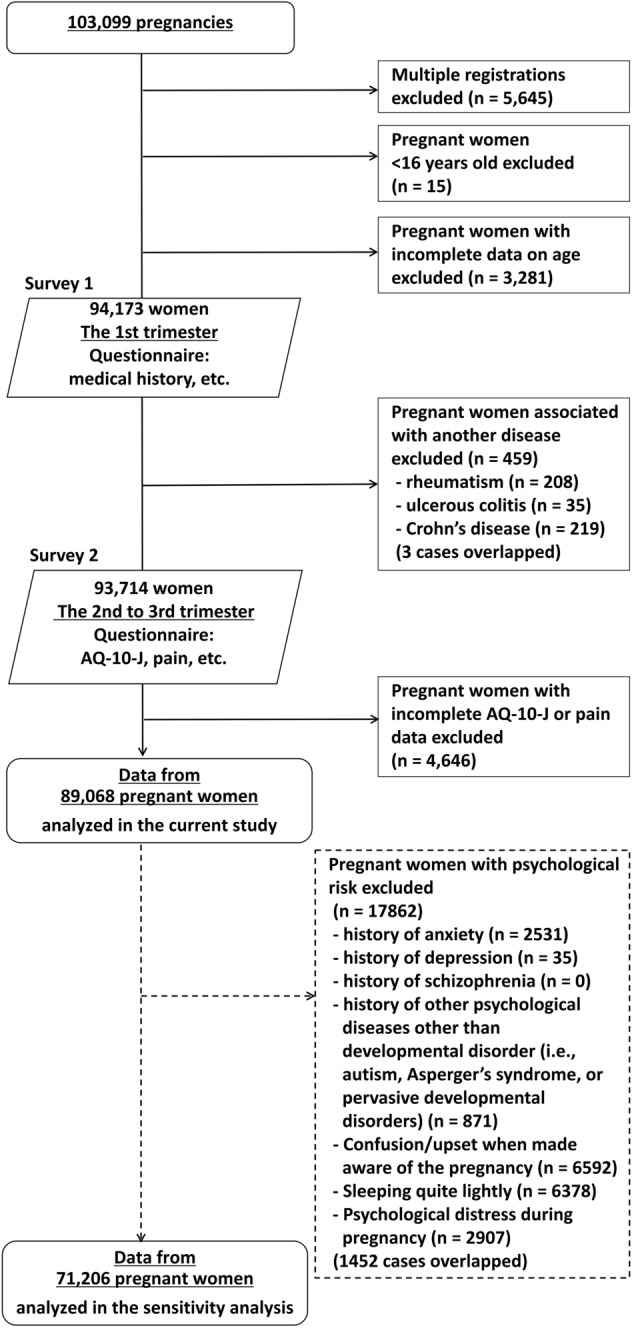
The aim of cross-sectional study was to investigate whether the presence of autistic traits in pregnant women was positively associated with the prevalence and severity of antenatal pain. We analyzed 89,068 pregnant women from a Japanese national birth cohort cross-sectionally. Autistic traits were assessed using the Japanese version of the Autism-Spectrum Quotient short form (AQ-10-J). Antenatal pain was measured using the SF-8 bodily pain item (SF-8-Pain). Antenatal pain in the second to third trimester during pregnancy was categorized into three groups: without pain, mild pain, and moderate-to-severe pain. Participants were divided into eight groups by AQ-10-J score: seven consecutive scoring groups (scores 0-6), and those above the cut-off (≥ 7) for probable autistic spectrum disorders. Odds ratios (OR) for the prevalence of mild and moderate-to-severe pain were calculated for each AQ-10-J scoring group (reference: without pain group) using multinominal logistic regression analysis. Autistic traits were positively associated with mild and moderate-to-severe pain in a dose-response manner, but the association with moderate-to-severe pain was strongest. Fully-adjusted ORs (95% confidence intervals) for moderate-to-severe pain were: 1.01 (0.91-1.13) for 1 point, 1.13 (1.02-1.25) for 2 points, 1.16 (1.04-1.29) for 3 points, 1.20 (1.07-1.34) for 4 points, 1.23 (1.09-1.40) for 5 points, 1.27 (1.10-1.47) for 6 points, and 1.24 (1.05-1.46) for ≥ 7 points (AQ-10-J cut-off). We identified an association between maternal autistic traits and antenatal pain. Maternal autistic traits may need to be considered when addressing antenatal pain during healthcare for expectant mothers.
这项横断面研究的目的是探讨孕妇是否存在自闭症特征与产前疼痛的患病率和严重程度之间是否存在正相关。我们对来自日本全国出生队列的 89068 名孕妇进行了横断面分析。自闭症特征使用日本版自闭症谱系商数短表(AQ-10-J)进行评估。产前疼痛使用 SF-8 身体疼痛项目(SF-8-Pain)进行测量。将妊娠中期至晚期的产前疼痛分为三组:无疼痛、轻度疼痛和中重度疼痛。根据 AQ-10-J 评分,将参与者分为八组:七个连续评分组(评分 0-6)和自闭症谱系障碍可能存在的评分≥7 的组。使用多项逻辑回归分析计算每个 AQ-10-J 评分组(参考:无疼痛组)中轻度和中重度疼痛的患病率比值比(OR)。自闭症特征与轻度和中重度疼痛呈剂量反应关系,但与中重度疼痛的关联最强。中重度疼痛的完全调整比值比(95%置信区间)为:1 分(0.91-1.13)、2 分(1.02-1.25)、3 分(1.16-1.29)、4 分(1.20-1.34)、5 分(1.23-1.40)、6 分(1.27-1.47)、≥7 分(AQ-10-J 截止值)(1.24-1.05-1.46)。我们发现母亲自闭症特征与产前疼痛之间存在关联。在为孕妇提供医疗保健时,可能需要考虑母亲的自闭症特征与产前疼痛之间的关系。