Department of Pharmacology and Toxicology, Medical College of Wisconsin, Milwaukee, Wisconsin, USA.
Department of Pediatrics and Human Development, College of Human Medicine, Michigan State University, Grand Rapids, Michigan, USA.
J Biol Chem. 2023 Jun;299(6):104698. doi: 10.1016/j.jbc.2023.104698. Epub 2023 Apr 12.
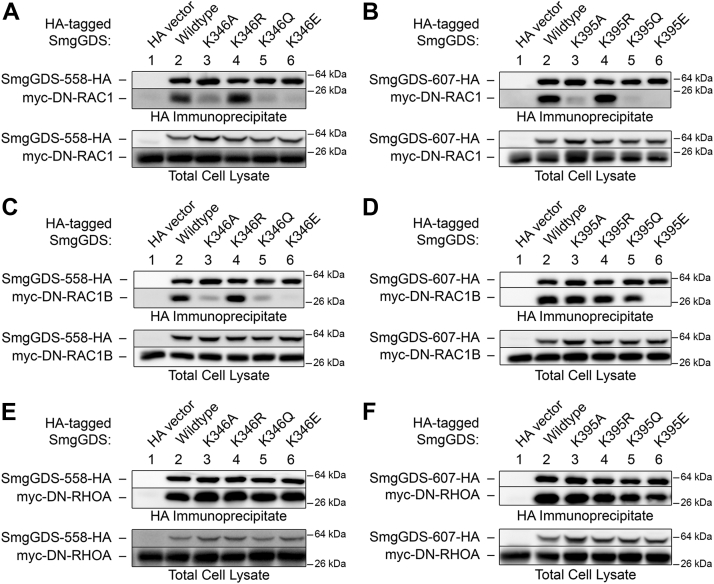
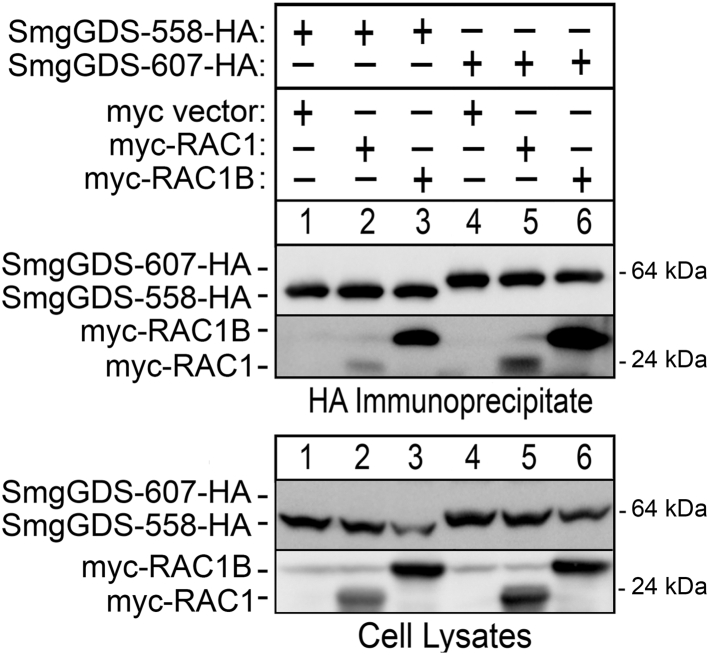
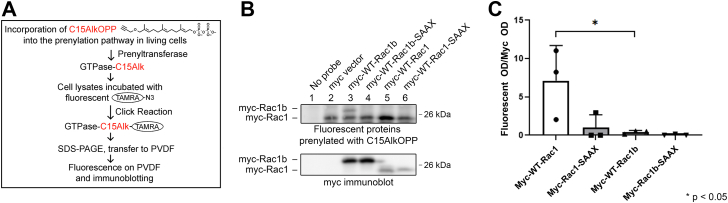
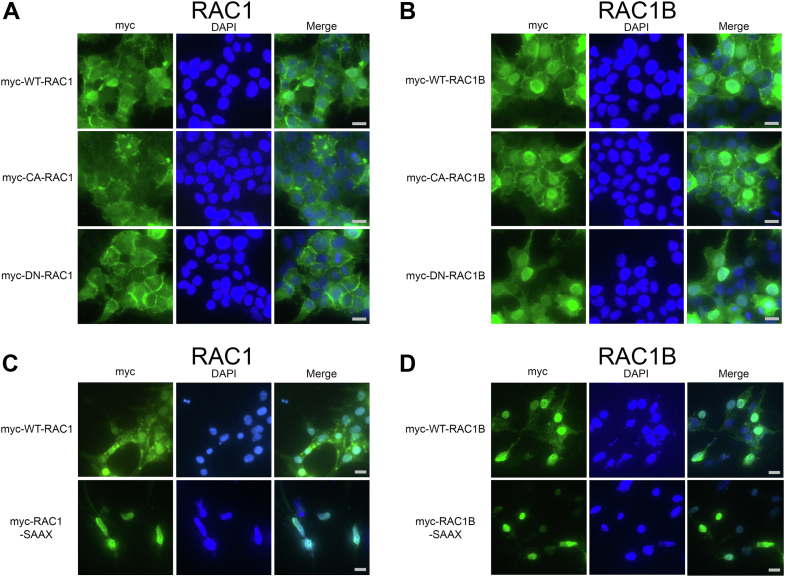
Identifying events that regulate the prenylation and localization of small GTPases will help define new strategies for therapeutic targeting of these proteins in disorders such as cancer, cardiovascular disease, and neurological deficits. Splice variants of the chaperone protein SmgGDS (encoded by RAP1GDS1) are known to regulate prenylation and trafficking of small GTPases. The SmgGDS-607 splice variant regulates prenylation by binding preprenylated small GTPases but the effects of SmgGDS binding to the small GTPase RAC1 versus the splice variant RAC1B are not well defined. Here we report unexpected differences in the prenylation and localization of RAC1 and RAC1B and their binding to SmgGDS. Compared to RAC1, RAC1B more stably associates with SmgGDS-607, is less prenylated, and accumulates more in the nucleus. We show that the small GTPase DIRAS1 inhibits binding of RAC1 and RAC1B to SmgGDS and reduces their prenylation. These results suggest that prenylation of RAC1 and RAC1B is facilitated by binding to SmgGDS-607 but the greater retention of RAC1B by SmgGDS-607 slows RAC1B prenylation. We show that inhibiting RAC1 prenylation by mutating the CAAX motif promotes RAC1 nuclear accumulation, suggesting that differences in prenylation contribute to the different nuclear localization of RAC1 versus RAC1B. Finally, we demonstrate RAC1 and RAC1B that cannot be prenylated bind GTP in cells, indicating that prenylation is not a prerequisite for activation. We report differential expression of RAC1 and RAC1B transcripts in tissues, consistent with these two splice variants having unique functions that might arise in part from their differences in prenylation and localization.
鉴定调控小 GTP 酶的类异戊二烯化和定位的事件,将有助于确定针对癌症、心血管疾病和神经功能缺损等疾病中这些蛋白质的治疗靶向的新策略。伴侣蛋白 SmgGDS(由 RAP1GDS1 编码)的剪接变体已知可调节小 GTP 酶的类异戊二烯化和运输。SmgGDS-607 剪接变体通过结合预类异戊二烯化的小 GTP 酶来调节类异戊二烯化,但 SmgGDS 与小 GTP 酶 RAC1 而非剪接变体 RAC1B 的结合的效果尚未明确界定。在这里,我们报告了 RAC1 和 RAC1B 的类异戊二烯化和定位以及它们与 SmgGDS 结合的意外差异。与 RAC1 相比,RAC1B 更稳定地与 SmgGDS-607 结合,类异戊二烯化程度较低,并且更多地积累在核内。我们表明,小 GTP 酶 DIRAS1 抑制 RAC1 和 RAC1B 与 SmgGDS 的结合,并减少它们的类异戊二烯化。这些结果表明,RAC1 和 RAC1B 的类异戊二烯化是通过与 SmgGDS-607 结合来促进的,但 SmgGDS-607 对 RAC1B 的保留更多会减缓 RAC1B 的类异戊二烯化。我们表明,通过突变 CAAX 基序来抑制 RAC1 的类异戊二烯化可促进 RAC1 的核积累,表明类异戊二烯化的差异导致 RAC1 与 RAC1B 的核定位不同。最后,我们证明不能进行类异戊二烯化的 RAC1 和 RAC1B 在细胞中结合 GTP,表明类异戊二烯化不是激活的先决条件。我们报告了组织中 RAC1 和 RAC1B 转录本的差异表达,这与这两种剪接变体具有独特的功能一致,这些功能可能部分源于它们在类异戊二烯化和定位方面的差异。