Department of Pharmacy, Taipei Veterans General Hospital, Taipei, Taiwan.
Department and Institute of Pharmacology, College of Medicine, National Yang Ming Chiao Tung University, Taipei, Taiwan.
Cancer Med. 2023 Jun;12(11):12354-12364. doi: 10.1002/cam4.5936. Epub 2023 Apr 16.
Taiwanese patients frequently experience severe hepatotoxicity associated with high-dose methotrexate (HD-MTX) treatment, which interferes with subsequent treatment. Drug-drug interactions occur when MTX is used in combination with proton pump inhibitors (PPIs), trimethoprim-sulfamethoxazole (TMP-SMX), or non-steroidal anti-inflammatory drugs (NSAIDs). In East Asia, real-world analyses on the effects of co-medication and other potential risk factors on the clinical course of HD-MTX-mediated acute hepatotoxicity in patients with osteogenic sarcoma (OGS) are limited.
This cohort study included patients with newly diagnosed OGS who were treated with HD-MTX between 2009 and 2017 at Taipei Veterans General Hospital. We collected data on the clinical course of HD-MTX-mediated acute hepatotoxicity, co-medications, and other potential risk factors, and analyzed the effects of these factors on the clinical course of HD-MTX-mediated acute hepatotoxicity.
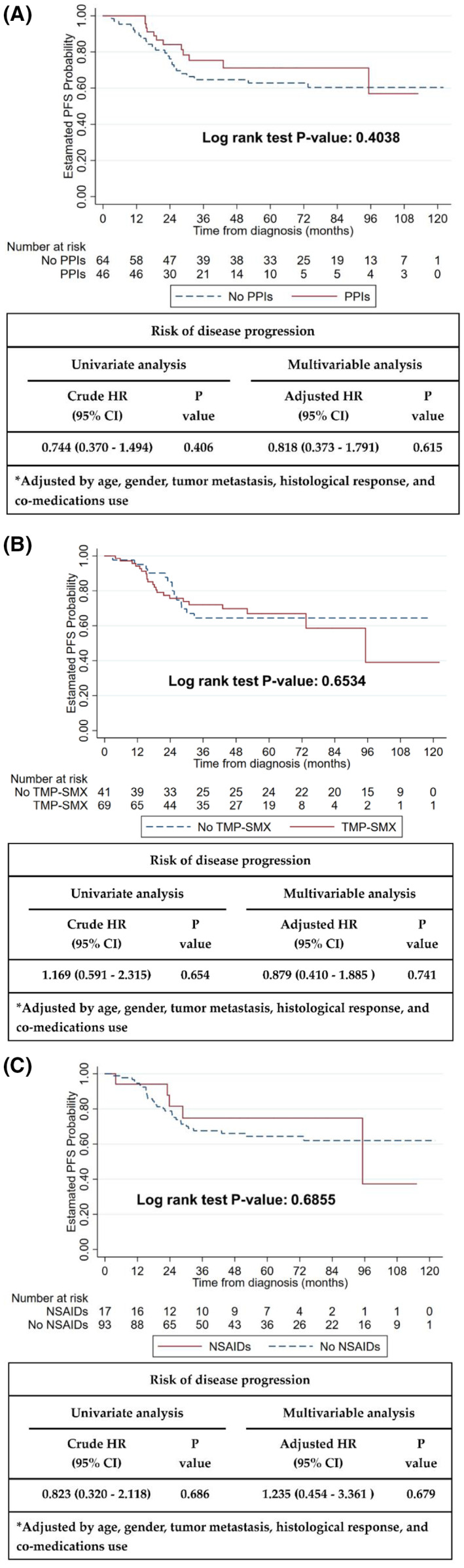
Almost all patients with OGS treated with HD-MTX developed acute hepatotoxicity with elevated alanine aminotransferase (ALT) levels. Most patients with Grade 3-4 ALT elevation failed to recover to Grade 2 within 7 days. Women and children are high-risk subgroups for HD-MTX-mediated elevation of ALT levels. Age is a factor that contributes to the pharmacokinetic differences of HD-MTX. However, the concurrent use of PPIs, TMP-SMX, or NSAIDs did not affect the elimination of MTX when administered with adequate supportive therapy.
Co-administration of PPIs, TMP-SMX, or NSAIDs may have limited effects on acute hepatotoxicity in well-monitored and adequately pre-medicated patients with OGS undergoing chemotherapy with HD-MTX. Clinicians should pay particular attention to ALT levels when prescribing HD-MTX to children and women.
台湾患者在接受高剂量甲氨蝶呤(HD-MTX)治疗时常出现严重肝毒性,从而干扰后续治疗。当 MTX 与质子泵抑制剂(PPIs)、甲氧苄啶-磺胺甲恶唑(TMP-SMX)或非甾体抗炎药(NSAIDs)联合使用时,会发生药物相互作用。在东亚,关于联合用药和其他潜在危险因素对骨肉瘤(OGS)患者接受 HD-MTX 治疗后急性肝毒性临床过程的影响,真实世界分析有限。
本队列研究纳入了 2009 年至 2017 年在台北荣民总医院接受 HD-MTX 治疗的新诊断为 OGS 的患者。我们收集了关于 HD-MTX 介导的急性肝毒性的临床过程、联合用药和其他潜在危险因素的数据,并分析了这些因素对 HD-MTX 介导的急性肝毒性临床过程的影响。
几乎所有接受 HD-MTX 治疗的 OGS 患者均出现了丙氨酸氨基转移酶(ALT)水平升高的急性肝毒性。大多数 ALT 升高 3-4 级的患者在 7 天内未能恢复到 2 级。女性和儿童是 HD-MTX 引起 ALT 水平升高的高风险亚组。年龄是导致 HD-MTX 药代动力学差异的一个因素。然而,在给予充分支持治疗时,同时使用 PPI、TMP-SMX 或 NSAIDs 并不会影响 MTX 的消除。
在接受 HD-MTX 化疗的 OGS 患者中,联合使用 PPI、TMP-SMX 或 NSAIDs 可能对急性肝毒性的影响有限,这些患者在接受密切监测和充分预用药时。临床医生在为儿童和女性开具 HD-MTX 处方时应特别注意 ALT 水平。