Liu Yixiao, Jin Bo, Shen Cheng, Gao Xianshu, Qi Xin, Ma Mingwei, Li Hongzhen, Hao Han, Tang Qi, Yang Kaiwei, Mi Yue, Guan Jie, Feng Xuero, He Zhisong, Li Haixia, Yu Wei
Department of Urology, Peking University First Hospital, Peking University, Beijing, China.
Institute of Urology, Peking University, Beijing, China.
Front Oncol. 2023 Mar 29;13:1086517. doi: 10.3389/fonc.2023.1086517. eCollection 2023.
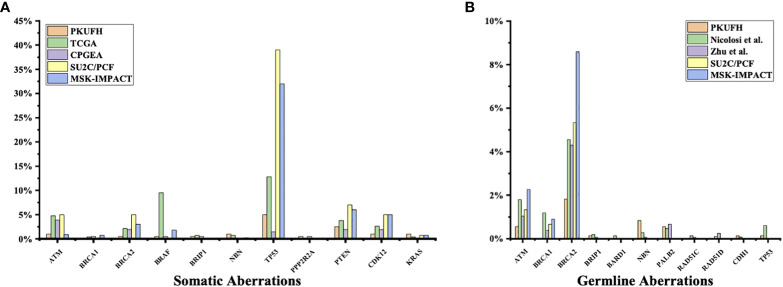
Somatic and germline aberrations in homologous recombinant repair (HHR) genes are associated with increased incidence and poor prognosis for prostate cancer. Through next-generation sequencing of prostate cancer patients across all clinical states from north China, here the authors identified a somatic mutational rate of 3% and a germline mutational rate of 3.9% for HRR genes using 200 tumor tissues and 714 blood specimens. Thus, mutational rates in HRR genes were lower compared with previous studies.
Homologous recombination repair deficiency is associated with higher risk and poorer prognosis for prostate cancer. However, the landscapes of somatic and germline mutations in these genes remain poorly defined in Chinese patients, especially for those with localized disease and those from north part of China. In this study, we explore the genomic profiles of these patients.
We performed next-generation sequencing with 200 tumor tissues and 714 blood samples from prostate cancer patients at Peking University First Hospital, using a 32 gene panel including 19 homologous recombination repair genes.
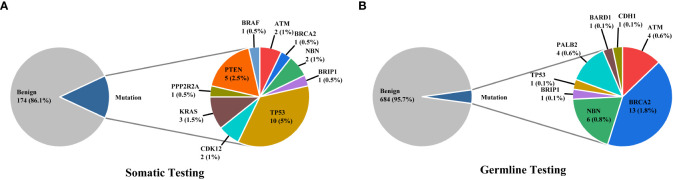
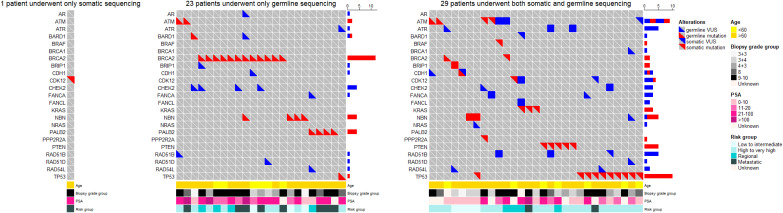
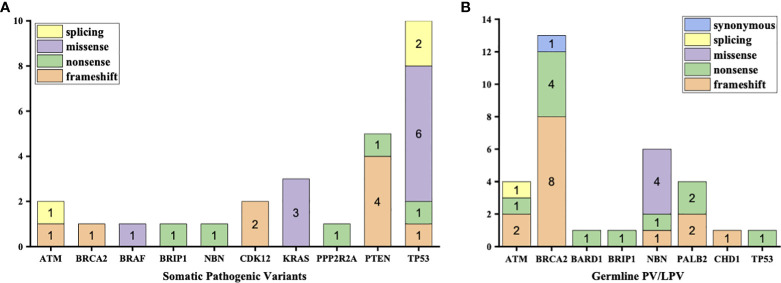
TP53, PTEN, KRAS were the most common somatic aberrations; BRCA2, NBN, ATM were the most common germline aberrations. In terms of HRR genes, 3% (6/200) patients harbored somatic aberrations, and 3.8% (28/714) patients harbored germline aberrations. 98.0% (196/200) somatic-tested and 72.7% (519/714) germline tested patients underwent prostatectomy, of which 28.6% and 42.0% had Gleason scores ≥8 respectively. Gleason scores at either biopsy or prostatectomy were predictive for somatic aberrations in general and in TP53; while age of onset <60 years old, PSA at diagnosis, and Gleason scores at biopsy were clinical factors associated with positive germline aberrations in BRCA2/ATM.
Our results showed a distinct genomic profile in homologous recombination repair genes for patients with prostate cancer across all clinical states from north China. Clinicians may consider to expand the prostate cancer patients receiving genetic tests to include more individuals due to the weak guiding role by the clinical factors currently available.
同源重组修复(HHR)基因中的体细胞和种系畸变与前列腺癌的发病率增加和预后不良有关。通过对来自中国北方所有临床状态的前列腺癌患者进行下一代测序,作者在这里使用200个肿瘤组织和714份血液标本确定了HRR基因的体细胞突变率为3%,种系突变率为3.9%。因此,与先前的研究相比,HRR基因的突变率较低。
同源重组修复缺陷与前列腺癌的更高风险和更差预后相关。然而,这些基因中的体细胞和种系突变情况在中国患者中仍不清楚,特别是对于那些局限性疾病患者和来自中国北方的患者。在本研究中,我们探索了这些患者的基因组概况。
我们使用包含19个同源重组修复基因的32基因面板,对北京大学第一医院的200个前列腺癌患者的肿瘤组织和714份血液样本进行了下一代测序。
TP53、PTEN、KRAS是最常见的体细胞畸变;BRCA2、NBN、ATM是最常见的种系畸变。就HRR基因而言,3%(6/200)的患者存在体细胞畸变,3.8%(28/714)的患者存在种系畸变。98.0%(196/200)接受体细胞检测的患者和72.7%(519/714)接受种系检测的患者接受了前列腺切除术,其中分别有28.6%和42.0%的患者Gleason评分≥8。活检或前列腺切除时的Gleason评分通常可预测体细胞畸变以及TP53中的畸变;而发病年龄<60岁、诊断时的PSA以及活检时的Gleason评分是与BRCA2/ATM中种系畸变阳性相关的临床因素。
我们的结果显示,来自中国北方所有临床状态的前列腺癌患者在同源重组修复基因方面具有独特的基因组概况。由于目前可用的临床因素指导作用较弱,临床医生可能会考虑扩大接受基因检测的前列腺癌患者范围,以纳入更多个体。