Nicolazzo Chiara, Magri Valentina, Marino Luca, Belardinilli Francesca, Di Nicolantonio Federica, De Renzi Gianluigi, Caponnetto Salvatore, De Meo Michela, Giannini Giuseppe, Santini Daniele, Cortesi Enrico, Gazzaniga Paola
Lab. Liquid Biopsy, Department of Molecular Medicine, Sapienza University of Rome, Rome, Italy.
Department of Radiology, Oncology and Pathology, Sapienza University, Rome, Italy.
Front Oncol. 2023 Mar 29;13:1160673. doi: 10.3389/fonc.2023.1160673. eCollection 2023.
The term "neo- wild-type" refers to the switch to wild-type disease in plasma circulating tumor DNA (ctDNA) from originally mutant colorectal cancers. Consistently, the hypothesis to re-determine mutational status in ctDNA at disease progression in RAS mutant mCRC opened to a new perspective for clinically-based selection of patients to be treated with EGFR inhibitors. Currently, the genomic landscape of "neo- wild-type" is unknown. This is a prospective study aimed to investigate clinical and genomic features associated with mutation clearance in a large cohort of mutant mCRC patients who converted to wild- type in liquid biopsy at failure of first-line treatments. Secondary aim was to investigate the long term prognostic significance of "true neo-- type".
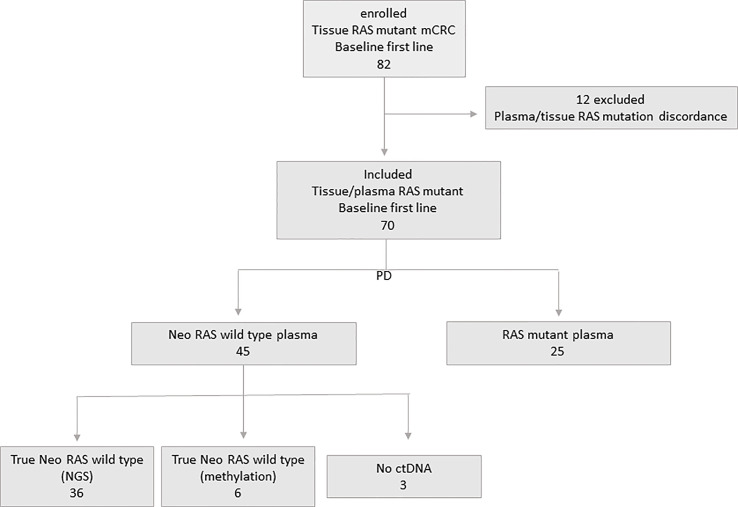
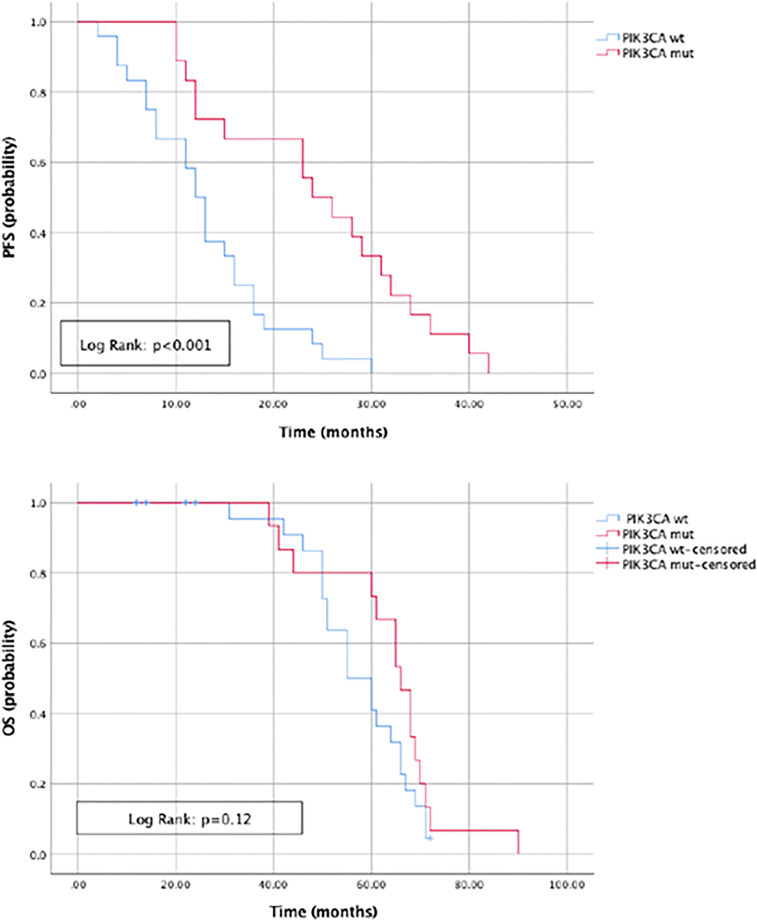
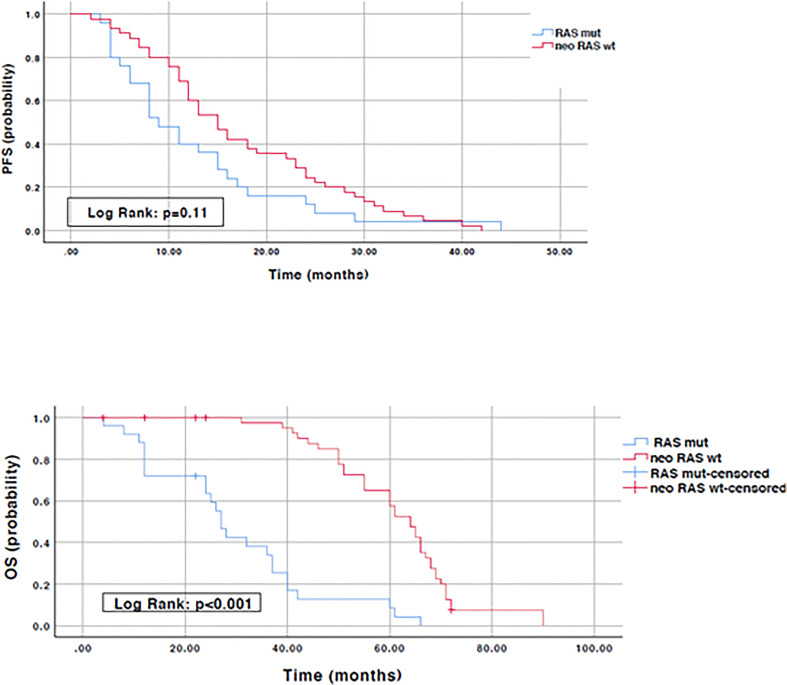
70 patients with stage IV mutant colorectal cancer were prospectively enrolled. Plasma samples were collected at progression from first-line treatment. /BRAF mutations in plasma were assessed by RT-PCR. In /BRAF wild-type samples, ctDNA was used to generate libraries using a 17 genes panel whose alteration has clinical relevance. To investigate the prognostic significance of mutation clearance, test curves for PFS and OS were represented by Kaplan-Meier estimator plot and Log-rank test.
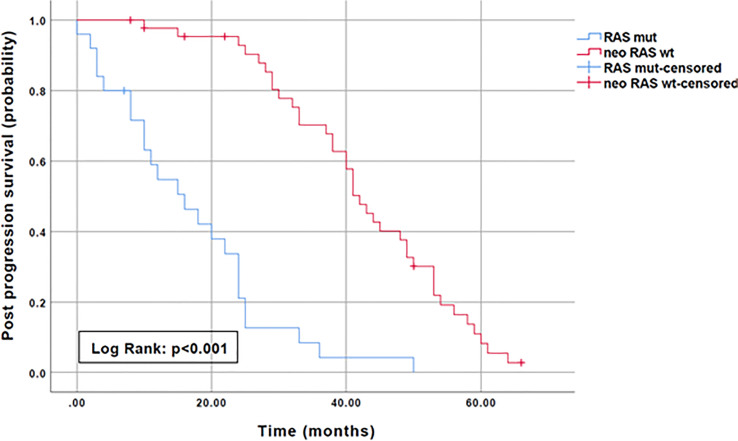
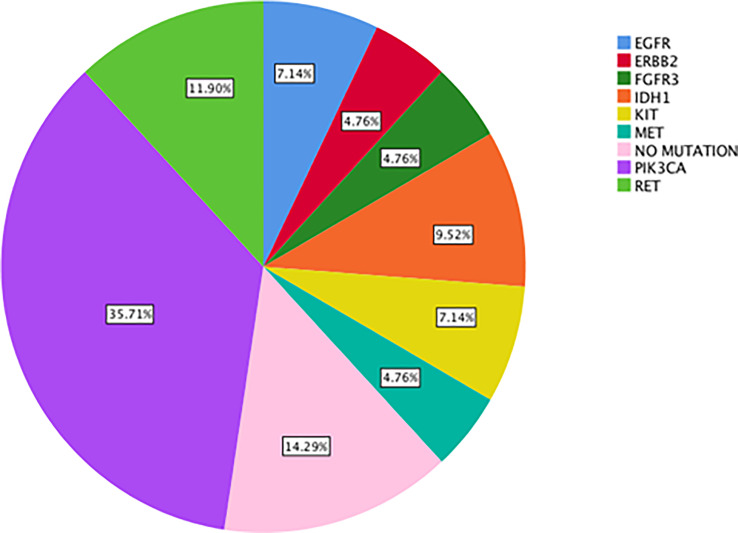
The most commonly detected actionable mutations in "neo- wild-type" were: (35.7%); (11.9%); (9.5%); (7%); (7%); (4.7%); (4.7%); (4.7%). Both OS and post-progression survival were longer in patients with "neo- wild-type" compared to those who remained mutant (p<0.001 for both).
De-novo-targetable mutations occured in a large percentage of "neo- wild-type", being the most commonly detected. mutation clearance in ctDNA is associated with long- term improvement of overall survival.
“新野生型”一词指的是原本为突变型的结直肠癌患者血浆循环肿瘤DNA(ctDNA)转变为野生型疾病。同样,在RAS突变型转移性结直肠癌(mCRC)疾病进展时重新确定ctDNA中突变状态的假设,为基于临床选择接受EGFR抑制剂治疗的患者开辟了新的前景。目前,“新野生型”的基因组格局尚不清楚。这是一项前瞻性研究,旨在调查一大群在一线治疗失败时液体活检转变为野生型的突变型mCRC患者中与突变清除相关的临床和基因组特征。次要目的是研究“真正的新野生型”的长期预后意义。
前瞻性纳入70例IV期突变型结直肠癌患者。在一线治疗进展时采集血浆样本。通过RT-PCR评估血浆中的/BRAF突变。在/BRAF野生型样本中,使用具有临床相关性改变的17个基因panel对ctDNA进行文库构建。为了研究突变清除的预后意义,通过Kaplan-Meier估计图和对数秩检验来表示无进展生存期(PFS)和总生存期(OS)的测试曲线。
“新野生型”中最常检测到的可操作突变是:(35.7%);(11.9%);(9.5%);(7%);(7%);(4.7%);(4.7%);(4.7%)。与仍为突变型的患者相比,“新野生型”患者的OS和进展后生存期均更长(两者均p<0.001)。
大量“新野生型”中出现了从头可靶向突变,其中最常检测到。ctDNA中的突变清除与总生存期的长期改善相关。