Yang Qing, Li Gengyu, Wu Xiaoqiu, Lin Haiying, Wu Wanrui, Xie Xiangpang, Zhu Yu, Cai Wei, Shi Changsheng, Zhuo Shengye
Department of Gastroenterology, The Third Affiliated Hospital of Wenzhou Medical University, Wenzhou, Zhejiang, China.
Interventional vascular Surgery, The Third Affiliated Hospital of Wenzhou Medical University, Wenzhou, Zhejiang, China.
Front Oncol. 2023 Mar 29;13:1136366. doi: 10.3389/fonc.2023.1136366. eCollection 2023.
83 patients with hepatocellular carcinoma (HCC) admitted to the interventional oncology department were randomly divided into two groups. Apatinib and camrelizumab were administered to 42 patients in group A, whereas sorafenib was administered to 41 patients in group B for three months. The clinical efficacy was evaluated in terms of objective response rate (ORR), and disease control rate (DCR). Certain tumor markers like alpha-fetoprotein (AFP), carbohydrate antigen 199 (CA199), carcinoembryonic antigen (CEA), hypoxia-inducible factor (HIF-1), immune function T lymphocyte subsets (CD3+, CD4+, CD8+, CD4+/CD8+) were determined before and after treatment. The serum levels of vascular endothelial growth factor (VEGF), osteopontin (OPN), aspartate aminotransferase (AST), and epidermal growth factor 7 (EGF7)] were observed. The survival time between the two groups was compared, such as progression-free survival (PFS) and median survival (MS). Finally, the toxicity and side effects data were also obtained.
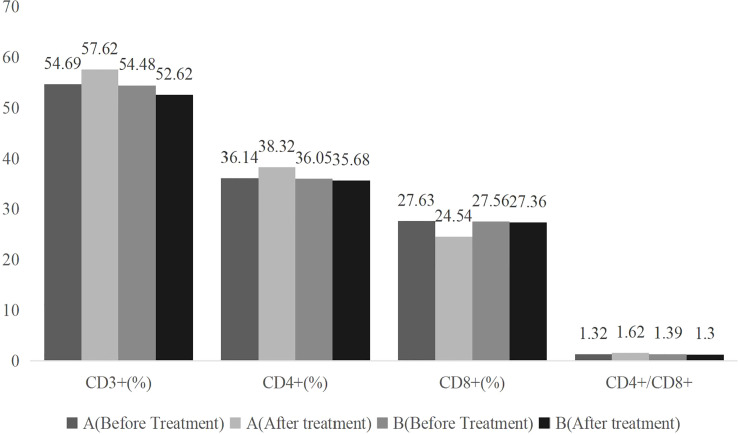
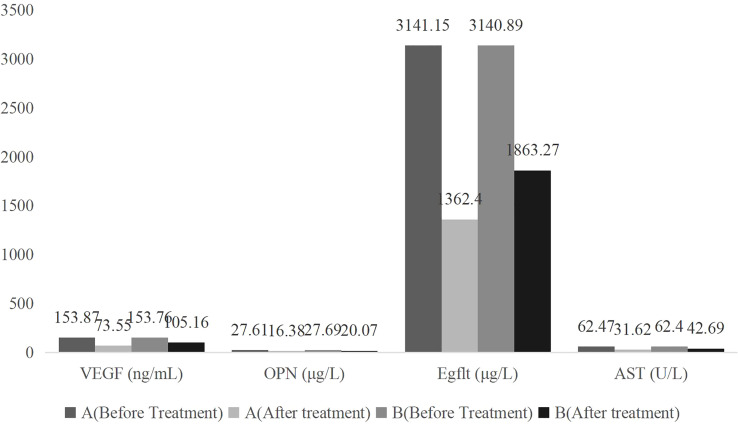
The ORR and DCR of group A were 69.05% and 88.10%, respectively, which were significantly higher (P<0.05) than group B (ORR=53.66% and DCR=70.73%). After treatment, the AFP, CA199, CEA, and HIF-1 levels of both groups decreased significantly (P<0.05), and the respective biomarker levels of group A were lower than those of group B (P<0.05). Following treatment, CD3+, CD4+, CD4+/CD8+ index in group A significantly increased (P<0.05) while CD8+ level was significantly decreased (P<0.05). Compared to group B, a significant increase was observed in group A's CD3+, CD4+, and CD4+/CD8+ index. There were no significant changes in CD3+, CD4+, CD8+, CD4+/CD8+ indexes before and after treatment in group B (P>0.05). The serum level of VEGF, OPN, EGF-7 and AST indexes of group A&B were decreased significantly (P<0.05). Compared with group B, the VEGF, OPN, EGF7 and AST indexes of group A were significantly reduced (P<0.05). PFS and MS in group A were significantly higher than in group B (P<0.05). There was no significant difference between groups A and B in terms of toxicity and adverse effects (P>0.05).
In treating HCC, combining apatinib and camrelizumab can reduce tumor markers, enhance the immune system and curative effect, and prolong patient survival. The underline mechanism is related to the down-regulation of VEGF, OPN and HIF-1 indexes.
将介入肿瘤科收治的83例肝细胞癌(HCC)患者随机分为两组。A组42例患者给予阿帕替尼和卡瑞利珠单抗,B组41例患者给予索拉非尼,治疗3个月。根据客观缓解率(ORR)和疾病控制率(DCR)评估临床疗效。测定治疗前后某些肿瘤标志物,如甲胎蛋白(AFP)、糖类抗原199(CA199)、癌胚抗原(CEA)、缺氧诱导因子(HIF-1)、免疫功能T淋巴细胞亚群(CD3+、CD4+、CD8+、CD4+/CD8+)。观察血管内皮生长因子(VEGF)、骨桥蛋白(OPN)、天冬氨酸转氨酶(AST)和表皮生长因子7(EGF7)的血清水平。比较两组的生存时间,如无进展生存期(PFS)和中位生存期(MS)。最后,还获取了毒性和副作用数据。
A组的ORR和DCR分别为69.05%和88.10%,显著高于B组(ORR = 53.66%,DCR = 70.73%,P<0.05)。治疗后,两组的AFP、CA199、CEA和HIF-1水平均显著降低(P<0.05),且A组各生物标志物水平低于B组(P<0.05)。治疗后,A组的CD3+、CD4+、CD4+/CD8+指数显著升高(P<0.05),而CD8+水平显著降低(P<0.05)。与B组相比,A组的CD3+、CD4+和CD4+/CD8+指数显著升高。B组治疗前后CD3+、CD4+、CD8+、CD4+/CD8+指数无显著变化(P>0.05)。A、B两组的VEGF、OPN、EGF-7和AST指数血清水平均显著降低(P<0.05)。与B组相比,A组的VEGF、OPN、EGF7和AST指数显著降低(P<0.05)。A组的PFS和MS显著高于B组(P<0.05)。A、B两组在毒性和不良反应方面无显著差异(P>0.05)。
在治疗HCC时,联合使用阿帕替尼和卡瑞利珠单抗可降低肿瘤标志物,增强免疫系统和疗效,延长患者生存期。潜在机制与VEGF、OPN和HIF-1指数的下调有关。