Medizinische Klinik I, Klinikum Memmingen, Memmingen, Germany.
University of Heidelberg, Department of Cardiology, Angiology and Pneumology, Heidelberg, Germany.
J Interv Cardiol. 2023 Apr 6;2023:9412132. doi: 10.1155/2023/9412132. eCollection 2023.
The aim of this retrospective analysis was to compare the patient outcome after interventional therapy of saphenous vein graft (SVG) stenoses in an all-comers population receiving either self-expanding drug-eluting stents (SExS) or balloon expanding drug-eluting stents (BExS).
The interventional therapy of degenerated SVGs remains challenging. Diameter variations of stenotic segments and friable plaques can lead to malapposition and distal embolization with increased major adverse cardiac event (MACE) rates.
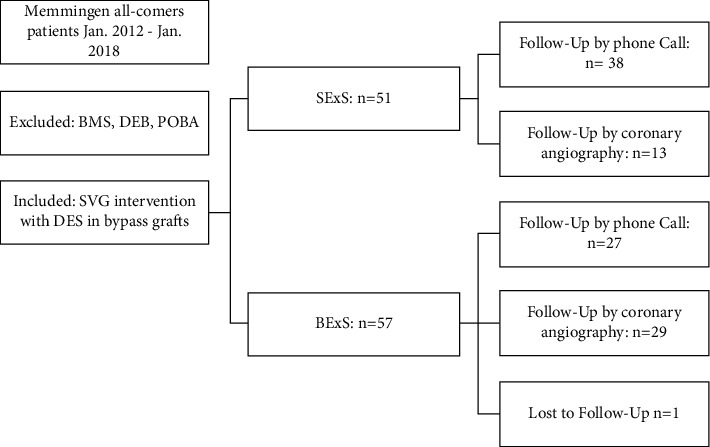
107 patients with a total of 130 SVG interventions were separated into two groups according to either SExS ( = 51) or BExS ( = 56) treatment. Primary endpoint was the MACE rate, which is defined as the composite of cardiac death, myocardial infarction (MI), target vessel (TVR), and target lesion revascularization (TLR) at 30 days and at one-year follow-up.
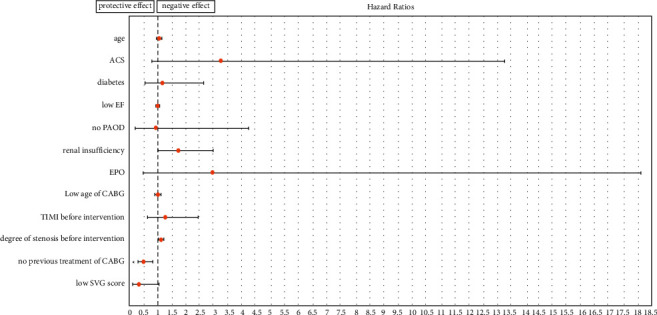
Both patient groups did not differ significantly regarding patient characteristics. The patient outcome was significantly better in the SExS patient group: the MACE rate at 30 days was 1/51 (2.0%) in group SExS vs. 7/56 (12.5%) in group BExS; < 0.05. At one-year follow-up, the MACE rate remained significantly lower in the SExS group 8/51(15.7%) vs. 20/56 (35.7%) in the BExS group, < 0.02. Additionally, cardiac death occurred significantly later within the SExS patient group compared to the BExS group ( < 0.05). A better overall outcome of patients with de novo SVG-stenosis compared to patients with previous CABG (coronary artery bypass graft) intervention was noted in both groups.
Our findings demonstrate that SVG treatment with SExS is safe and provides clinical benefits by comparatively improving short and especially long-term patient outcomes.
本回顾性分析旨在比较在所有患者人群中,接受自膨式药物洗脱支架(SExS)或球囊扩张药物洗脱支架(BExS)治疗的情况下,介入治疗大隐静脉移植物(SVG)狭窄的患者结局。
退行性 SVG 的介入治疗仍然具有挑战性。狭窄段和易碎斑块的直径变化可能导致贴壁不良和远端栓塞,导致主要不良心脏事件(MACE)发生率增加。
根据接受 SExS(n=51)或 BExS(n=56)治疗,将 107 名共接受 130 次 SVG 介入治疗的患者分为两组。主要终点是 MACE 发生率,定义为 30 天和 1 年随访时的心脏死亡、心肌梗死(MI)、靶血管(TVR)和靶病变血运重建(TLR)的复合终点。
两组患者的患者特征无显著差异。SExS 组患者的预后显著更好:30 天的 MACE 发生率在 SExS 组为 1/51(2.0%),而在 BExS 组为 7/56(12.5%);<0.05。1 年随访时,SExS 组的 MACE 发生率仍显著较低,为 8/51(15.7%),而 BExS 组为 20/56(35.7%);<0.02。此外,SExS 组的心脏死亡发生时间明显晚于 BExS 组;<0.05。与先前 CABG(冠状动脉旁路移植术)介入治疗的患者相比,新发 SVG 狭窄患者的总体预后更好,这在两组中均有体现。
我们的研究结果表明,SExS 治疗 SVG 是安全的,并通过改善短期和长期患者结局提供临床获益。