Dangre Pankaj V, Korekar Pawan P, Borkar Maheshkumar R, Chaturvedi Kaushalendra K, Borikar Sachin P, Pethe Anil M
Department of Pharmaceutics, Datta Meghe College of Pharmacy, DMIHER (DU), Wardha 442001, Maharashtra, India.
Department of Pharmaceutical Quality Assurance, R C Patel Institute of Pharmaceutical Education and Research, Shirpur 425405, Maharashtra, India.
ACS Omega. 2023 Mar 30;8(14):12820-12829. doi: 10.1021/acsomega.2c08079. eCollection 2023 Apr 11.
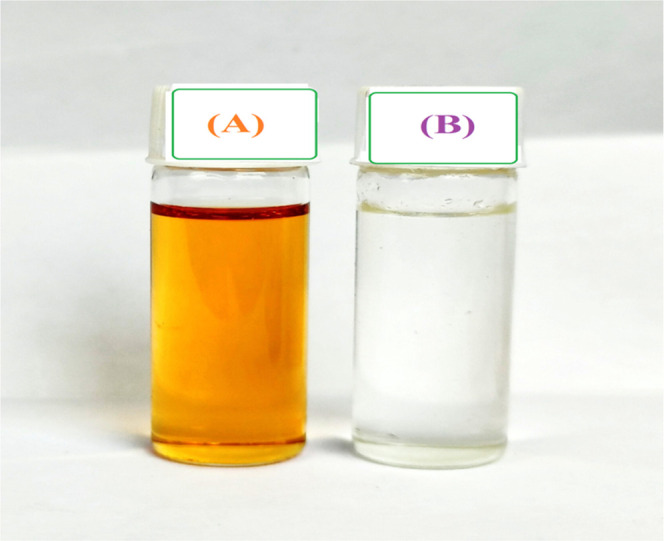
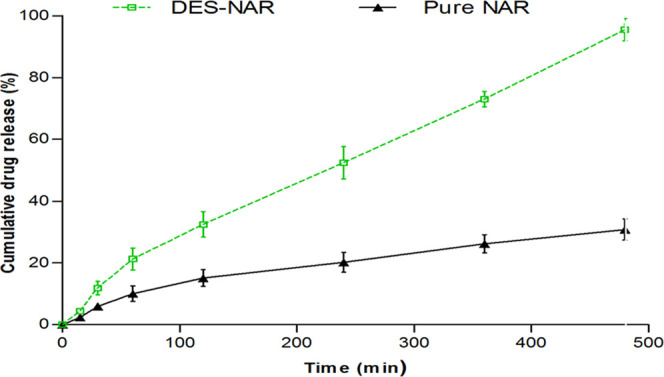
Recently, the applications of deep eutectic solvents (DESs) as green and sustainable solvents for the solubilization of functional foods and phytophenols have dramatically risen concerning global issues on the utilization of organic solvents. Nevertheless, developing a suitable DES system for phytocomponents to enhance its solubility and bioavailability is complex and requires a sound experimental setup. Herein, we have attempted to develop DES encompassing the choline chloride (ChCl) along with oxalic acid (OA), l-glutamine (l-Glu), urea (U), and glycerol (Gro) at different ratios to elicit the solubility and bioavailability of naringin (NAR). Several DES systems were designed and tested for solubility, kinematic viscosity, and pH. Among these, DES-NAR encompassing ChCl/Gro in a 1:3 ratio exhibited the maximum solubility of NAR (232.56 ± 7.1 mg/mL) and neutral characteristic and thus considered suitable for NAR. Further, the conductor-like screening model for real solvents (COSMO-RS) has been employed to estimate the molecular and electrostatic interactions. DES-NAR was evaluated by polarized optical microscopy, Fourier-transform infrared (FTIR), differential scanning calorimetry (DSC), and H NMR to investigate the molecular transition and interaction. Further, diffusion and permeability studies were performed, which suggest significant improvements in DES-NAR. Likewise, the pharmacokinetic studies revealed a two times increase in the oral bioavailability of NAR in a designed DES system. Thus, the work represents a systematic and efficient development of the DES system for a potential phytocomponent considering the biosafety impact, which may widen the interest in pharmaceutical and food sciences.
最近,鉴于有机溶剂使用方面的全球问题,深共熔溶剂(DESs)作为用于增溶功能性食品和植物酚类的绿色可持续溶剂,其应用急剧增加。然而,开发一种适用于植物成分的DES系统以提高其溶解度和生物利用度是复杂的,并且需要完善的实验装置。在此,我们尝试开发包含不同比例氯化胆碱(ChCl)与草酸(OA)、L-谷氨酰胺(L-Glu)、尿素(U)和甘油(Gro)的DES,以提高柚皮苷(NAR)的溶解度和生物利用度。设计并测试了几种DES系统的溶解度、运动粘度和pH值。其中,ChCl与Gro比例为1:3的DES-NAR表现出NAR的最大溶解度(232.56±7.1mg/mL)且呈中性,因此被认为适用于NAR。此外,已采用真实溶剂的导体类筛选模型(COSMO-RS)来估计分子和静电相互作用。通过偏光显微镜、傅里叶变换红外光谱(FTIR)、差示扫描量热法(DSC)和核磁共振氢谱(1H NMR)对DES-NAR进行评估,以研究分子转变和相互作用。此外,还进行了扩散和渗透性研究,结果表明DES-NAR有显著改善。同样,药代动力学研究显示,在设计的DES系统中,NAR的口服生物利用度提高了两倍。因此,考虑到生物安全性影响,这项工作代表了一种针对潜在植物成分的DES系统的系统而有效的开发,这可能会扩大制药和食品科学领域的研究兴趣。