Seidel Laura, Sachpazidou Varvara, Ketzer Marcelo, Hylander Samuel, Forsman Anders, Dopson Mark
Centre for Ecology and Evolution in Microbial Model Systems (EEMiS), Linnaeus University, Kalmar, Sweden.
Front Microbiol. 2023 Mar 29;14:1099445. doi: 10.3389/fmicb.2023.1099445. eCollection 2023.
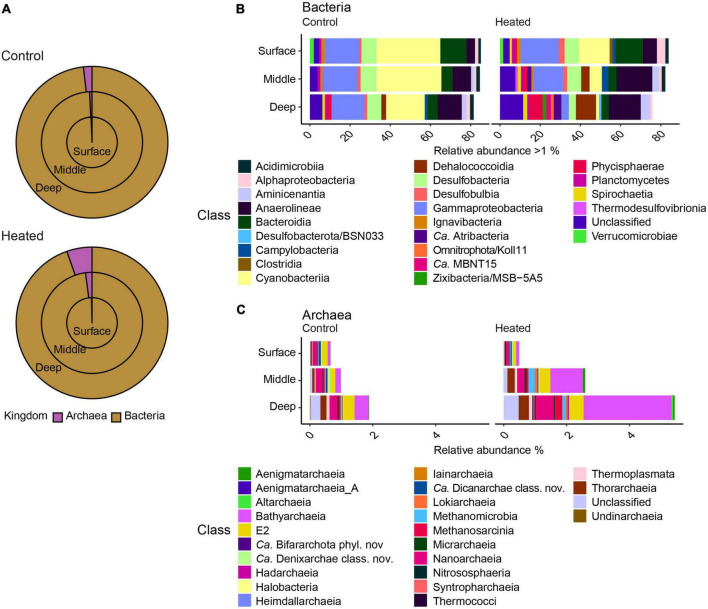
Coastal waters such as those found in the Baltic Sea already suffer from anthropogenic related problems including increased algal blooming and hypoxia while ongoing and future climate change will likely worsen these effects. Microbial communities in sediments play a crucial role in the marine energy- and nutrient cycling, and how they are affected by climate change and shape the environment in the future is of great interest. The aims of this study were to investigate potential effects of prolonged warming on microbial community composition and nutrient cycling including sulfate reduction in surface (∼0.5 cm) to deeper sediments (∼ 24 cm). To investigate this, 16S rRNA gene amplicon sequencing was performed, and sulfate concentrations were measured and compared between sediments in a heated bay (which has been used as a cooling water outlet from a nearby nuclear power plant for approximately 50 years) and a nearby but unaffected control bay. The results showed variation in overall microbial diversity according to sediment depth and higher sulfate flux in the heated bay compared to the control bay. A difference in vertical community structure reflected increased relative abundances of sulfur oxidizing- and sulfate reducing bacteria along with a higher proportion of archaea, such as Bathyarchaeota, in the heated compared to the control bay. This was particularly evident closer to the sediment surface, indicating a compression of geochemical zones in the heated bay. These results corroborate findings in previous studies and additionally point to an amplified effect of prolonged warming deeper in the sediment, which could result in elevated concentrations of toxic compounds and greenhouse gases closer to the sediment surface.
波罗的海等沿海水域已经受到与人为活动相关的问题影响,包括藻类大量繁殖和缺氧现象加剧,而当前及未来的气候变化可能会使这些影响恶化。沉积物中的微生物群落对海洋能量和养分循环起着关键作用,它们如何受到气候变化的影响以及未来如何塑造环境是人们极为关注的问题。本研究的目的是调查长期变暖对微生物群落组成和养分循环的潜在影响,包括表层(约0.5厘米)至深层沉积物(约24厘米)中的硫酸盐还原作用。为了进行调查,我们进行了16S rRNA基因扩增子测序,并测量了硫酸盐浓度,对一个受热海湾(已用作附近核电站的冷却排水口约50年)和附近未受影响的对照海湾的沉积物中的硫酸盐浓度进行了比较。结果表明,总体微生物多样性随沉积物深度而变化,受热海湾的硫酸盐通量高于对照海湾。垂直群落结构的差异反映出,与对照海湾相比,受热海湾中硫氧化细菌和硫酸盐还原细菌的相对丰度增加,同时古菌(如深海古菌)的比例更高。这在沉积物表面附近尤为明显,表明受热海湾中地球化学带受到压缩。这些结果证实了先前研究中的发现,此外还表明沉积物深处长期变暖的放大效应,这可能导致沉积物表面附近有毒化合物和温室气体浓度升高。