Department of Psychology, The Ohio State University, Columbus, OH, USA.
Centre for Addiction and Mental Health, Toronto, Canada.
J Alzheimers Dis. 2023;93(2):633-651. doi: 10.3233/JAD-221084.
Prior work has shown that certain modifiable health, Alzheimer's disease (AD) biomarker, and demographic variables are associated with cognitive performance. However, less is known about the relative importance of these different domains of variables in predicting longitudinal change in cognition.
Identify novel relationships between modifiable physical and health variables, AD biomarkers, and slope of cognitive change over two years in a cohort of older adults with mild cognitive impairment (MCI).
Metrics of cardiometabolic risk, stress, inflammation, neurotrophic/growth factors, and AD pathology were assessed in 123 older adults with MCI at baseline from the Alzheimer's Disease Neuroimaging Initiative (mean age = 73.9; SD = 7.6; mean education = 16.0; SD = 3.0). Partial least squares regression (PLSR)-a multivariate method which creates components that best predict an outcome-was used to identify whether these physiological variables were important in predicting slope of change in episodic memory or executive function over two years.
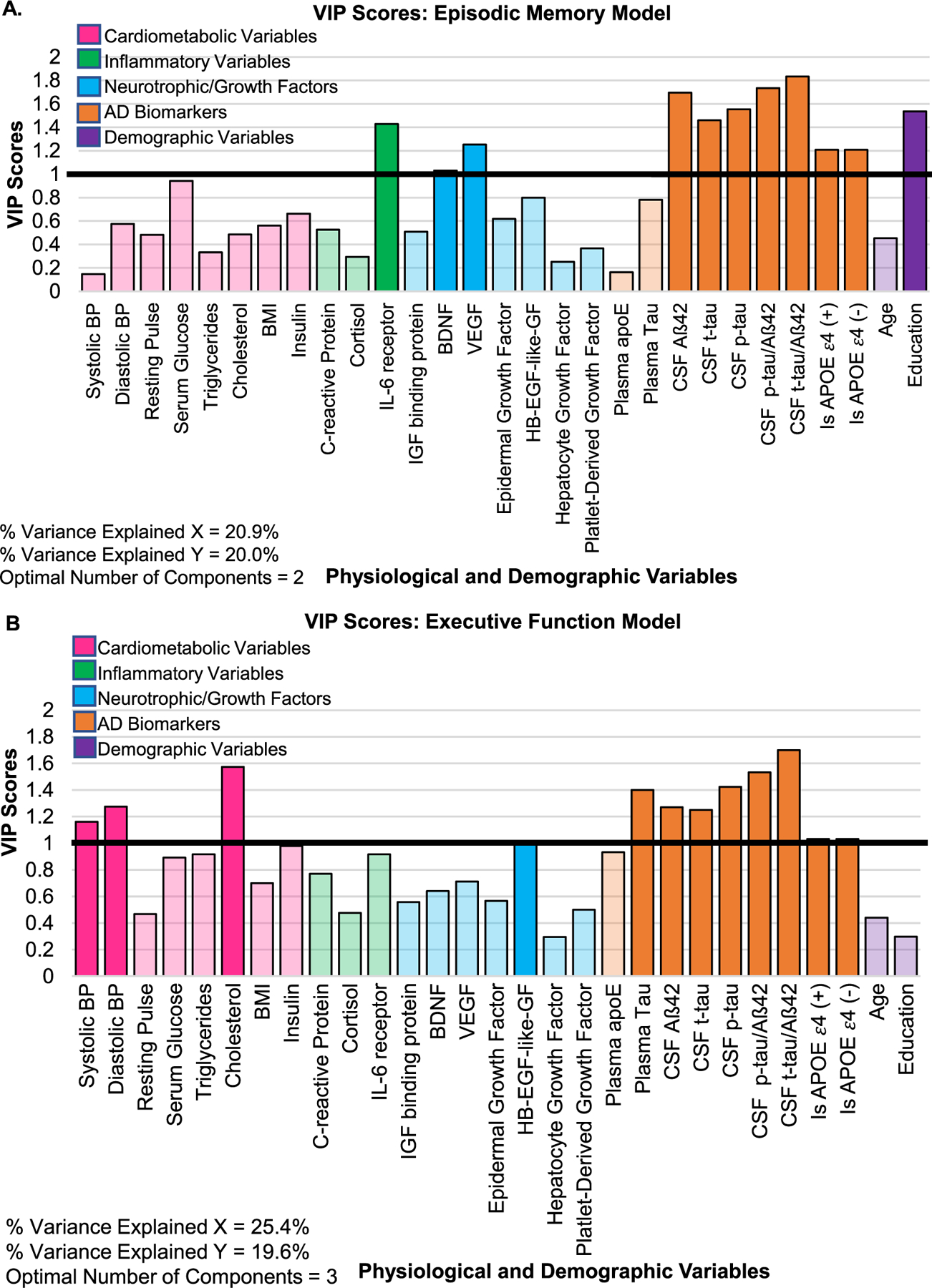
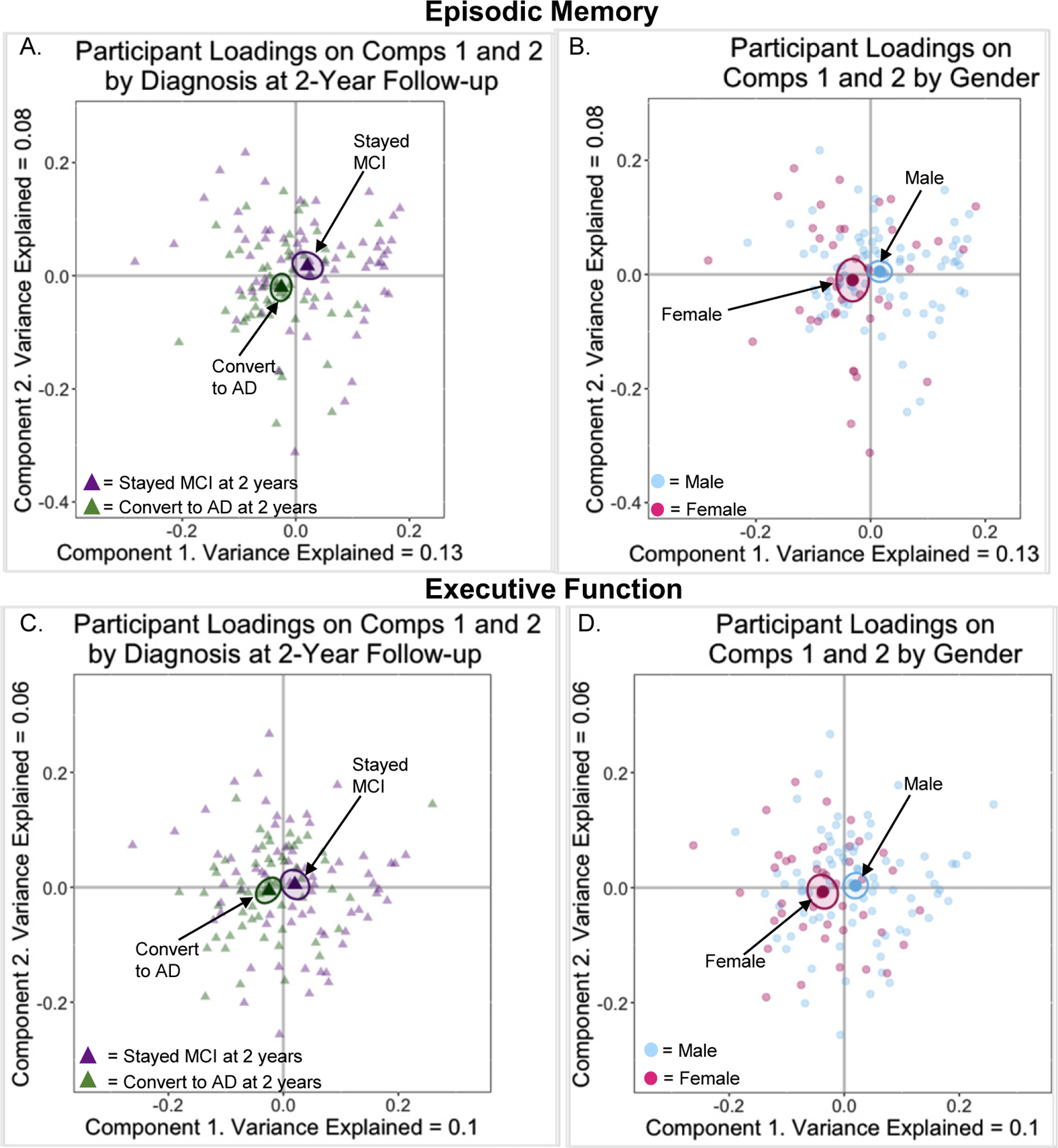
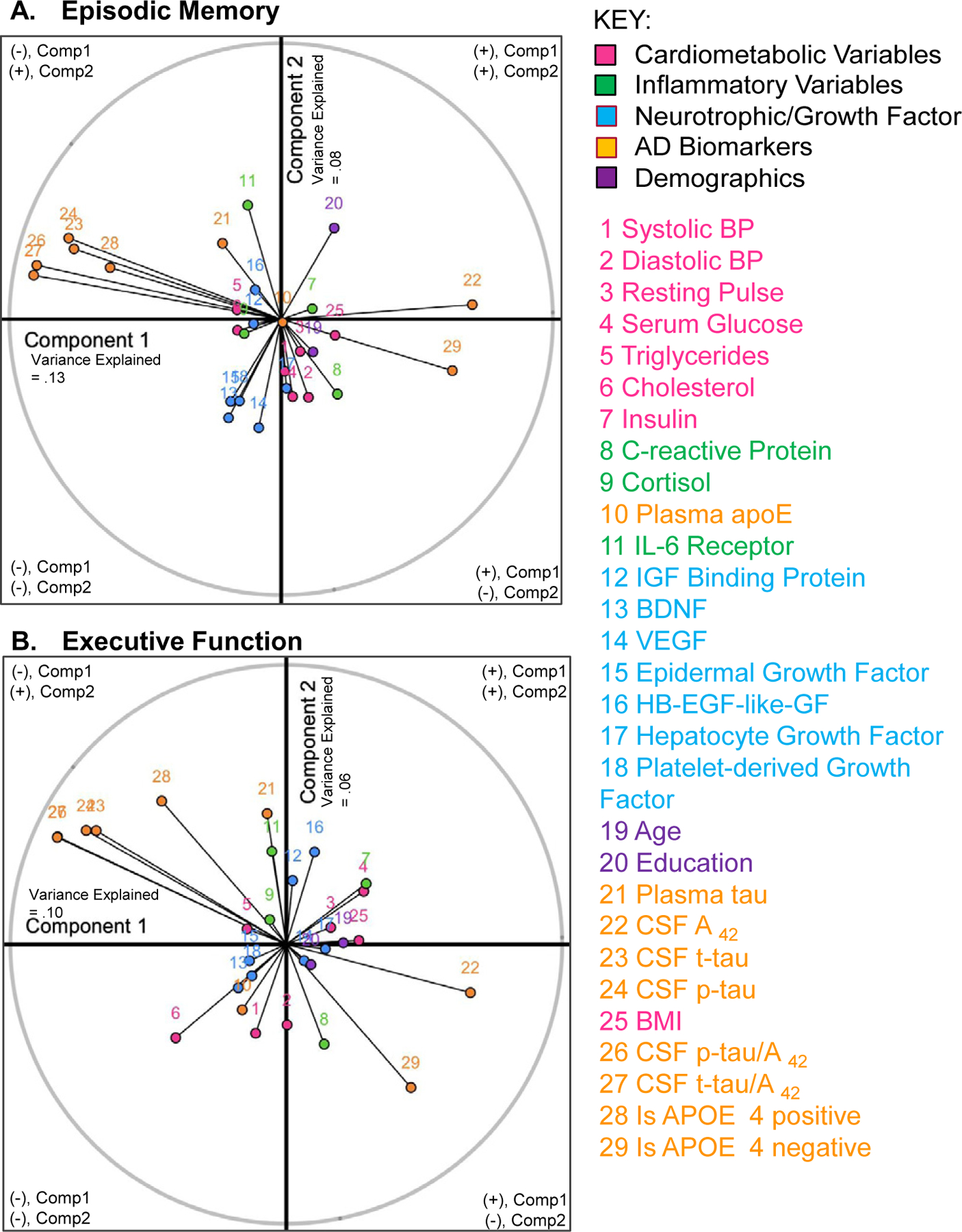
At two-year follow-up, the two PLSR models predicted, respectively, 20.0% and 19.6% of the variance in change in episodic memory and executive function. Baseline levels of AD biomarkers were important in predicting change in both episodic memory and executive function. Baseline education and neurotrophic/growth factors were important in predicting change in episodic memory, whereas cardiometabolic variables such as blood pressure and cholesterol were important in predicting change in executive function.
These data-driven analyses highlight the impact of AD biomarkers on cognitive change and further clarify potential domain specific relationships with predictors of cognitive change.
先前的研究表明,某些可改变的健康状况、阿尔茨海默病(AD)生物标志物和人口统计学变量与认知表现有关。然而,对于这些不同领域的变量在预测认知纵向变化方面的相对重要性,了解较少。
在轻度认知障碍(MCI)的老年队列中,确定可改变的身体和健康变量、AD 生物标志物与认知变化斜率之间的新关系。
从阿尔茨海默病神经影像学倡议(ADNI)中,对 123 名基线 MCI 老年人(平均年龄 73.9;SD 7.6;平均教育年限 16.0;SD 3.0)的心血管代谢风险、压力、炎症、神经营养/生长因子和 AD 病理学进行了测量。偏最小二乘回归(PLSR)——一种创建最能预测结果的组件的多元方法——用于确定这些生理变量是否对预测两年内情景记忆或执行功能变化的斜率是否重要。
在两年的随访中,两个 PLSR 模型分别预测了情景记忆和执行功能变化的 20.0%和 19.6%的方差。AD 生物标志物的基线水平对情景记忆和执行功能的变化均有重要预测作用。基线教育和神经营养/生长因子对情景记忆的变化很重要,而心血管代谢变量如血压和胆固醇对执行功能的变化很重要。
这些基于数据的分析强调了 AD 生物标志物对认知变化的影响,并进一步阐明了认知变化预测因素的潜在特定领域关系。