
发展性语言障碍儿童中θ和δ波对反馈处理的贡献。
The contribution of theta and delta to feedback processing in children with developmental language disorder.
机构信息
MGH Institute of Health Professions, Boston, MA, USA.
出版信息
J Neurodev Disord. 2023 Apr 17;15(1):13. doi: 10.1186/s11689-023-09481-1.
PURPOSE
The study aimed at evaluating feedback processing at the electrophysiological level and its relation to learning in children with developmental language disorder (DLD) to further advance our understanding of the underlying neural mechanisms of feedback-based learning in children with this disorder.
METHOD
A feedback-based probabilistic learning task required children to classify novel cartoon animals into two categories that differ on five binary features, the probabilistic combination of which determined classification. The learning outcomes' variance in relation to time- and time-frequency measures of feedback processing were examined and compared between 20 children with developmental language disorder and 25 age-matched children with typical language development.
RESULTS
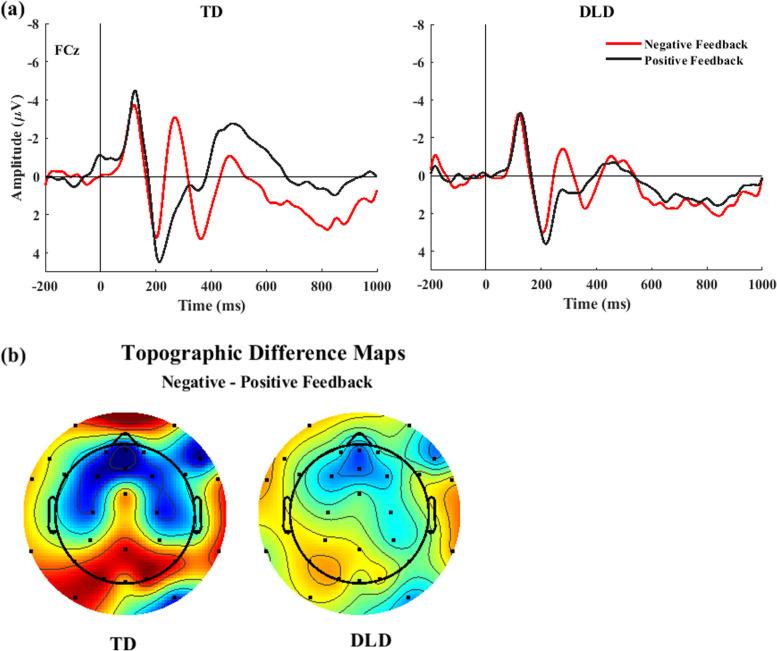
Children with developmental language disorder (DLD) performed poorer on the task when compared with their age-matched peers with typical language development (TD). The electrophysiological data in the time domain indicated no differences in the processing of positive and negative feedback among children with DLD. However, the time-frequency analysis revealed a strong theta activity in response to negative feedback in this group, suggesting an initial distinction between positive and negative feedback that was not captured by the ERP data. In the TD group, delta activity played a major role in shaping the FRN and P3a and was found to predict test performance. Delta did not contribute to the FRN and P3a in the DLD group. Additionally, theta and delta activities were not associated with the learning outcomes of children with DLD.
CONCLUSION
Theta activity, which is associated with the initial processing of feedback at the level of the anterior cingulate cortex, was detected in children with developmental language disorder (DLD) but was not associated with their learning outcomes. Delta activity, which is assumed to be generated by the striatum and to be linked to elaborate processing of outcomes and adjustment of future actions, contributed to processing and learning outcomes of children with typical language development but not of children with DLD. The results provide evidence for atypical striatum-based feedback processing in children with DLD.
目的
本研究旨在评估发展性语言障碍(DLD)儿童在电生理水平上的反馈处理及其与学习的关系,以进一步深入了解该障碍儿童基于反馈的学习的潜在神经机制。
方法
一项基于反馈的概率学习任务要求儿童将新的卡通动物分类到两个类别中,这两个类别在五个二进制特征上有所不同,这些特征的概率组合决定了分类。检查并比较了 20 名发育性语言障碍儿童和 25 名年龄匹配的具有典型语言发育儿童在反馈处理的时程和时频测量方面的学习成果的方差。
结果
与具有典型语言发育的年龄匹配的同伴相比,发育性语言障碍(DLD)儿童在任务中的表现较差。时域中的电生理数据表明,DLD 儿童在处理正反馈和负反馈时没有差异。然而,时频分析显示,该组对负反馈有强烈的θ活动,表明在 ERP 数据中没有捕捉到正反馈和负反馈之间的初步区分。在 TD 组中,δ活动在塑造 FRN 和 P3a 中起主要作用,并且发现它可以预测测试表现。在 DLD 组中,δ 没有对 FRN 和 P3a 产生影响。此外,θ和δ活动与 DLD 儿童的学习成果无关。
结论
在发育性语言障碍(DLD)儿童中检测到与前扣带皮层水平的反馈初步处理相关的θ活动,但与他们的学习成果无关。假设由纹状体产生并与结果的精细处理和未来行为的调整相关的δ活动,对具有典型语言发育的儿童的处理和学习成果有贡献,但对 DLD 儿童没有贡献。结果为 DLD 儿童的基于纹状体的异常反馈处理提供了证据。



 Zotero 插件