UPR4278 Laboratory of Experimental Cardiovascular Physiology, Avignon University, Avignon, France.
Fondation Charles Mion - AIDER Santé, Grabels, France.
J Am Soc Nephrol. 2023 Aug 1;34(8):1445-1455. doi: 10.1681/ASN.0000000000000149. Epub 2023 Apr 18.
Hemodialysis (HD) can lead to acute left ventricular (LV) myocardial wall motion abnormalities (myocardial stunning) due to segmental hypoperfusion. Exercise during dialysis is associated with favorable effects on central hemodynamics and BP stability, factors considered in the etiology of HD-induced myocardial stunning. In a speckle-tracking echocardiography analysis, the authors explored effects of acute intradialytic exercise (IDE) on LV regional myocardial function in 60 patients undergoing HD. They found beneficial effects of IDE on LV longitudinal and circumferential function and on torsional mechanics, not accounted for by cardiac loading conditions or central hemodynamics. These findings support the implementation of IDE in people with ESKD, given that LV transient dysfunction imposed by repetitive HD may contribute to heart failure and increased risk of cardiac events in such patients.
Hemodialysis (HD) induces left ventricular (LV) transient myocardial dysfunction. A complex interplay between linear deformations and torsional mechanics underlies LV myocardial performance. Although intradialytic exercise (IDE) induces favorable effects on central hemodynamics, its effect on myocardial mechanics has never been comprehensively documented.
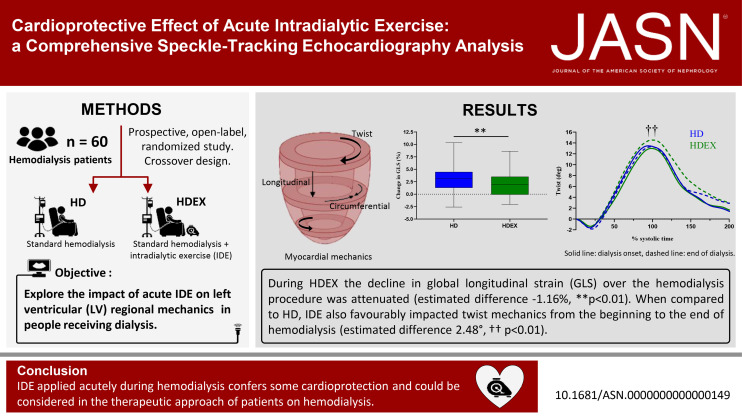
To evaluate the effects of IDE on LV myocardial mechanics, assessed by speckle-tracking echocardiography, we conducted a prospective, open-label, two-center randomized crossover trial. We enrolled 60 individuals with ESKD receiving HD, who were assigned to participate in two sessions performed in a randomized order: standard HD and HD incorporating 30 minutes of aerobic exercise (HDEX). We measured global longitudinal strain (GLS) at baseline (T0), 90 minutes after HD onset (T1), and 30 minutes before ending HD (T2). At T0 and T2, we also measured circumferential strain and twist, calculated as the net difference between apical and basal rotations. Central hemodynamic data (BP, cardiac output) also were collected.
The decline in GLS observed during the HD procedure was attenuated in the HDEX sessions (estimated difference, -1.16%; 95% confidence interval [95% CI], -0.31 to -2.02; P = 0.008). Compared with HD, HDEX also demonstrated greater improvements from T0 to T2 in twist, an important component of LV myocardial function (estimated difference, 2.48°; 95% CI, 0.30 to 4.65; P = 0.02). Differences in changes from T0 to T2 for cardiac loading and intradialytic hemodynamics did not account for the beneficial effects of IDE on LV myocardial mechanics kinetics.
IDE applied acutely during HD improves regional myocardial mechanics and might warrant consideration in the therapeutic approach for patients on HD.
血液透析(HD)可导致局部灌注不足导致急性左心室(LV)心肌壁运动异常(心肌顿抑)。透析期间运动与中心血液动力学和血压稳定性的有利影响相关,这些因素被认为与 HD 诱导的心肌顿抑的病因有关。在斑点追踪超声心动图分析中,作者研究了 60 例接受 HD 的患者中急性透析内运动(IDE)对 LV 局部心肌功能的影响。他们发现 IDE 对 LV 纵向和圆周功能以及扭转力学有有益影响,而这些不受心脏负荷条件或中心血液动力学影响。这些发现支持在 ESKD 患者中实施 IDE,因为由重复 HD 引起的 LV 短暂性功能障碍可能导致心力衰竭,并增加此类患者的心脏事件风险。
血液透析(HD)可引起左心室(LV)短暂性功能障碍。LV 心肌功能的基础是线性变形和扭转力学之间的复杂相互作用。尽管透析内运动(IDE)对中心血液动力学有有利影响,但它对心肌力学的影响从未得到全面记录。
为了通过斑点追踪超声心动图评估 IDE 对 LV 心肌力学的影响,我们进行了一项前瞻性、开放标签、双中心随机交叉试验。我们招募了 60 名接受 HD 的 ESKD 患者,将他们随机分为两组,进行两次治疗:标准 HD 和包含 30 分钟有氧运动的 HD(HDEX)。我们在基线(T0)、HD 开始后 90 分钟(T1)和 HD 结束前 30 分钟(T2)测量了整体纵向应变(GLS)。在 T0 和 T2,我们还测量了圆周应变和扭转,计算为心尖和基底旋转之间的净差。还收集了中心血液动力学数据(血压、心输出量)。
HD 过程中 GLS 的下降在 HDEX 治疗中得到缓解(估计差异,-1.16%;95%置信区间[95%CI],-0.31 至-2.02;P=0.008)。与 HD 相比,HDEX 还显示从 T0 到 T2 的扭转改善更大,扭转是 LV 心肌功能的一个重要组成部分(估计差异,2.48°;95%CI,0.30 至 4.65;P=0.02)。从 T0 到 T2 的变化在心脏负荷和透析内血液动力学方面的差异不能解释 IDE 对 LV 心肌力学动力学的有益影响。
HD 期间急性应用 IDE 可改善局部心肌力学,可能值得在 HD 患者的治疗方法中考虑。