Nutrition and Health Innovation Research Institute, School of Medical and Health Sciences, Edith Cowan University, Joondalup, WA, Australia.
Institute of Physical Activity and Nutrition, Deakin University, Geelong, VIC, Australia.
J Cachexia Sarcopenia Muscle. 2023 Jun;14(3):1508-1519. doi: 10.1002/jcsm.13227. Epub 2023 Apr 19.
Impaired muscle function has been identified as a risk factor for declining cognitive function and cardiovascular health, both of which are risk factors for late-life dementia (after 80 years of age). We examined whether hand grip strength and timed-up-and-go (TUG) performance, including their change over 5 years, were associated with late-life dementia events in older women and whether any associations provided independent information to Apolipoprotein E 4 (APOE 4) genotype.
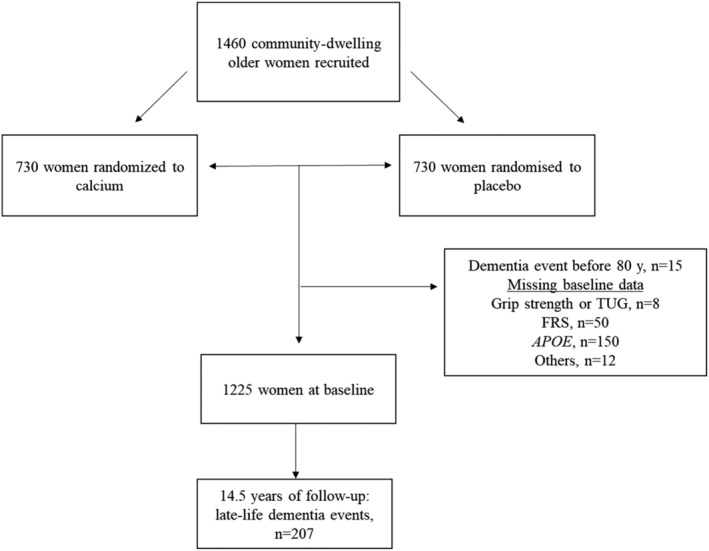
Grip strength and TUG were assessed in community-dwelling older women (mean ± SD; age 75.0 ± 2.6 years) at baseline (n = 1225) and 5 years (n = 1052). Incident 14.5-year late-life dementia events (dementia-related hospitalization/death) were obtained from linked health records. Cardiovascular risk factors (Framingham Risk Score), APOE genotyping, prevalent atherosclerotic vascular disease and cardiovascular-related medications were evaluated at baseline. These were included in multivariable-adjusted Cox-proportional hazards models assessing the relationship between muscle function measures and late-life-dementia events.
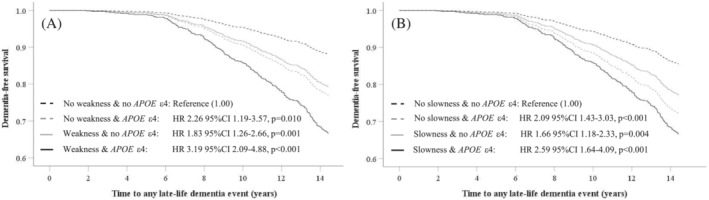
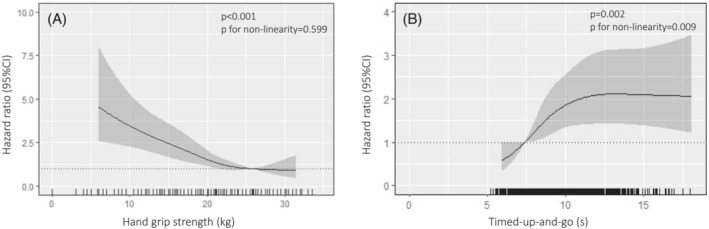
Over follow-up, 207 (16.9%) women had a late-life dementia event. Compared with women with the highest grip strength (Quartile [Q] 4, 25.8 kg), those with the lowest grip strength (Q1, 16.0 kg) had greater hazard for a late-life dementia event (HR 2.27 95% CI 1.54-3.35, P < 0.001). For TUG, the slowest women (Q4, 12.4 vs. Q1, 7.4 s) also recorded a greater hazard for a late-life dementia event (HR 2.10 95% CI 1.42-3.10, P = 002). Weak hand grip (<22 kg) or slow TUG (>10.2 s) provided independent information to the presence of an APOE 4 allele (n = 280, 22.9%). Compared with women with no weakness and no APOE 4 allele, those with weakness and APOE 4 allele had a greater hazard (HR 3.19 95% CI 2.09-4.88, P < 0.001) for a late-life dementia event. Women presenting with slowness and the APOE 4 allele also recorded a greater hazard for a late-life dementia event (HR 2.59 95% CI 1.64-4.09, P < 0.001). For 5-year muscle function changes, compared with women with the lowest performance decrement (Q1), those with the largest decrement (Q4) had higher hazards for a late-life dementia event (grip strength HR 1.94 95% CI 1.22-3.08, P = 0.006; TUG HR 2.52 95% CI 1.59-3.98, P < 0.001) over the next 9.5 years.
Weaker grip strength and slower TUG, and a greater decline over 5 years, were significant risk factors for a late-life-dementia event in community-dwelling older women, independent of lifestyle and genetic risk factors. Incorporating muscle function measures as part of dementia screening appears useful to identify high-risk individuals who might benefit from primary prevention programmes.
肌肉功能受损已被确定为认知功能和心血管健康下降的风险因素,而这两者都是老年痴呆症(80 岁以后)的风险因素。我们研究了握力和计时起立行走(TUG)表现,包括它们在 5 年内的变化,是否与老年女性的晚年痴呆事件有关,以及任何关联是否为载脂蛋白 E4(APOE4)基因型提供了独立信息。
在基线时(n=1225)和 5 年后(n=1052)评估了居住在社区的老年女性的握力和 TUG。从相关健康记录中获得了 14.5 年的晚年痴呆事件(与痴呆相关的住院/死亡)。在基线时评估了心血管风险因素(弗雷明汉风险评分)、APOE 基因型、现患动脉粥样硬化血管疾病和心血管相关药物。这些因素被纳入多变量调整 Cox 比例风险模型,以评估肌肉功能测量值与晚年痴呆事件之间的关系。
在随访期间,207 名(16.9%)女性发生了晚年痴呆事件。与握力最强的女性(四分位 [Q]4,25.8kg)相比,握力最低的女性(Q1,16.0kg)晚年痴呆事件的发生风险更高(HR 2.27,95%CI 1.54-3.35,P<0.001)。对于 TUG,最慢的女性(Q4,12.4 秒比 Q1,7.4 秒)晚年痴呆事件的发生风险也更高(HR 2.10,95%CI 1.42-3.10,P=0.002)。握力较弱(<22kg)或 TUG 较慢(>10.2s)为 APOE4 等位基因的存在提供了独立信息(n=280,22.9%)。与没有虚弱和没有 APOE4 等位基因的女性相比,有虚弱和 APOE4 等位基因的女性晚年痴呆事件的发生风险更高(HR 3.19,95%CI 2.09-4.88,P<0.001)。表现出虚弱和 APOE4 等位基因的女性晚年痴呆事件的发生风险也更高(HR 2.59,95%CI 1.64-4.09,P<0.001)。对于 5 年的肌肉功能变化,与表现出最低性能下降的女性(Q1)相比,表现出最大下降的女性(Q4)晚年痴呆事件的发生风险更高(握力 HR 1.94,95%CI 1.22-3.08,P=0.006;TUG HR 2.52,95%CI 1.59-3.98,P<0.001)在接下来的 9.5 年。
在居住在社区的老年女性中,握力较弱、TUG 较慢以及 5 年内下降幅度较大是晚年痴呆事件的重要风险因素,独立于生活方式和遗传风险因素。将肌肉功能测量纳入痴呆筛查似乎有助于识别高危人群,这些人群可能受益于初级预防计划。