Mate Kedar K V, Abou-Sharkh Ahmed, Mansoubi Maedeh, Alosaimi Aeshah, Dawes Helen, Michael Wright, Stanwood Olivia, Harding Sarah, Gorenko Daniel, Mayo Nancy E
Faculty of Medicine and Health Sciences, McGill University, Montreal, QC, Canada.
Medical School, University of Exeter, Exeter, United Kingdom.
JMIR Rehabil Assist Technol. 2023 Apr 19;10:e40680. doi: 10.2196/40680.
The number of wearable technological devices or sensors that are commercially available for gait training is increasing. These devices can fill a gap by extending therapy outside the clinical setting. This was shown to be important during the COVID-19 pandemic when people could not access one-on-one treatment. These devices vary widely in terms of mechanisms of therapeutic effect, as well as targeted gait parameters, availability, and strength of the evidence supporting the claims.
This study aimed to create an inventory of devices targeting improvement in gait pattern and walking behavior and identify the strength of the evidence underlying the claims of effectiveness for devices that are commercially available to the public.
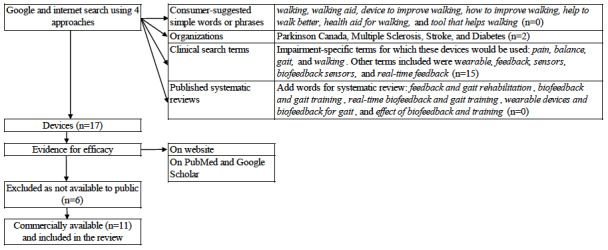
As there is no systematic or reproducible way to identify gait training technologies available to the public, we used a pragmatic, iterative approach using both the gray and published literature. Four approaches were used: simple words, including some suggested by laypersons; devices endorsed by condition-specific organizations or charities; impairment-specific search terms; and systematic reviews. A findable list of technological devices targeting walking was extracted separately by 3 authors. For each device identified, the evidence for efficacy was extracted from material displayed on the websites, and full-text articles were obtained from the scientific databases PubMed, Ovid MEDLINE, Scopus, or Google Scholar. Additional information on the target population, mechanism of feedback, evidence for efficacy or effectiveness, and commercial availability was obtained from the published material or websites. A level of evidence was assigned to each study involving the device using the Oxford Centre for Evidence-Based Medicine classification. We also proposed reporting guidelines for the clinical appraisal of devices targeting movement and mobility.
The search strategy for this consumer-centered review yielded 17 biofeedback devices that claim to target gait quality improvement through various sensory feedback mechanisms. Of these 17 devices, 11 (65%) are commercially available, and 6 (35%) are at various stages of research and development. Of the 11 commercially available devices, 4 (36%) had findable evidence for efficacy potential supporting the claims. Most of these devices were targeted to people living with Parkinson disease. The reporting of key information about the devices was inconsistent; in addition, there was no summary of research findings in layperson's language.
The amount of information that is currently available to the general public to help them make an informed choice is insufficient, and, at times, the information presented is misleading. The evidence supporting the effectiveness does not cover all aspects of technology uptake. Commercially available technologies help to provide continuity of therapy outside the clinical setting, but there is a need to demonstrate effectiveness to support claims made by the technologies.
市面上可用于步态训练的可穿戴技术设备或传感器数量正在增加。这些设备可以通过将治疗扩展到临床环境之外来填补空白。在新冠疫情期间,当人们无法获得一对一治疗时,这一点被证明很重要。这些设备在治疗效果机制、目标步态参数、可用性以及支持其宣称的证据力度等方面差异很大。
本研究旨在创建一份旨在改善步态模式和行走行为的设备清单,并确定公众可购买的设备有效性宣称背后证据的力度。
由于没有系统或可重复的方法来识别公众可获得的步态训练技术,我们采用了一种实用的迭代方法,同时使用灰色文献和已发表的文献。使用了四种方法:简单词汇,包括一些外行建议的词汇;特定疾病组织或慈善机构认可的设备;特定损伤的搜索词;以及系统评价。三位作者分别提取了一份可找到的针对行走的技术设备清单。对于识别出的每个设备,从网站上展示的材料中提取疗效证据,并从科学数据库PubMed、Ovid MEDLINE、Scopus或谷歌学术中获取全文文章。从已发表的材料或网站上获取有关目标人群、反馈机制、疗效或有效性证据以及商业可用性的其他信息。使用牛津循证医学中心分类为涉及该设备的每项研究分配证据水平。我们还提出了针对旨在改善运动和活动能力的设备进行临床评估的报告指南。
这项以消费者为中心的综述的搜索策略产生了17种生物反馈设备,这些设备声称通过各种感官反馈机制来改善步态质量。在这17种设备中,11种(65%)已上市,6种(35%)处于不同的研发阶段。在11种已上市的设备中,4种(36%)有可找到潜在疗效证据支持其宣称。这些设备大多针对帕金森病患者。关于这些设备的关键信息报告不一致;此外,没有用外行语言总结研究结果。
目前普通公众可获得的帮助他们做出明智选择的信息量不足,而且有时所呈现的信息具有误导性。支持有效性的证据并未涵盖技术应用的所有方面。已上市的技术有助于在临床环境之外提供持续治疗,但需要证明有效性以支持这些技术所做的宣称。
