MRC Molecular Haematology Unit, MRC Weatherall Institute of Molecular Medicine, Radcliffe Department of Medicine, University of Oxford, Oxford, UK.
Department of Clinical Haematology, Royal London Hospital, Barts Health NHS Trust, London, UK.
Nat Commun. 2023 Apr 19;14(1):2238. doi: 10.1038/s41467-023-37604-8.
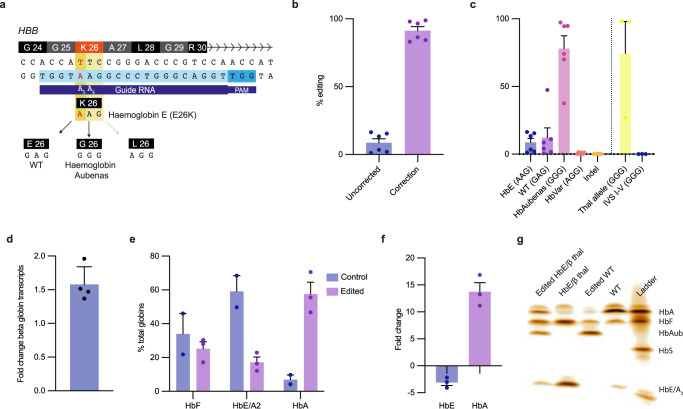
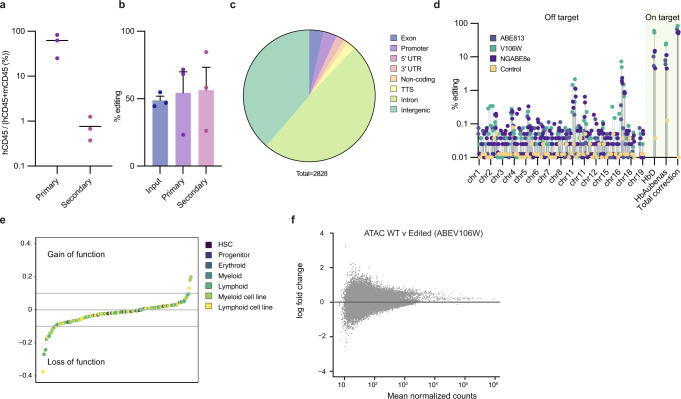
Haemoglobin E (HbE) β-thalassaemia causes approximately 50% of all severe thalassaemia worldwide; equating to around 30,000 births per year. HbE β-thalassaemia is due to a point mutation in codon 26 of the human HBB gene on one allele (GAG; glutamatic acid → AAG; lysine, E26K), and any mutation causing severe β-thalassaemia on the other. When inherited together in compound heterozygosity these mutations can cause a severe thalassaemic phenotype. However, if only one allele is mutated individuals are carriers for the respective mutation and have an asymptomatic phenotype (β-thalassaemia trait). Here we describe a base editing strategy which corrects the HbE mutation either to wildtype (WT) or a normal variant haemoglobin (E26G) known as Hb Aubenas and thereby recreates the asymptomatic trait phenotype. We have achieved editing efficiencies in excess of 90% in primary human CD34 + cells. We demonstrate editing of long-term repopulating haematopoietic stem cells (LT-HSCs) using serial xenotransplantation in NSG mice. We have profiled the off-target effects using a combination of circularization for in vitro reporting of cleavage effects by sequencing (CIRCLE-seq) and deep targeted capture and have developed machine-learning based methods to predict functional effects of candidate off-target mutations.
血红蛋白 E (HbE) β-地中海贫血症导致全球约 50%的严重地中海贫血症;相当于每年约有 3 万人出生。HbE β-地中海贫血症是由于人类 HBB 基因一个等位基因上的密码子 26 发生点突变(GAG;谷氨酸→AAG;赖氨酸,E26K),以及另一个等位基因上导致严重β-地中海贫血症的任何突变。当这些突变在复合杂合子中遗传时,它们可能导致严重的地中海贫血表型。然而,如果只有一个等位基因发生突变,个体则为相应突变的携带者,表现为无症状表型(β-地中海贫血特征)。在这里,我们描述了一种碱基编辑策略,可以将 HbE 突变校正为野生型(WT)或一种称为 Hb Aubenas 的正常变异血红蛋白(E26G),从而再现无症状特征表型。我们在原代人 CD34+细胞中实现了超过 90%的编辑效率。我们使用 NSG 小鼠的连续异种移植证明了对长期重造血干细胞(LT-HSCs)的编辑。我们使用结合测序的环化(CIRCLE-seq)体外报告切割效应和深度靶向捕获来分析脱靶效应,并开发了基于机器学习的方法来预测候选脱靶突变的功能效应。