Laboratory Medicine Program, University Health Network, Toronto General Hospital, Toronto, Canada.
Department of Pathology and Laboratory Medicine, Rhode Island Hospital and Lifespan Medical Center, Providence, RI, USA.
J Pathol Clin Res. 2023 Jul;9(4):313-321. doi: 10.1002/cjp2.318. Epub 2023 Apr 20.
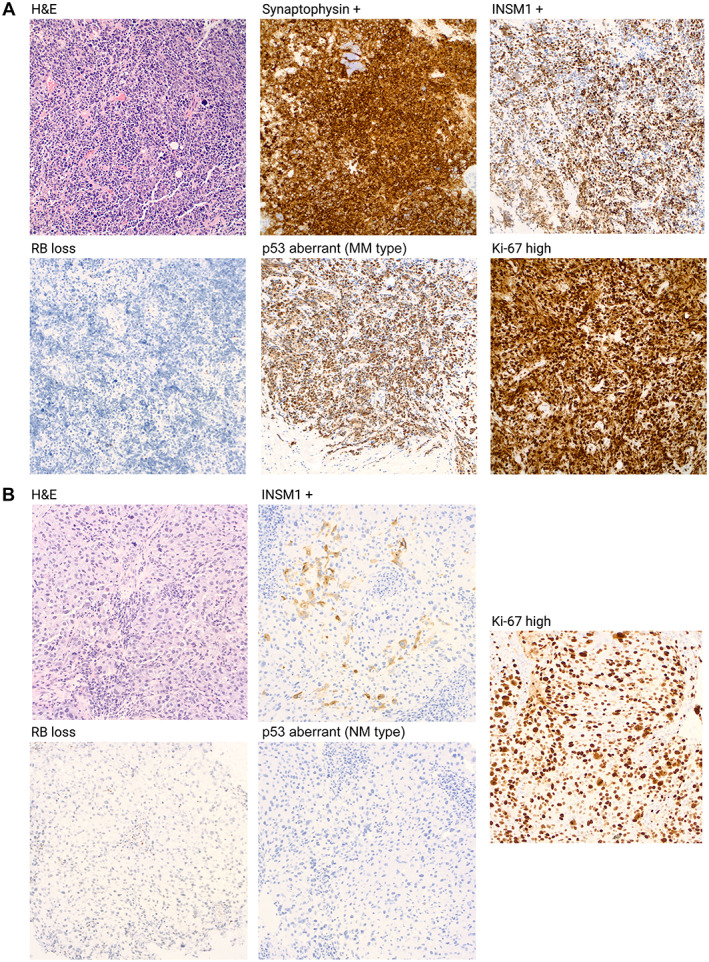
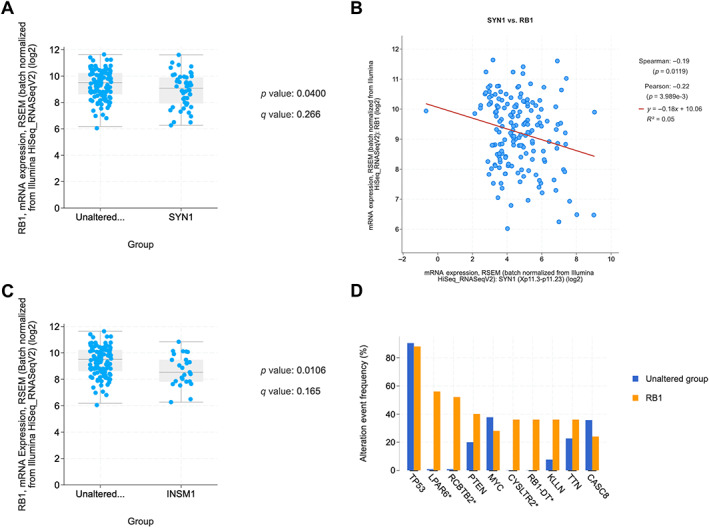
Primary breast neuroendocrine (NE) neoplasms are uncommon, and definitions harbor controversy. We retrospectively collected 73 triple-negative breast cancers (TNBC) and evaluated NE biomarker expression along with p53 aberrant staining (which correlates with TP53 gene mutation) and Rb protein loss by immunohistochemistry. In the study cohort, we found 11 (15%) cases of TNBC with neuroendocrine differentiation (TNBC-NED) showing positivity for one or more NE markers (synaptophysin/chromogranin/insulinoma-associated protein 1 [INSM1]). We also identified one separate small cell neuroendocrine carcinoma. Histologic types for these 11 TNBC-NED cases were as follows: 8 invasive ductal carcinoma (IDC) not otherwise specified (NOS), 2 IDC with apocrine features, 1 IDC with solid papillary features. INSM1 had the highest positivity and was seen in all 11 carcinomas. Seven (64%) cases showed p53 aberrant staining, 6 (55%) had Rb protein loss, while 6 (55%) had p53/Rb co-aberrant staining/protein loss. TNBC-NED was associated with Rb protein loss (p < 0.001), as well as p53/Rb co-aberrant staining/protein loss (p < 0.001). In 61 cases negative for NE markers, 37 (61%) showed p53 aberrant staining, while 5 (8%) had Rb protein loss. We also analyzed genomic and transcriptomic data from The Cancer Genome Atlas (TCGA) PanCancer Atlas of 171 basal/TNBC patients. Transcriptomic analysis revealed mRNA expression of RB1 to be correlated negatively with SYN1 mRNA expression (p = 0.0400) and INSM1 mRNA expression (p = 0.0106) in this cohort. We would like to highlight the importance of these findings. TNBC-NED is currently diagnosed as TNBC, and although it overlaps morphologically with TNBC without NED, the unique p53/Rb signature highlights a genetic overlap with NE carcinomas of the breast.
原发性乳腺神经内分泌(NE)肿瘤较为罕见,其定义存在争议。我们回顾性收集了 73 例三阴性乳腺癌(TNBC)患者的资料,并通过免疫组织化学方法评估了 NE 生物标志物表达、p53 异常染色(与 TP53 基因突变相关)和 Rb 蛋白缺失情况。在研究队列中,我们发现 11 例(15%)具有神经内分泌分化的 TNBC(TNBC-NED)病例,其一种或多种 NE 标志物(突触素/嗜铬粒蛋白/胰岛瘤相关蛋白 1[INSM1])呈阳性。我们还发现了一个单独的小细胞神经内分泌癌。这 11 例 TNBC-NED 的组织学类型如下:8 例非特殊型浸润性导管癌(IDC-NOS)、2 例具有大汗腺特征的 IDC、1 例具有实性乳头状特征的 IDC。INSM1 的阳性率最高,见于所有 11 例癌中。7 例(64%)病例存在 p53 异常染色,6 例(55%)存在 Rb 蛋白缺失,而 6 例(55%)存在 p53/Rb 共异常染色/蛋白缺失。TNBC-NED 与 Rb 蛋白缺失相关(p<0.001),也与 p53/Rb 共异常染色/蛋白缺失相关(p<0.001)。在 11 例 NE 标志物阴性的病例中,37 例(61%)存在 p53 异常染色,而 5 例(8%)存在 Rb 蛋白缺失。我们还分析了来自癌症基因组图谱(TCGA)泛癌症图谱的 171 例基底型/TNBC 患者的基因组和转录组数据。在该队列中,转录组分析显示 RB1mRNA 的表达与 SYN1mRNA 的表达(p=0.0400)和 INSM1mRNA 的表达(p=0.0106)呈负相关。我们希望强调这些发现的重要性。TNBC-NED 目前被诊断为 TNBC,虽然它在形态上与没有 NED 的 TNBC 重叠,但独特的 p53/Rb 特征突出了其与乳腺神经内分泌癌的遗传重叠。