Natural History Museum, University of Oslo, P.O. Box 1172, Blindern, 0318 Oslo, Norway.
Centre of Molecular Biodiversity Research, Zoological Research Museum Alexander Koenig Bonn 53113, Germany.
Syst Biol. 2023 Aug 7;72(4):925-945. doi: 10.1093/sysbio/syad023.
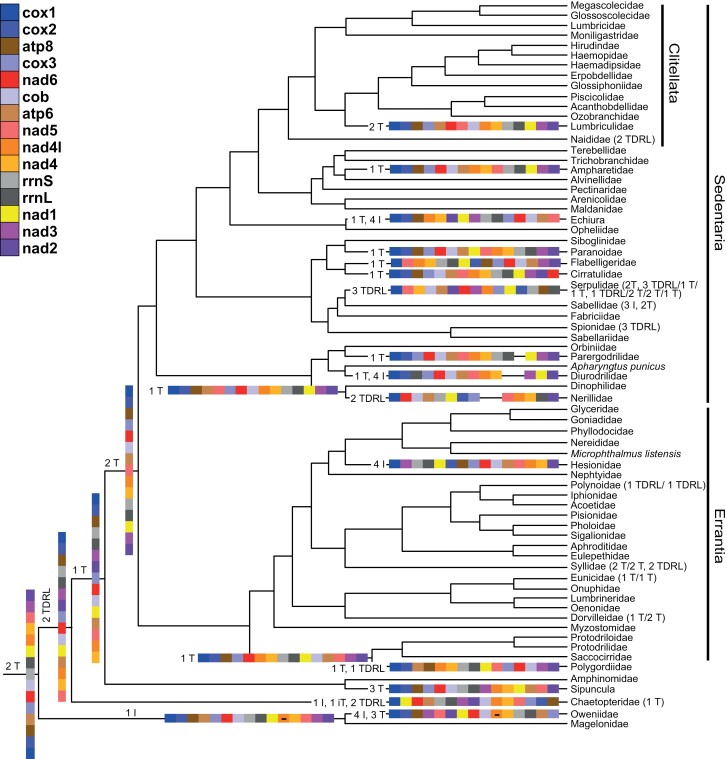
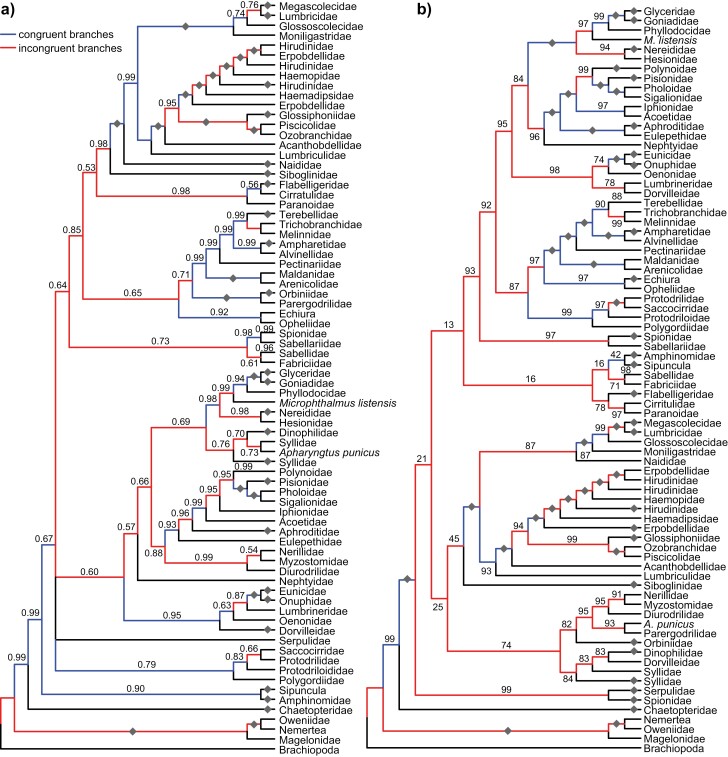
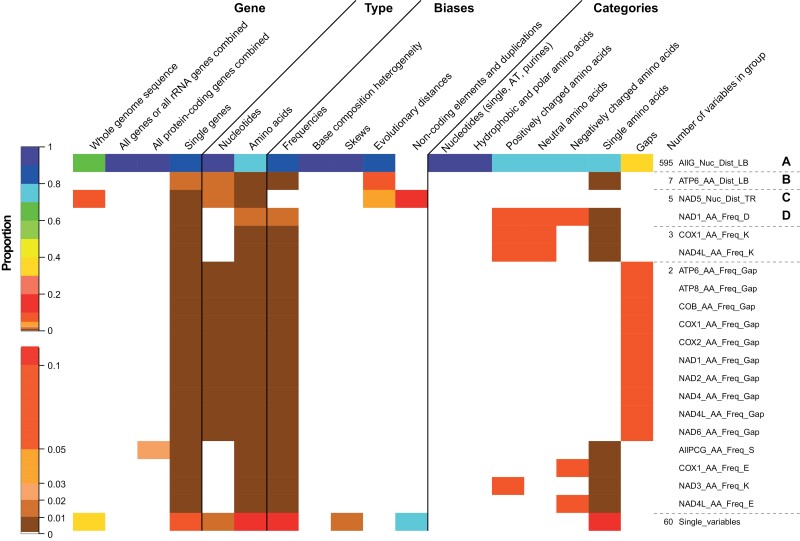
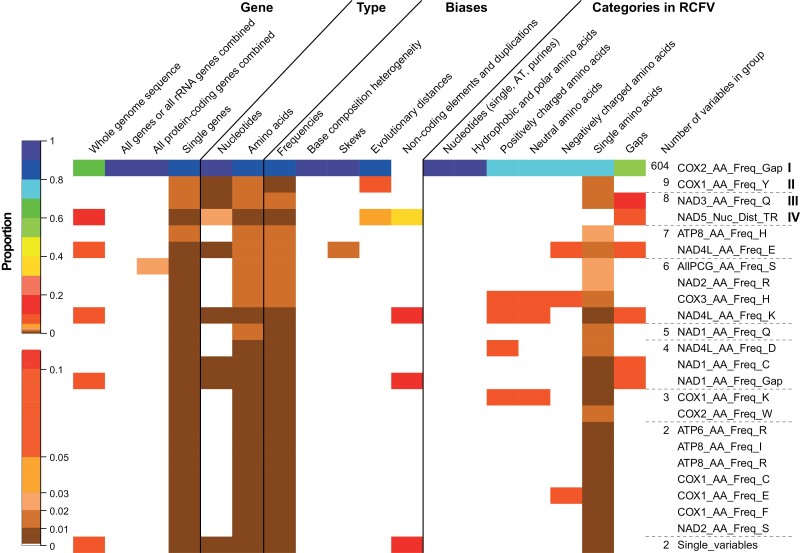
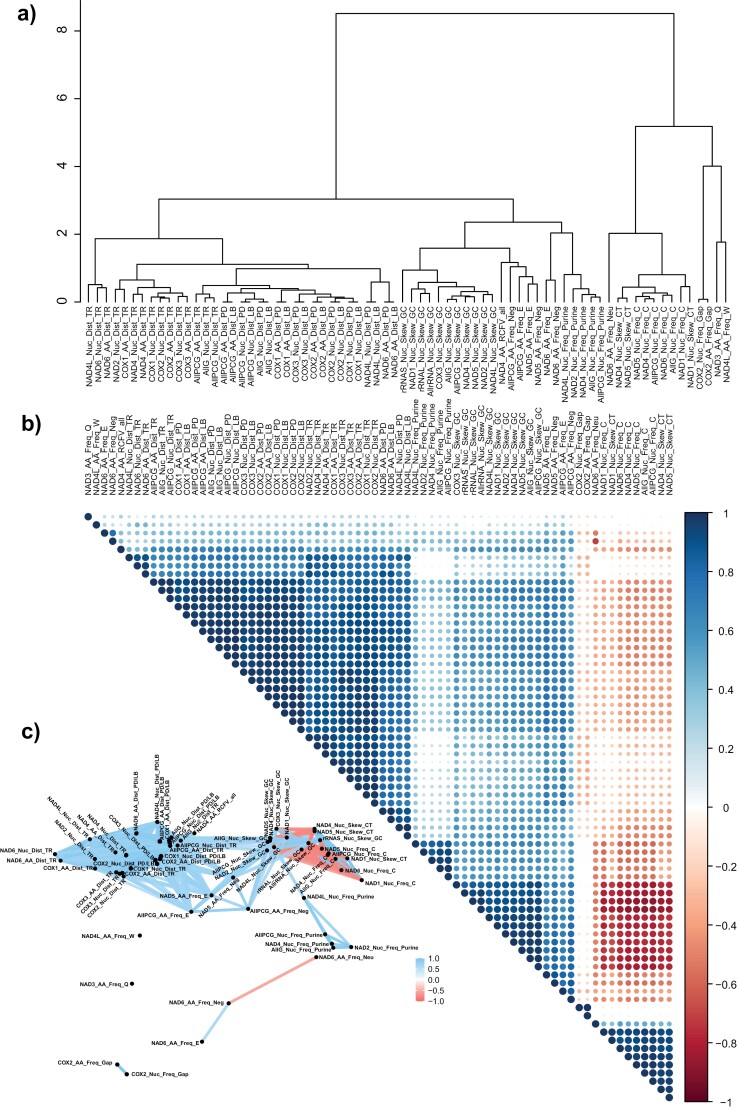
The mitochondrial genomes of Bilateria are relatively conserved in their protein-coding, rRNA, and tRNA gene complement, but the order of these genes can range from very conserved to very variable depending on the taxon. The supposedly conserved gene order of Annelida has been used to support the placement of some taxa within Annelida. Recently, authors have cast doubts on the conserved nature of the annelid gene order. Various factors may influence gene order variability including, among others, increased substitution rates, base composition differences, structure of noncoding regions, parasitism, living in extreme habitats, short generation times, and biomineralization. However, these analyses were neither done systematically nor based on well-established reference trees. Several focused on only a few of these factors and biological factors were usually explored ad-hoc without rigorous testing or correlation analyses. Herein, we investigated the variability and evolution of the annelid gene order and the factors that potentially influenced its evolution, using a comprehensive and systematic approach. The analyses were based on 170 genomes, including 33 previously unrepresented species. Our analyses included 706 different molecular properties, 20 life-history and ecological traits, and a reference tree corresponding to recent improvements concerning the annelid tree. The results showed that the gene order with and without tRNAs is generally conserved. However, individual taxa exhibit higher degrees of variability. None of the analyzed life-history and ecological traits explained the observed variability across mitochondrial gene orders. In contrast, the combination and interaction of the best-predicting factors for substitution rate and base composition explained up to 30% of the observed variability. Accordingly, correlation analyses of different molecular properties of the mitochondrial genomes showed an intricate network of direct and indirect correlations between the different molecular factors. Hence, gene order evolution seems to be driven by molecular evolutionary aspects rather than by life history or ecology. On the other hand, variability of the gene order does not predict if a taxon is difficult to place in molecular phylogenetic reconstructions using sequence data or not. We also discuss the molecular properties of annelid mitochondrial genomes considering canonical views on gene evolution and potential reasons why the canonical views do not always fit to the observed patterns without making some adjustments. [Annelida; compositional biases; ecology; gene order; life history; macroevolution; mitochondrial genomes; substitution rates.].
后生动物的线粒体基因组在其蛋白质编码、rRNA 和 tRNA 基因方面相对保守,但这些基因的顺序可能因分类群而异,从非常保守到非常多变。环节动物的假定保守基因顺序被用来支持某些分类群在环节动物中的位置。最近,作者对环节动物基因顺序的保守性质提出了质疑。各种因素可能影响基因顺序的可变性,包括但不限于替代率增加、碱基组成差异、非编码区结构、寄生、生活在极端生境、世代时间短和生物矿化。然而,这些分析既没有系统地进行,也没有基于可靠的参考树进行。其中一些分析只关注其中的少数几个因素,而生物学因素通常是临时探索的,没有经过严格的测试或相关性分析。在此,我们使用全面系统的方法研究了环节动物基因顺序的可变性和进化,以及潜在影响其进化的因素。分析基于包括 33 个以前未代表的物种在内的 170 个基因组。我们的分析包括 706 种不同的分子特性、20 种生活史和生态特征以及对应于环节动物树最近改进的参考树。结果表明,带和不带 tRNA 的基因顺序通常是保守的。然而,个别分类群表现出更高程度的可变性。分析的生活史和生态特征没有一个解释了线粒体基因顺序的观察到的可变性。相比之下,替代率和碱基组成的最佳预测因子的组合和相互作用解释了高达 30%的观察到的可变性。因此,对线粒体基因组不同分子特性的相关性分析显示了不同分子因素之间直接和间接相关性的复杂网络。因此,基因顺序的进化似乎是由分子进化方面驱动的,而不是由生活史或生态学驱动的。另一方面,基因顺序的可变性并不能预测一个分类群是否难以在使用序列数据进行分子系统发育重建中定位。我们还讨论了环节动物线粒体基因组的分子特性,同时考虑了基因进化的规范观点以及在不进行某些调整的情况下,为什么规范观点并不总是符合观察到的模式的潜在原因。[环节动物;组成性偏倚;生态学;基因顺序;生活史;宏观进化;线粒体基因组;替代率]。