Wu Shao-Ming, Ouyang Li-Qun, Meng Peng, He Meng-Hang, Lin Qin, Chen Yan-Kai, Liu Wen-Jing, Su Xiao-Ming, Dai Ming
Institute of Food Inspection, Fujian Inspection and Research Institute for Product Quality, National Quality Supervision and Testing Center for Processed Food, Fuzhou 350002, China.
Se Pu. 2023 May 8;41(5):434-442. doi: 10.3724/SP.J.1123.2022.08019.
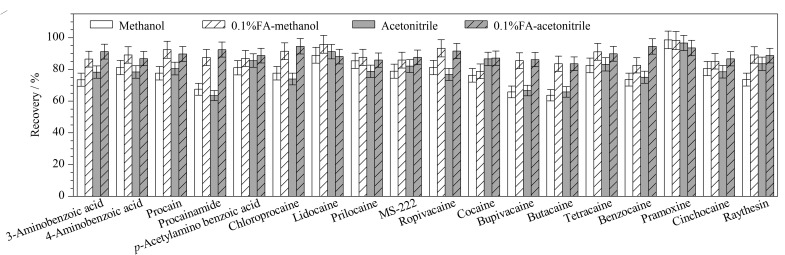
Because of the widespread application of anesthetic drugs in the fields of animal breeding and transportation, demand for the rapid, sensitive detection of anesthetic drugs in animal meat is increasing. The complex animal meat matrix contains various interfering substances, such as proteins, fats, and phospholipids, along with anesthetic drug residues at very low concentrations. Therefore, adopting appropriate pretreatment methods is necessary to improve the sensitivity of detection. In this study, a rapid, accurate analytical method based on ultra-performance liquid chromatography-tandem mass spectrometry (UPLC-MS/MS) and solid phase extraction (SPE) was established to determine the contents of 18 caines in animal meat. The MS parameters, such as the collision energies of 18 caines, were optimized. Furthermore, the chromatographic separation conditions and response intensities of the caine in different mobile phases were compared. The effects of different pretreatment conditions on the extraction efficiencies of the 18 caines in meat samples and those of different purification conditions, such as extraction solvent, SPE column, and dimethylsulfoxide (DMSO) dosage, on their recoveries were investigated. Combined with the external standard method, the 18 caines in meat were successfully quantified. Sample pretreatment is a three-step process. First, in ultrasound-assisted extraction, 2.0 g samples were added to 2.0 mL water and extracted using 10 mL 0.1% (v/v) formic acid in acetonitrile under ultrasound conditions for 10 min. SPE was then performed using an Oasis PRIME HLB column. Finally, DMSO-assisted concentration was employed: the organic layer was collected and dried at 40 ℃ under a stream of N gas with the addition of 100 μL DMSO. Acetonitrile-water (1∶9, v/v) was added to the residue to yield a final volume of 1.0 mL for use in UPLC-MS/MS. The 18 caines were separated using an HSS T (100 mm×2.1 mm, 1.8 μm) column with 0.1% (v/v) formic acid in water (containing 0.02 mmol/L ammonium acetate) and methanol as mobile phases. Samples were detected using an electrospray ion source (ESI) in the positive ion and multiple reaction monitoring (MRM) modes during UPLC-MS/MS. Under the optimized conditions, the 18 target caine anesthetics displayed good linearities in the range of 1.00-50.0 μg/L, and the correlation coefficients () were >0.999. The respective limits of detection (LODs) and quantification (LOQs) were 0.2-0.5 μg/kg, and 0.6-1.5 μg/kg. In pork, beef, and mutton samples, the recoveries obtained at three spiked levels were 83.4%-100.4% with relative standard deviations (RSDs) of 3.1%-8.5%. This simple, rapid, sensitive method may be applied in the detection of 18 caine anesthetics in animal meat and may provide technical support to the food safety department in China in monitoring the residues of caine anesthetics in animal meat.
由于麻醉药物在动物养殖和运输领域的广泛应用,对动物肉中麻醉药物进行快速、灵敏检测的需求日益增加。复杂的动物肉基质中含有各种干扰物质,如蛋白质、脂肪和磷脂,同时还含有极低浓度的麻醉药物残留。因此,采用适当的预处理方法对于提高检测灵敏度是必要的。在本研究中,建立了一种基于超高效液相色谱-串联质谱法(UPLC-MS/MS)和固相萃取(SPE)的快速、准确的分析方法,用于测定动物肉中18种卡因类药物的含量。对18种卡因类药物的质谱参数,如碰撞能量进行了优化。此外,还比较了不同流动相中卡因类药物的色谱分离条件和响应强度。研究了不同预处理条件对肉样中18种卡因类药物提取效率的影响,以及不同净化条件,如提取溶剂、SPE柱和二甲基亚砜(DMSO)用量对其回收率的影响。结合外标法,成功对肉中的18种卡因类药物进行了定量分析。样品预处理为三步过程。首先,在超声辅助萃取中,将2.0 g样品加入2.0 mL水中,在超声条件下用10 mL 0.1%(v/v)甲酸乙腈溶液萃取10 min。然后使用Oasis PRIME HLB柱进行固相萃取。最后,采用DMSO辅助浓缩:收集有机层,在40℃下用氮气吹干,并加入100 μL DMSO。向残渣中加入乙腈-水(1∶9,v/v),最终定容至1.0 mL,用于UPLC-MS/MS分析。采用HSS T(100 mm×2.1 mm,1.8 μm)柱,以含0.02 mmol/L醋酸铵的0.1%(v/v)甲酸水溶液和甲醇作为流动相,对18种卡因类药物进行分离。在UPLC-MS/MS分析过程中,采用电喷雾离子源(ESI)在正离子和多反应监测(MRM)模式下对样品进行检测。在优化条件下,18种目标卡因类麻醉药在1.00 - 50.0 μg/L范围内呈现良好的线性关系,相关系数()>0.999。各自的检测限(LOD)和定量限(LOQ)分别为0.2 - 0.5 μg/kg和0.6 - 1.5 μg/kg。在猪肉、牛肉和羊肉样品中,三个加标水平下的回收率为83.4% - 100.4%,相对标准偏差(RSD)为3.1% - 8.5%。这种简单、快速、灵敏的方法可应用于动物肉中18种卡因类麻醉药的检测,可为中国食品安全部门监测动物肉中卡因类麻醉药残留提供技术支持。