Department of Radiation Oncology, Ruijin Hospital, Shanghai Jiaotong University School of Medicine, Shanghai, China.
Department of Radiation Oncology, The Third Affiliated Hospital of Wenzhou Medical University, Wenzhou, China.
Thorac Cancer. 2023 Jun;14(17):1556-1566. doi: 10.1111/1759-7714.14898. Epub 2023 Apr 24.
The aim of the study was to analyze the relationship between pretreatment inflammatory biomarkers (IBs) and survival outcomes for patients with esophageal squamous cell carcinoma (ESCC) treated with neoadjuvant chemoradiotherapy (neo-CRT) and pembrolizumab.
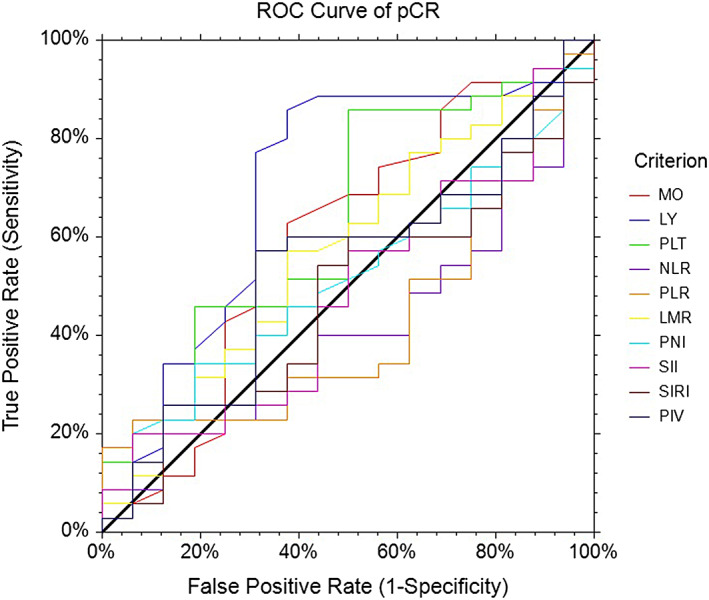
Clinical variables and IBs (absolute monocyte count [AMC], absolute lymphocyte count [ALC], platelet count [PLT], neutrophil-to-lymphocyte ratio [NLR], platelet-to-lymphocyte ratio [PLR], lymphocyte-to-monocyte ratio [LMR], pan-immune inflammation value [PIV], systemic immunoinflammatory index [SII], systemic immunoreactivity index [SIRI] and prognostic nutritional index [PNI]) were collected. Univariate and multivariate analysis were performed to identify the independent factors for outcomes of ESCC.
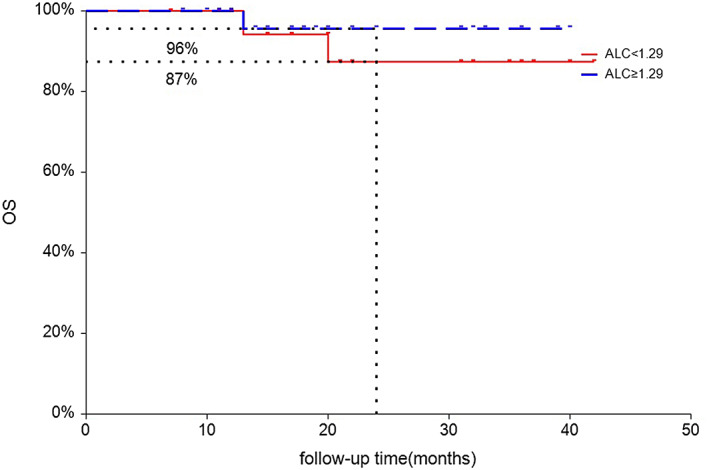
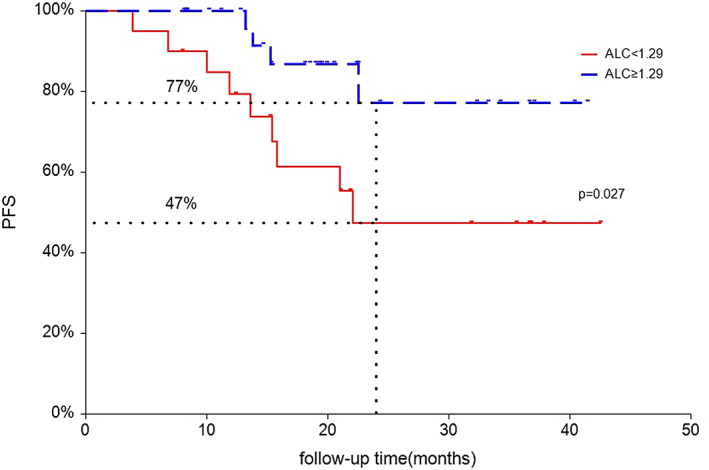
A total of 51 patients were included. Of these, 35 patients achieved pathological complete response (pCR) after neo-CRT and pembrolizumab (pCR: 68.6%). With a median follow-up of 20 months, the two-year PFS and OS of the cohort was 64% and 91%, respectively. Multivariate logistic regression analysis indicated that ALC (overall response [OR] 4.4, p = 0.051) and PLT (OR 6.7, p = 0.023) were two independent predictors for achieving pCR among ESCC treated with neo-CRT and pembrolizumab. Multivariate Cox regression analysis showed that ALC (HR 0.27, p = 0.028) and SIRI (HR 3.13, p = 0.048) were two independent predictors associated with PFS. Kaplan Meier analysis demonstrated that the PFS of ESCC with high baseline ALC was significantly better than those with low ALC (2-year PFS: 77% vs. 47%, p = 0.027), but not for overall survival (2-year OS: 96% vs. 87%, p = 0.46).
This retrospective analysis based on a prospective cohort for the first time demonstrates that pretreatment ALC is an independent predictor for achieving pCR and favorable outcomes of ESCC treated with neo-CRT and pembrolizumab.
本研究旨在分析新辅助放化疗(neo-CRT)联合帕博利珠单抗治疗食管鳞癌(ESCC)患者的治疗前炎症生物标志物(IBs)与生存结局之间的关系。
收集了临床变量和 IBs(绝对单核细胞计数[AMC]、绝对淋巴细胞计数[ALC]、血小板计数[PLT]、中性粒细胞与淋巴细胞比值[NLR]、血小板与淋巴细胞比值[PLR]、淋巴细胞与单核细胞比值[LMR]、全免疫炎症值[PIV]、全身免疫炎症指数[SII]、全身免疫反应指数[SIRI]和预后营养指数[PNI])。进行单因素和多因素分析,以确定 ESCC 结局的独立因素。
共纳入 51 例患者。其中,35 例患者在 neo-CRT 和帕博利珠单抗治疗后达到病理完全缓解(pCR)(pCR:68.6%)。中位随访 20 个月后,该队列的 2 年 PFS 和 OS 分别为 64%和 91%。多因素逻辑回归分析表明,ALC(总反应[OR]4.4,p=0.051)和 PLT(OR 6.7,p=0.023)是 neo-CRT 和帕博利珠单抗治疗后 ESCC 获得 pCR 的两个独立预测因素。多因素 Cox 回归分析显示,ALC(HR 0.27,p=0.028)和 SIRI(HR 3.13,p=0.048)是与 PFS 相关的两个独立预测因素。Kaplan-Meier 分析表明,基线 ALC 较高的 ESCC 的 PFS 明显优于 ALC 较低的 ESCC(2 年 PFS:77%比 47%,p=0.027),但对总生存无影响(2 年 OS:96%比 87%,p=0.46)。
本回顾性分析基于前瞻性队列,首次表明治疗前 ALC 是 neo-CRT 联合帕博利珠单抗治疗 ESCC 患者获得 pCR 和良好结局的独立预测因素。