
炎症评分可预测脑出血患者的早期血肿扩大和不良预后。
Inflammatory score predicts early hematoma expansion and poor outcomes in patients with intracerebral hemorrhage.
机构信息
Department of Gerontology, Shanghai Sixth People's Hospital Affiliated to Shanghai Jiao Tong University School of Medicine.
Health Management Center, School of Medicine, Renji Hospital, School of Medicine, Shanghai Jiaotong University.
出版信息
Int J Surg. 2023 Mar 1;109(3):266-276. doi: 10.1097/JS9.0000000000000191.
BACKGROUND
This study aimed to develop a prediction score named inflammatory score based on proper integration of several inflammatory markers and investigate whether it was associated with hematoma expansion and poor outcomes in patients with intracerebral hemorrhage (ICH).
METHODS
This study involved a consecutive series of spontaneous ICH patients of two cohorts admitted within 24 hours after symptom onset. Inflammatory score (0-9) was developed with the combination of neutrophil-to-lymphocyte ratio, platelet-to-lymphocyte ratio, monocyte-to-lymphocyte ratio, systemic immune-inflammation index, lactate dehydrogenase, and C-reactive protein. The authors investigated the association between inflammatory score and hematoma expansion and poor outcomes by using univariate and multivariate logistic regression analyses. The optimal cutoff point of inflammatory score was determined by receiver operating characteristic analysis in the development cohort and then validated.
RESULTS
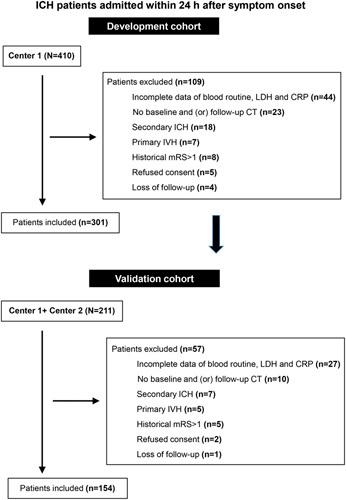
A total of 301 and 154 ICH patients were enrolled in the development and validation cohorts. Inflammatory score was significantly higher in patients with hematoma expansion and poor outcomes. The multivariate logistic regression analysis revealed inflammatory score was independently associated with hematoma expansion, secondary neurological deterioration within 48 hours, 30-day mortality, and 3-month poor modified Rankin scale (4-6). The diagnostic accuracy of inflammatory score exhibited by area under the curve showed numerically or statistically higher than most of the individual indicators. Moreover, inflammatory score greater than or equal to 5 was selected as the optimal cutoff point, which was further prospectively validated with high diagnostic accuracy.
CONCLUSIONS
The inflammatory score is a reliable predictor for early hematoma expansion and short-term and long-term poor outcomes with good diagnostic accuracies in ICH patients.
背景
本研究旨在开发一种名为炎症评分的预测评分,该评分基于对几种炎症标志物的适当整合,并探讨其与脑出血(ICH)患者血肿扩大和不良结局的关系。
方法
本研究纳入了两个队列中发病 24 小时内连续就诊的自发性 ICH 患者。炎症评分(0-9)是通过中性粒细胞与淋巴细胞比值、血小板与淋巴细胞比值、单核细胞与淋巴细胞比值、全身免疫炎症指数、乳酸脱氢酶和 C 反应蛋白的组合来制定的。作者通过单变量和多变量逻辑回归分析研究了炎症评分与血肿扩大和不良结局之间的关系。在开发队列中通过接受者操作特征分析确定炎症评分的最佳截断点,然后进行验证。
结果
共有 301 名和 154 名 ICH 患者分别纳入开发和验证队列。血肿扩大和不良结局患者的炎症评分显著升高。多变量逻辑回归分析表明,炎症评分与血肿扩大、48 小时内继发性神经功能恶化、30 天死亡率和 3 个月改良 Rankin 量表(4-6)不良结局独立相关。曲线下面积(AUC)显示炎症评分的诊断准确性在数值上或统计学上均高于大多数单个指标。此外,炎症评分大于等于 5 被选为最佳截断点,前瞻性验证也显示了较高的诊断准确性。
结论
炎症评分是 ICH 患者早期血肿扩大以及短期和长期不良结局的可靠预测指标,具有较高的诊断准确性。


 Zotero 插件