
头部姿势调节认知与老年人手握力和捏力的关联:使用结构方程模型的检验。
Head posture mediates the association of cognition with hand grip and pinch strength in older adults: an examination using structural equation modeling.
机构信息
Bilge Çocuk Special Education and Rehabilitation Center, Ankara, Turkey.
Department of Physiotherapy and Rehabilitation, Faculty of Health Sciences, Lokman Hekim University, Ankara, Turkey.
出版信息
BMC Musculoskelet Disord. 2023 Apr 25;24(1):324. doi: 10.1186/s12891-023-06436-4.
BACKGROUND
The association of cognition with hand grip and pinch strength has been well-recognized in older adults. The authors sought to explore: (1) associations among forward head posture (FHP), cognition, and hand grip and pinch strength in older adults; and (2) the mediator role of FHP in these pathways using structural equation modeling (SEM).
METHODS
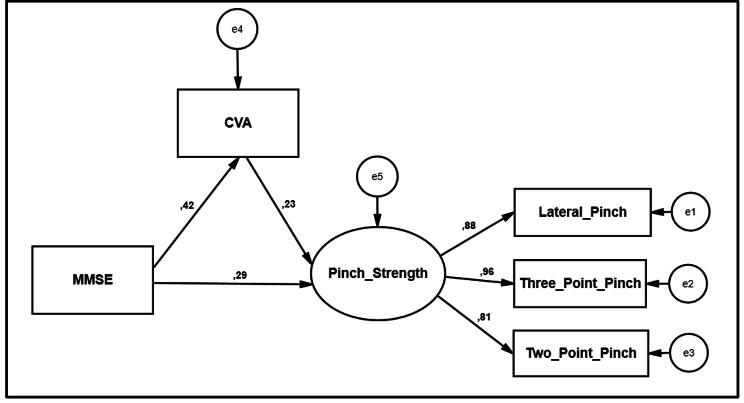
This cross-sectional study included 88 older adults (70.5% male; mean age = 68.75±3.87 years). Cognition was assessed by the Mini-Mental State Examination (MMSE), head posture by the Craniovertebral Angle (CVA) obtained from photographic analysis, hand grip strength by a handheld dynamometer, and pinch strength by a pinch meter. Using the two SEMs, a potential mediator role of the CVA was investigated. While the MMSE was addressed as an independent variable in both models, hand grip and pinch strength were addressed as dependent variables in model 1 and model 2, respectively.
RESULTS
The correlations between the CVA and MMSE (r = 0.310), hand grip strength (r = 0.370), and pinch strength (r = 0.274 to 0.292) were statistically significant (p < 0.001). In addition, significant associations were found between the MMSE and hand grip and pinch strength, ranging from 0.307 to 0.380 (p < 0.001). The mediation analysis showed that the standardized total (β = 0.41, p < 0.001) and indirect (mediated) effects (β = 0.12, p = 0.008) of the MMSE on hand grip strength were significant in model (1) The results were similar for model (2) The standardized total (β = 0.39, p = 0.001) and indirect effects (β = 0.10, p = 0.026) of the MMSE on pinch strength were significant. As a partial mediator in both models, the CVA explained 29% and 26% of the total effect in models 1 and 2, respectively.
CONCLUSIONS
The CVA was associated with the MMSE, hand grip strength, and pinch strength, and CVA partially mediates the association of the MMSE with grip and pinch strength in older adults, indicating that cognition had an effect on grip and pinch strength through an indirect path via head posture. This finding reveals that evaluating head posture and providing corrective therapeutic interventions as needed may be beneficial in reducing the negative impact of decreased cognition on motor functions in older adults.
背景
认知与手握力和指捏力的关系在老年人中得到了很好的认识。作者试图探讨:(1)老年人中前伸头姿势(FHP)、认知与手握力和指捏力之间的关系;(2)使用结构方程模型(SEM)探索 FHP 在这些途径中的中介作用。
方法
这项横断面研究包括 88 名老年人(70.5%为男性;平均年龄 68.75±3.87 岁)。认知由简易精神状态检查(MMSE)评估,头姿势由摄影分析得出的颅颈角(CVA)评估,手握力由手持测力计评估,指捏力由指捏计评估。使用两个 SEM,研究了 CVA 的潜在中介作用。在两个模型中,MMSE 被视为自变量,而手握力和指捏力在模型 1 中作为因变量,在模型 2 中作为因变量。
结果
CVA 与 MMSE(r=0.310)、手握力(r=0.370)和指捏力(r=0.274 至 0.292)之间的相关性具有统计学意义(p<0.001)。此外,MMSE 与手握力和指捏力之间存在显著关联,范围为 0.307 至 0.380(p<0.001)。中介分析表明,模型 1 中 MMSE 对手握力的标准化总效应(β=0.41,p<0.001)和间接(中介)效应(β=0.12,p=0.008)具有统计学意义。模型 2 的结果类似。MMSE 对指捏力的标准化总效应(β=0.39,p=0.001)和间接效应(β=0.10,p=0.026)具有统计学意义。CVA 作为两个模型中的部分中介,分别解释了模型 1 和模型 2中总效应的 29%和 26%。
结论
CVA 与 MMSE、手握力和指捏力相关,CVA 部分介导了 MMSE 与老年人握力和指捏力之间的关联,表明认知通过头位的间接途径对握力和指捏力产生影响。这一发现表明,评估头位并在需要时提供纠正性治疗干预可能有助于减少认知能力下降对老年人运动功能的负面影响。

 Zotero 插件