Department of Environmental Health Sciences, Fielding School of Public Health University of California Los Angeles CA USA.
School of Nursing University of California Los Angeles CA USA.
J Am Heart Assoc. 2023 May 2;12(9):e027374. doi: 10.1161/JAHA.122.027374. Epub 2023 Apr 26.
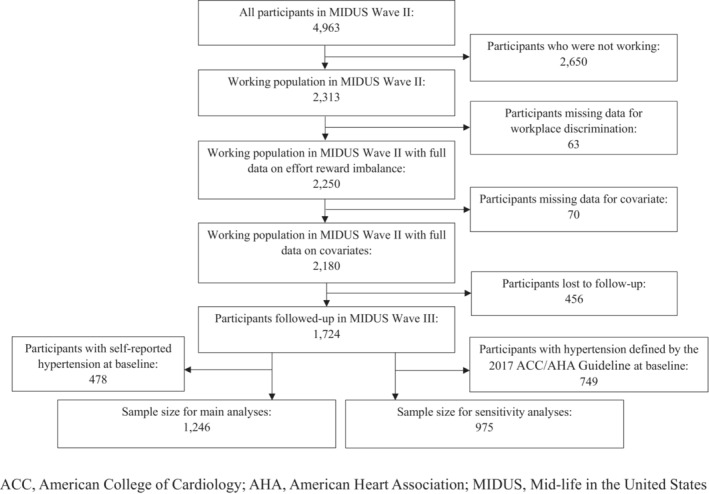
Background Mounting evidence has demonstrated a role of psychosocial stressors such as discrimination in hypertension and cardiovascular diseases. The objective of this study was to provide the first instance of research evidence examining prospective associations of workplace discrimination with onset of hypertension. Methods and Results Data were from MIDUS (Midlife in the United States), a prospective cohort study of adults in the United States. Baseline data were collected in 2004 to 2006, with an average 8-year follow-up period. Workers with self-reported hypertension at baseline were excluded, yielding a sample size of 1246 participants for the main analysis. Workplace discrimination was assessed using a validated 6-item instrument. During follow-up with 9923.17 person-years, 319 workers reported onset of hypertension, and incidence rates of hypertension were 25.90, 30.84, and 39.33 per 1000 person-years among participants with low, intermediate, and high levels of workplace discrimination, respectively. Cox proportional hazards regression analyses demonstrated that workers who experienced high exposure to workplace discrimination, compared with workers with low exposure, had a higher hazard of hypertension (adjusted hazard ratio, 1.54 [95% CI, 1.11-2.13]). Sensitivity analysis excluding more baseline hypertension cases based on additional information on blood pressure plus antihypertensive medication use (N=975) showed slightly stronger associations. A trend analysis showed an exposure-response association. Conclusions Workplace discrimination was prospectively associated with elevated risk of hypertension among US workers. The adverse impacts of discrimination on cardiovascular disease have major implications for workers' health and indicate a need for government and employer policy interventions addressing discrimination.
越来越多的证据表明,心理社会压力源,如歧视,在高血压和心血管疾病中起作用。本研究的目的是首次提供研究证据,检验工作场所歧视与高血压发病之间的前瞻性关联。
数据来自美国中年生活研究(MIDUS),这是一项针对美国成年人的前瞻性队列研究。基线数据于 2004 年至 2006 年收集,平均随访 8 年。排除基线时有自我报告高血压的工人,主要分析的样本量为 1246 名参与者。使用经过验证的 6 项工具评估工作场所歧视。在 9923.17 人年的随访期间,319 名工人报告高血压发病,参与者中低、中、高水平工作场所歧视的高血压发病率分别为 25.90、30.84 和 39.33/1000 人年。Cox 比例风险回归分析表明,与低暴露工人相比,经历高暴露工作场所歧视的工人患高血压的风险更高(调整后的危险比,1.54 [95%CI,1.11-2.13])。基于血压和降压药物使用的额外信息排除更多基线高血压病例的敏感性分析(N=975)显示出稍强的关联。趋势分析显示存在暴露-反应关系。
工作场所歧视与美国工人高血压风险升高之间存在前瞻性关联。歧视对心血管疾病的不良影响对工人的健康具有重大影响,表明需要政府和雇主采取政策干预措施来解决歧视问题。