Faculty of Sport Sciences, Waseda University, Saitama, Japan.
Human Performance Laboratory, Comprehensive Research Organization, Waseda University, Tokyo, Japan.
J Strength Cond Res. 2023 Nov 1;37(11):e588-e592. doi: 10.1519/JSC.0000000000004536. Epub 2023 Apr 26.
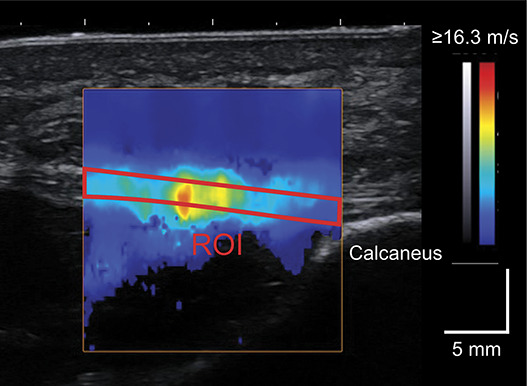
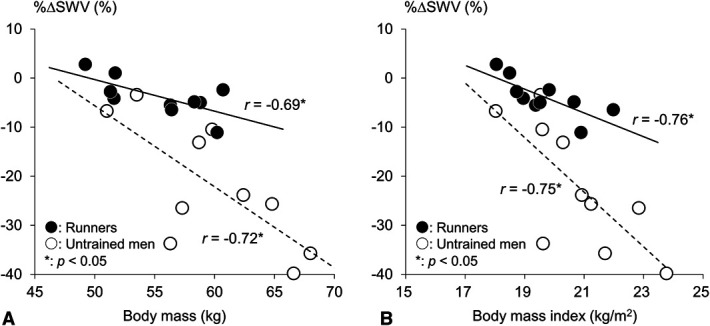
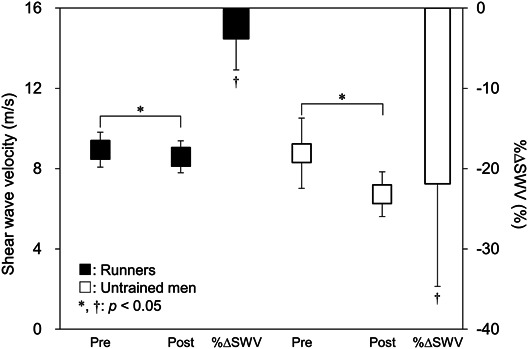
Shiotani, H, Mizokuchi, T, Yamashita, R, Naito, M, and Kawakami, Y. Influence of body mass on running-induced changes in mechanical properties of plantar fascia. J Strength Cond Res 37(11): e588-e592, 2023-Body mass is a major risk factor for plantar fasciopathy; however, evidence explaining the process between risk factors and injury development is limited. Long-distance running induces transient and site-specific reduction in plantar fascia (PF) stiffness, reflecting mechanical fatigue and microscopic damage within the tissue. As greater mechanical loads can induce greater reduction in tissue stiffness, we hypothesized that the degree of running-induced change in PF stiffness is associated with body mass. Ten long-distance male runners (age: 21 - 23 years, body mass: 55.5 ± 4.2 kg; mean ± SD ) and 10 untrained men (age: 20 - 24 years, body mass: 58.4 ± 5.6 kg) ran for 10 km. Before and immediately after running, the shear wave velocity (SWV) of PF at the proximal site, which is an index of tissue stiffness, was measured using ultrasound shear wave elastography. Although the PF SWV significantly decreased after running in runners (-4.0%, p = 0.010) and untrained men (-21.9%, p < 0.001), runners exhibited smaller changes ( p < 0.001). The relative changes in SWV significantly correlated with body mass in both runners ( r = -0.691, p = 0.027) and untrained individuals ( r = -0.723, p = 0.018). These results indicate that a larger body mass is associated with a greater reduction in PF stiffness. Our findings provide in vivo evidence of the biomechanical basis for body mass as a risk factor for plantar fasciopathy. Furthermore, group differences suggest possible factors that reduce the fatigue responses, such as adaptation enhancing the resilience of PF and running mechanics.
筱谷秀一, 水黾琢也, 山下理, 直井真悟, 河上康裕。体重对跑步引起的足底筋膜力学特性变化的影响。J 力量与体能研究 37(11): e588-e592, 2023-体重是足底筋膜炎的主要危险因素;然而,解释危险因素与损伤发展之间关系的证据有限。长距离跑步会导致足底筋膜(PF)的刚度暂时且特定部位的降低,反映出组织内的机械疲劳和微观损伤。由于更大的机械负荷会导致组织刚度更大的降低,我们假设 PF 刚度的跑步诱导变化程度与体重有关。10 名长跑男性跑步者(年龄:21-23 岁,体重:55.5 ± 4.2 公斤;平均值 ± SD)和 10 名未经训练的男性(年龄:20-24 岁,体重:58.4 ± 5.6 公斤)跑了 10 公里。在跑步前和跑步后立即,使用超声剪切波弹性成像测量 PF 近端部位的剪切波速度(SWV),这是组织刚度的指标。尽管跑步者(-4.0%,p = 0.010)和未经训练的男性(-21.9%,p < 0.001)的 PF SWV 在跑步后明显降低,但跑步者的变化较小(p < 0.001)。SWV 的相对变化与跑步者(r = -0.691,p = 0.027)和未经训练个体(r = -0.723,p = 0.018)的体重均显著相关。这些结果表明,较大的体重与 PF 刚度的较大降低相关。我们的研究结果提供了体重作为足底筋膜炎危险因素的生物力学基础的体内证据。此外,组间差异表明可能存在一些因素可以降低疲劳反应,例如适应增强了 PF 和跑步力学的弹性。