Behavioural Ecology and Ecophysiology Group, Department of Biology, University of Antwerp, Antwerp, Belgium.
Centre for Research and Conservation, Royal Zoological Society of Antwerp, Antwerp, Belgium.
PLoS One. 2023 Apr 26;18(4):e0284361. doi: 10.1371/journal.pone.0284361. eCollection 2023.
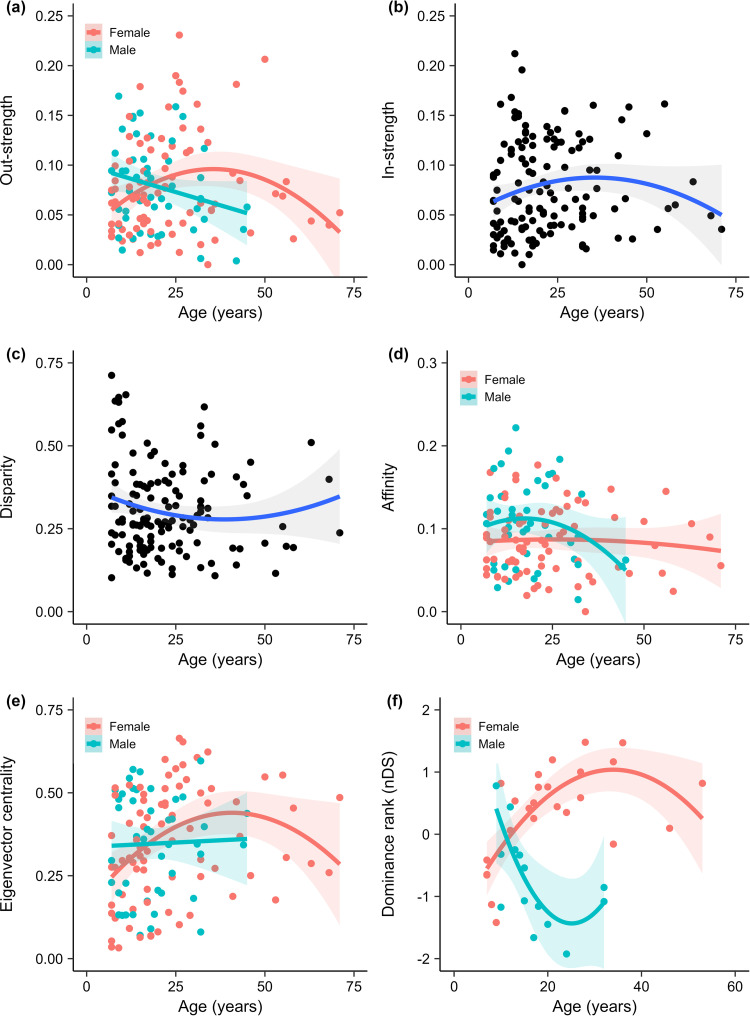
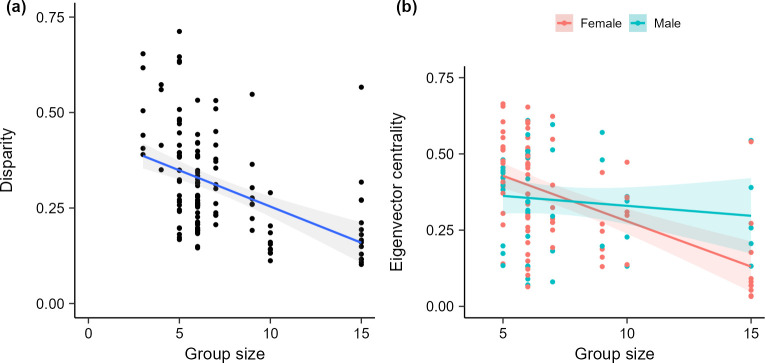
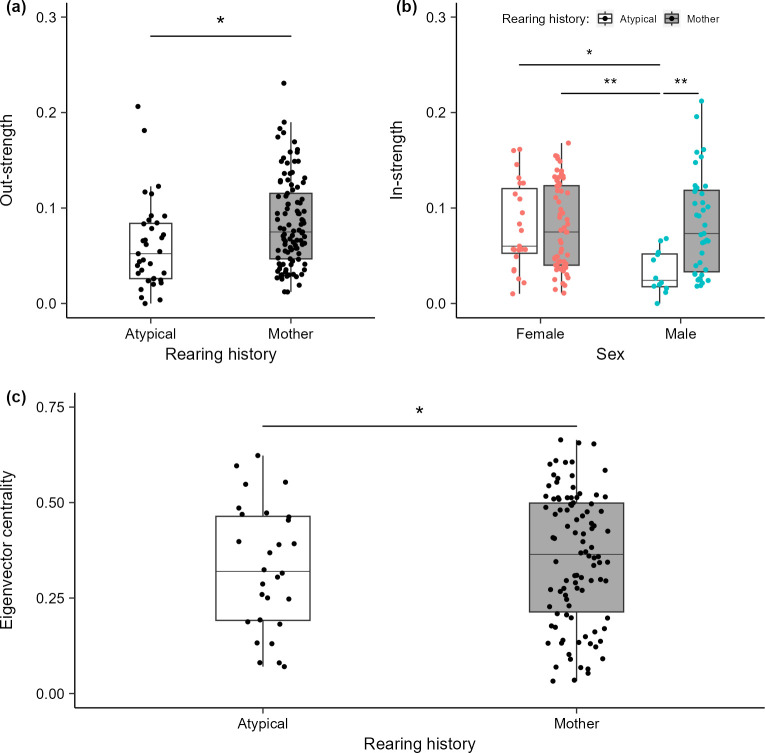
Individual variation in complex social behavioral traits, like primate grooming, can be influenced by the characteristics of the individual and those of its social group. To better grasp this complexity, social network analysis can be used to quantify direct and indirect grooming relationships. However, multi-group social network studies remain rare, despite their importance to disentangle individual from group-level trait effects on grooming strategies. We applied social network analysis to grooming data of 22 groups of zoo-housed bonobos and investigated the impact of three individual (sex, age, and rearing-history) and two group-level traits (group size and sex ratio) on five social network measures (out-strength, in-strength, disparity, affinity, and eigenvector centrality). Our results showed age-effects on all investigated measures: for females, all measures except for affinity showed quadratic relationships with age, while in males, the effects of age were more variable depending on the network measure. Bonobos with atypical rearing histories showed lower out-strength and eigenvector centrality, while in-strength was only impacted by rearing history in males. Group size showed a negative association with disparity and eigenvector centrality, while sex ratio did not influence any of the investigated measures. Standardization for group size did not impact the effects of sex and age, indicating the robustness of these findings. Our study provides comprehensive insights into the complexity of grooming behavior in zoo-housed bonobos, and underlines the importance of multi-group analyses for the generalizability of social network analysis results for species as a whole.
个体在复杂的社会行为特征上存在差异,例如灵长类动物的梳理行为,这可能受到个体特征和其所在社会群体特征的影响。为了更好地理解这种复杂性,可以使用社会网络分析来量化直接和间接的梳理关系。然而,尽管多群体社会网络研究对于区分个体和群体水平对梳理策略的影响很重要,但这种研究仍然很少。我们应用社会网络分析对 22 组圈养的倭黑猩猩的梳理数据进行了分析,并研究了三个个体特征(性别、年龄和养育史)和两个群体特征(群体大小和性别比例)对五个社会网络度量(出强度、入强度、离差、亲和度和特征向量中心度)的影响。我们的结果表明年龄对所有被调查的指标都有影响:对于雌性,除了亲和度之外,所有指标都与年龄呈二次关系,而对于雄性,年龄的影响因网络指标而异。具有非典型养育史的倭黑猩猩的出强度和特征向量中心度较低,而入强度仅在雄性中受到养育史的影响。群体大小与离差和特征向量中心度呈负相关,而性别比例对所有被调查的指标都没有影响。群体大小的标准化对性别和年龄的影响没有影响,这表明这些发现具有稳健性。我们的研究提供了对圈养倭黑猩猩梳理行为复杂性的全面了解,并强调了多群体分析对于整个物种的社会网络分析结果的可推广性的重要性。